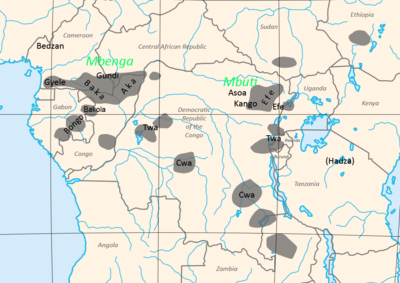
The Pygmies , a cultural and racial group of peoples of Equatorial Africa, known as "forest people", until recently had a Mesolithic lifestyle ( hunting and gathering ) and a primitive social structure devoid of hierarchy (which reminded modern Australian Bushmen and Aborigines). After the conquest by more developed agrarian tribes (mainly speakers of Ubangi and Bantu languages) they are dependent on their agrarian "patrons".
Even before European colonization, the Pygmies switched to the languages of the tribes that conquered them. The existence of pygmy languages in the era before their conquest is evidenced by the remnants of vocabulary associated with the forest lifestyle (names of edible and medicinal plants, terms associated with the collection of honey, etc.). In particular, the Pygmy tribes aka and Baka (Gabon) have the same "forest" vocabulary, while speaking the languages of different families (Bantu and Ubangi). At the same time, the fragmentation and heterogeneity of the extinct Pygmy languages should be assumed, since even the “forest” vocabulary, which distinguishes their languages from the languages of the “patron” peoples, is different for different Pygmy peoples.
Content
Initial Pygmy Hypotheses
At least for a number of ethnic groups of modern pygmies it is assumed that in the past there are languages of a different origin than those that they speak now. According to Merritt Roulin , “African pygmies speak languages that belong either to the Nilo-Saharan or Niger-Kordofan families. It is assumed that before the pygmies spoke their own language or languages, but then, due to symbiosis with other African peoples, even in pre-written times, they switched to languages belonging to these two families ” [1] . The only evidence of this is the general vocabulary of the aka and bak languages belonging to different families. According to Roger Blench , this general vocabulary could not have been of Pygmy origin, but borrowed from some other disappeared people [2] .
It is widely believed that African pygmies are direct descendants of hunters and gatherers of the late Stone Age of the central tropical forests of Africa, who were partially assimilated or replaced by migrant farmers, and learned their languages related to the Central Sudanese , Ubangian and Bantu families. This point of view has not yet been supported by archeology, and linguistic and genetic evidence is not universally recognized [3] [4] [5] .
About 30% of the vocabulary of the aka language does not apply to the Bantu languages, just as about 30% of the vocabulary of the Baka language does not apply to Ubangi. Most of this vocabulary refers to plants, the collection of honey, or is otherwise related to the forest lifestyle and is common to these two groups of pygmies in western Africa. It is assumed that this vocabulary is a substrate of the extinct Western Pygmy language, conventionally referred to as Mbenga or Baaka . Critics point out that this vocabulary could be a “wandering vocabulary”, moving from one Pygmy people to another, especially since it can only be reconstructed to the level of the 15th century AD. e. [6]
Languages of Modern Pygmy Peoples
Currently, the Pygmies mainly speak the Nilo-Sahara languages, the Niger-Kordofan languages.
Notes
- ↑ Ruhlen, Merritt. The Origin of Language: Tracing the Evolution of the Mother Tongue . John Wiley & Sons, Inc: New York, 1994. p. 154
- ↑ Blench, Roger. 1997. "The languages of Africa." In Blench & Spriggs (eds.), Archeology and language IV
- ↑ R. Blench and M. Dendo. Genetics and linguistics in sub-Saharan Africa , Cambridge-Bergen, June 24, 2004.
- ↑ Klieman, Kairn A. The Pygmies Were Our Compass: Bantu and BaTwa in the History of West Central Africa, Early Times to c. 1900 , Heinemann, 2003.
- ↑ Cavalli-Sforza, Luigi Luca, ed. African Pygmies . Orlando, Fla .: Academic Press, 1986.
- ↑ Serge Bahuchet, 1993, History of the inhabitants of the central African rain forest: perspectives from comparative linguistics. In CM Hladik, ed., Tropical forests, people, and food: Biocultural interactions and applications to development. Paris: Unesco / Parthenon.
Literature
- Serge Bahuchet (1993) Histoire d'une civilization forestière , volume 2.
- Serge Bahuchet, 2006. “Languages of the African Rainforest” Pygmy “Hunter-Gatherers: Language Shifts without Cultural Admixture.” [1] In Historical linguistics and hunter-gatherers populations in global perspective . Leipzig.
- Hewlett & Fancher, 2011. Central African Hunter-Gatherer Research Traditions. In Cummings, Jordan, & Zvelebil, eds, Oxford Handbook of the Archeology and Anthropology of Hunter-Gatherers. Oxford university press