The CCCP State Security Committee [2] ( abbr .: Officer of the KGB of the USSR ; “ committee ”, “ bodies ”, “office”, “security officers” ) is the central union-republican government body of the Union of Soviet Socialist Republics in the field of state Security , in force from 1954 to 1991 .
| USSR State Security Committee KGB of the USSR | |
|---|---|
 | |
| A country |  the USSR the USSR |
| Created by | March 13, 1954 |
| Dissolved (converted) | December 3, 1991 / December 26, 1991 [1] |
| Jurisdiction | Central Committee of the CPSU (1954-1990) President of the USSR (1990-1991) |
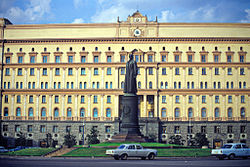
| Headquarters | Moscow , pl. Dzerzhinsky , d. 2 (now Lubyanka Square ) |
| Average number |
|
| Predecessor | |
| Successor | Inter-republican security service of the USSR |
| Guide | |
| Supervisor | Chairman of the KGB of the USSR |
From the moment of its creation until March 14, 1990, he worked under the direct supervision and control of the CPSU Central Committee [3] .
Since December 3, 1991, it was reformed, under the leadership of Vadim Bakatin, into the Inter-republican Security Service of the USSR . [four]
Content
- 1 Functions
- 2 History
- 2.1 KGB education
- 2.2 1950s
- 2.3 1960s
- 2.4 1970-1980s
- 2.4.1 The fight against anti-Soviet manifestations in the USSR
- 2.4.2 The fight against Zionism
- 2.4.3 "Ideological operations" of the KGB
- 2.4.4 Developing countries
- 2.4.5 Europe and North America
- 2.4.6 Investigation of the Chernobyl disaster
- 2.5 1990s
- 2.5.1 Review of business principles
- 2.5.2 Reorganization and abolition
- 3 Legal basis of activity and subordination
- 3.1 Regulation on the KGB
- 3.2 Law on State Security Agencies
- 4 Relations between the KGB and the CPSU
- 4.1 Party control
- 4.2 Human Resource Integration
- 4.3 Information Exchange
- 4.4 Military-political organs in the KGB
- 5 Governing bodies
- 5.1 KGB Chair
- 6 Structures of the KGB
- 7 KGB Armed Forces
- 7.1 KGB troops
- 7.1.1 Border troops of the KGB of the USSR
- 7.2 Special parts of the KGB
- 7.1 KGB troops
- 8 Republican Security Agencies
- 9 KGB educational institutions
- 10 Number of KGB bodies
- 11 Insignia
- 12 Assignees
- 12.1 Union level
- 12.2 Republican level
- 13 KGB in art and literature
- 14 Interesting Facts
- 15 See also
- 16 Notes
- 17 Literature
- 18 Links
Functions
The main functions of the KGB were foreign intelligence , counterintelligence , operational-search activities , protection of the state border of the USSR, protection of the leaders of the CPSU (until 1990) and the Government of the USSR , organization and provision of government communications, as well as the fight against nationalism , dissent , crime and anti-Soviet activities. The KGB was also tasked with providing the Central Committee of the CPSU (until March 14, 1990) and the highest bodies of state power and administration of the USSR with information affecting state security and defense of the country, the socio-economic situation in the Soviet Union, and questions of the foreign policy and foreign economic activity of the Soviet state and the Communist party .
The USSR KGB system included fourteen [5] republican state security committees on the territory of the republics of the USSR ; local bodies of state security in autonomous republics, territories, regions, individual cities and regions, military districts, formations and units of the army, navy and internal troops , in transport; border troops; government communications troops; military counterintelligence agencies; educational institutions and research institutions; as well as the so-called " first departments " of Soviet institutions, organizations and enterprises.
In different years, the KGB had different official names and status in the system of central government bodies:
| Full name | Abbreviation | Status | Years |
|---|---|---|---|
| "State Security Committee under the Council of Ministers of the USSR" | KGB | ministry of rights | March 13, 1954 - July 5, 1978 |
| "USSR State Security Committee" | KGB of the USSR | state committee | July 5, 1978 - April 1, 1991 |
| "USSR State Security Committee" | KGB of the USSR | Central government body with the rights of the ministry | April 1 - December 3, 1991 |
Currently, in addition to the main meaning, the abbreviation "KGB" and its derivatives are often used in colloquial speech to denote any special services of the USSR , the RSFSR and Russia .
History
KGB Education
The initiative to separate the “Cheka operative directorates and departments” [6] of the USSR Ministry of Internal Affairs into an independent department is attributed to the Minister of Internal Affairs Sergey Kruglov , who on February 4, 1954, submitted an official note with the corresponding proposal to the Central Committee of the CPSU . S. Kruglov’s proposals were discussed at a meeting of the Presidium of the Central Committee of the CPSU on February 8, 1954 and were fully approved, except that the “on affairs” [7] was removed from the name proposed by the Minister — the Committee on State Security Affairs under the USSR Council of Ministers . .
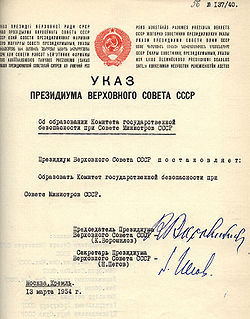
A month later, by Decree of the Presidium of the Supreme Soviet of the USSR of March 13, 1954, the State Security Committee was formed under the Council of Ministers of the USSR [8] . The new committee included the departments, services and departments allocated from the USSR Ministry of Internal Affairs that dealt with issues of ensuring state security. Colonel General I. A. Serov, the former First Deputy Minister of Internal Affairs of the USSR, was appointed Chairman of the Committee. On April 26 of the same year, the KGB chairman was included in the USSR Council of Ministers [9] .
It is noteworthy that the KGB was not formed as the central government body , which were its predecessors - the MGB and the Ministry of Internal Affairs of the USSR , but only in the status of a department under the Government of the USSR . According to some historians, the reason for the lowering of the status of the KGB in the hierarchy of government bodies was the desire of the party and Soviet leaders of the country to deprive the state security organs of independence, completely subordinating their activities to the apparatus of the Communist Party [10] . Nevertheless, the KGB chairmen were appointed to the post not by acts of the Council of Ministers of the USSR , as was customary for heads of departments under the government of the country, but by decrees of the Presidium of the Supreme Soviet of the USSR , as was done for ministers and chairmen of state committees .
1950s
Almost immediately after its formation, the KGB underwent a major structural reorganization and a reduction in the number of employees in connection with the process of the de-Stalinization of society and the state that began after the death of IV Stalin . From declassified documents of the State Archive of the Russian Federation, it became known that in the 1950s the number of KGB personnel was reduced by more than 50 percent compared to 1954. More than 3.5 thousand city and regional apparatuses were abolished, some operational and investigative units were merged, investigation departments and divisions in operational units were liquidated and united into single investigative apparatuses. The structure of special departments and bodies of the KGB in transport was greatly simplified. In 1955, more than 7.5 thousand employees were further reduced, while about 8 thousand KGB officers were transferred to the position of civil servants [8] .
In 1956, KGB officers actively participated in the suppression of the uprising in Hungary and the persecution of its participants. The Chairman of the KGB I. A. Serov, together with the deputy chief of the General Staff M. S. Malinin, traveled to Budapest, accompanied by the leaders of the CPSU Central Committee , to assess the situation in Hungary. During Operation Whirlwind, the plan of which was developed by the USSR Ministry of Defense , KGB officers arrested the Minister of Defense of Hungary, Lieutenant General Pal Maleter . This made it possible to neutralize the Hungarian military leadership and ensure the success of Soviet artillery, tank and infantry units in quickly suppressing the rebellion and restoring the Soviet regime loyal to the USSR in Hungary . In the first days after the uprising was suppressed, with the assistance of KGB officers, the Hungarian secret services arrested about 5,000 Hungarians - activists of Hungarian parties, military personnel and students, 846 of whom were sent to Soviet prisons [11] . According to some estimates, about 350 of those arrested were later executed [12] , including Hungarian Prime Minister Imre Nagy . For participation in the operation to suppress the uprising, the chairman of the KGB Serov was awarded the Order of Kutuzov , 1st degree. It should be noted the active role in suppressing the uprising of the USSR ambassador to Hungary, Yu. V. Andropov ; This experience came in handy to Andropov later, when he, as chairman of the KGB, had to direct the actions of employees of the Soviet state security agencies during Operation Danube in Czechoslovakia in 1968.
After the transfer of I. A. Serov to the post of head of the Main Intelligence Directorate , on December 25, 1958, A. N. Shelepin , the former head of the party department of the party bodies of the Central Committee of the CPSU for the Union Republics , was appointed chairman of the KGB, who carried out a series of cardinal transformations in the KGB apparatus to simplify it structure and staff reduction [8] .
On April 9, 1959, five years after the formation of the KGB, the Regulation on the State Security Committee under the Council of Ministers of the USSR was approved in strict secrecy, which secured the status of the State Security Committee as a department under the government with the rights of the ministry , and KGB subordination was established to the Presidium of the CPSU Central Committee and the Government of the USSR .
The KGB continued the practice of its predecessors - Bureau No. 1 of the USSR Ministry of State Security for diversionary work under the leadership of P. A. Sudoplatov and Bureau No. 2 for special tasks in the USSR under the leadership of V. A. Drozdov - in the field of so-called " active actions " which meant acts of individual terror on the territory of the country and abroad against persons who were qualified by the party bodies and Soviet special services as “the most active and vicious enemies of the Soviet Union from among the figures to pitalisticheskih countries, particularly dangerous foreign scouts, leaders of the anti-Soviet emigre organizations and traitors " [13] . The conduct of such operations was entrusted to the First Main Directorate of the KGB . So, in October 1959, the leader of Ukrainian nationalists Stepan Bandera was killed in Munich by the KGB agent Bogdan Stashinsky . The same fate befell another leader of the OUN - L. Rebet . Earlier, in 1957, an attempt was made to liquidate the former Soviet intelligence officer N. Khokhlov , who remained in the West after he made a public statement about the planned assassination of one of the leaders of the NTS Georgy Okolovich . Khokhlov was poisoned with a radioactive isotope ( thallium or polonium ), but survived.
1960s
In December 1961, at the initiative of the first secretary of the CPSU Central Committee N.S. Khrushchev , A.N. Shelepin was transferred to party work as Secretary of the CPSU Central Committee . The leadership of the KGB was adopted by V.E. Semichastny , a former colleague of Shelepin on work in the Komsomol Central Committee . [14] Sevenfold continued the policy of his predecessor for the structural reorganization of the KGB. The 4th, 5th and 6th KGB Directorates were poured into the Main Department of Internal Security and Counterintelligence ( 2nd Main Directorate ). The corresponding functional units of the 2nd Main Directorate passed under the wing of the 7th Directorate, which was involved in the protection of the diplomatic corps and external surveillance. 3rd Main Directorate has been demoted to management status. Corresponding structural changes have also occurred in the organs of the KGB of the Union and Autonomous Republics, in the territories and regions. [15] In 1967, the offices of commissioners in cities and regions were reorganized into city and district departments and offices of the KGB-UKGB-OKGB [16] As a result of the reduction of numerous structural units, the apparatus of the State Security Committee became more operational [8] , at that time how the creation in 1967, on the initiative of the new chairman of the KGB, Yu. V. Andropov, of the fifth directorate to fight dissidents made the KGB more prepared to deal with opponents of the Soviet system in the next two decades.
In the summer of 1962, KGB resources were involved in the operation to suppress the strike of workers at the Novocherkassk electric locomotive factory in the city of Novocherkassk . According to reports, security officials did not personally participate in the execution of strikers, but played an active role in monitoring the "instigators of the riots" and their arrests. The strike activists were identified thanks to photographs taken by KGB full-time employees and secret agents , and brought to trial on charges of banditry , rioting, and an attempt to overthrow the Soviet regime . Seven participants in the speeches were sentenced to death and executed, the rest received lengthy terms of imprisonment with serving in a maximum security prison [18] .
In 1968, the KGB took part in the Danube operation in Czechoslovakia , which was carried out with the aim of changing the country's political leadership and establishing a regime loyal to the USSR in Czechoslovakia. The task of the KGB officers was to assist the Soviet paratroopers and employees of the Czechoslovak state security organs in arresting and exporting to the USSR the leaders of the Communist Party and the government of Czechoslovakia. A few days after the start of the operation, on August 25, 1968, a group of Soviet dissidents held a protest demonstration against the invasion of Czechoslovakia by Soviet troops and the armed forces of the Warsaw Pact on Red Square in Moscow . The demonstrators were arrested by police and KGB and prosecuted on charges of “organizing and actively participating in group actions that violate order” [17] and in disseminating slanderous fabrications that defame the Soviet public and state system. Most of the demonstrators were sentenced to various terms of imprisonment and exile "to remote areas of the country" [17] [19] , and in court cases N. Gorbanevskaya and V. Fainberg were fabricated medical reports declaring the defendants insane with their sending for compulsory treatment in psychiatric hospitals of a special type [20] .
1970-1980s
Under the leadership of Yu. V. Andropov , as the chairman of the KGB from 1967 to 1982, the state security agencies significantly strengthened and expanded their control over all spheres of life of the state and society. Their political influence in the party nomenclature increased (Andropov was elected a member of the Politburo of the Central Committee of the CPSU , then Secretary of the Central Committee of the Party and subsequently took the highest party post of General Secretary of the Central Committee of the CPSU ), the position of the KGB in the system of government was increased - on July 5, 1978, the KGB was transformed from the department under the Council of Ministers of the USSR to the central government body of the USSR with the rights of a state committee [21] and renamed the USSR State Security Committee ( KGB of the USSR ) [22] , which, however, is not affected the system and structure of state security bodies [16] .
The fight against anti-Soviet manifestations in the USSR
Significant influence on the activities of the KGB in the 1970s and 80s was exerted by the socio-economic processes taking place in the country during the period of developed socialism and changes in the foreign policy of the USSR. During this period, the KGB concentrated its efforts on the struggle against nationalism and anti-Soviet manifestations at home and abroad. Within the country, state security agencies intensified the fight against dissidents; however, the actions related to exile and detention became more sophisticated. The use of psychological pressure on dissidents , including surveillance, pressure using public opinion, undermining professional careers, preventive conversations, deportation from the USSR, forced imprisonment in psychiatric clinics , political trials, defamation, various provocations and intimidations, has increased. [23] There was a ban on the residence of politically unreliable citizens in the capital cities of the country - the so-called “ link for the 101st kilometer ”. The KGB was closely monitored, first of all, by representatives of the creative intelligentsia - figures of literature, art and science - who, by their public status and international authority, could harm the reputation of the Soviet state.
The KGB’s activity in the persecution of the Soviet writer, Nobel Prize winner in literature A. I. Solzhenitsyn is indicative. In the summer of 1973, KGB officers detained one of the assistant writers, E. Voronyanskaya, and during the interrogation forced her to give out the location of one copy of the manuscript of Solzhenitsyn's Gulag Archipelago . Returning home, the woman hanged herself. Upon learning of the incident, Solzhenitsyn ordered the publication of the Archipelago to begin in the West. A powerful propaganda campaign was launched in the Soviet press , accusing the writer of slandering the Soviet state and social system. The KGB’s attempts, through Solzhenitsyn’s ex-wife, to persuade the writer to refuse to publish the Archipelago abroad in exchange for a promise of help in the official publication in the USSR of his story The Cancer Corps , were unsuccessful and the first volume of the work was published in Paris in December 1973. In January 1974, Solzhenitsyn was arrested, accused of treason , deprived of Soviet citizenship and expelled from the USSR. The initiator of the deportation of the writer was Andropov, whose opinion was decisive in choosing the measure of “suppressing anti-Soviet activity” Solzhenitsyn at a meeting of the Politburo of the CPSU Central Committee [24] . After the writer was expelled from the country, the KGB and personally Andropov continued the campaign of discrediting Solzhenitsyn and, as Andropov put it, "exposing the active use of such renegades by the reactionary circles of the West in ideological sabotage against the countries of the socialist community" [25] .
The object of many years of attention of the KGB were prominent scientists. For example, a Soviet physicist, three times Hero of Socialist Labor , a dissident and human rights activist , Nobel Peace Prize laureate A. D. Sakharov has been under the supervision of the KGB since the 1960s, and was searched. In 1980, on charges of anti-Soviet activity, Sakharov was arrested and sent to exile in Gorky without trial, where he spent 7 years under house arrest under the control of KGB officers. In 1978, the KGB made an attempt on charges of anti-Soviet activity to institute criminal proceedings against the Soviet philosopher, sociologist and writer A. A. Zinoviev with the aim of sending him to compulsory treatment in a psychiatric hospital, however, “taking into account the campaign unfolded in the West around psychiatry in the USSR” this preventive measure was deemed inappropriate. Alternatively, in a memorandum to the CPSU Central Committee, the KGB leadership recommended that Zinoviev and his family be allowed to go abroad and close his entry into the USSR.
To monitor the implementation of the USSR Helsinki agreements on the observance of human rights, in 1976 a group of Soviet dissidents formed the Moscow Helsinki Group (MHG), the first leader of which was a Soviet physicist, corresponding member of the Academy of Sciences of the Armenian SSR Yu. F. Orlov . Since its inception, the MHG has been subjected to constant harassment and pressure from the KGB and other law enforcement agencies of the Soviet state. Members of the group were threatened, forced to emigrate, forced to stop human rights activities. Since February 1977, activists Yu. F. Orlov , A. Ginzburg , A. Sharansky and M. Landu began to be arrested. In the Sharansky case, the KGB received the sanction of the CPSU Central Committee for the preparation and publication of a number of propaganda articles, as well as the writing and transmission to US President J. Carter of a personal letter from the father-in-law of the defendant, denying the fact of Sharansky’s marriage and “exposing” his immoral appearance. Under the pressure of the KGB in 1976-1977, members of the MHG L. Alekseev , P. Grigorenko and V. Rubin were forced to emigrate. In the period from 1976 to 1982, eight members of the group were arrested and sentenced to different terms of imprisonment or exile (a total of 60 years of camps and 40 years of exile), six more were forced to emigrate from the USSR and were deprived of citizenship. In the fall of 1982, in the face of increasing repression, the three remaining members of the group were forced to announce the cessation of the MHG. The Moscow Helsinki Group was only able to resume its activities in 1989 , at the height of the Gorbachev perestroika .
The fight against Zionism
In the summer of 1970, a group of Soviet refuseniks attempted to hijack a passenger plane for the purpose of emigrating from the USSR. KGB forces rally participants were arrested and brought to trial on charges of treason (attempted escape with illegal crossing of the state border), attempted embezzlement on an especially large scale (hijacking an airplane) and anti-Soviet agitation.
With the permission of the Central Committee of the CPSU, the state security agencies took measures to confiscate correspondence, parcels, and material assistance sent from abroad to persons or organizations that qualified the KGB as "hostile." For example, every year the KGB confiscated matzo parcels sent by Jewish communities from abroad to Soviet Jews on the occasion of Passover.
At the initiative of the Propaganda Department of the Central Committee of the CPSU and the KGB of the USSR, the Anti-Zionist Committee of the Soviet public was created in 1983 in the USSR, which, under the leadership of the secretariat of the Central Committee of the CPSU and state security bodies, was engaged in propaganda and publishing.
KGB Ideological Operations
A special place in the arsenal of the means of struggle of the KGB against the ideology and its bearers hostile to the political regime existing in the USSR was occupied by the preparation and formation of public opinion through the press, cinema, theater, television and radio. In 1978, the USSR KGB Special Prize was established in the field of literature and art , which was awarded to writers and actors whose work realized the ideological intentions of the leadership of state security bodies or covered the activities of committee members in accordance with the official point of view of the leadership of the KGB and the CPSU Central Committee . Thanks to this policy, such films as “ Seventeen Moments of Spring ”, “Omega Option” , “ Shield and Sword ”, “ State Border ”, “ TASS is authorized to declare ... ”
According to some researchers, the KGB recruited individual cultural, literary and scientific figures in the USSR and abroad for targeted actions called “ideological operations” [26] . So, these researchers suggest that in the 1970s, the Soviet American historian, doctor of historical sciences Nikolai Yakovlev [26] was recruited by the state security agencies for writing a number of books commissioned by the KGB - in particular, “ August 1, 1914 ” and “the CIA against the USSR "- claiming serious scientific research in the field of history on the basis of materials provided to the writer by the head of the 5th Directorate of the KGB, General Philip Bobkov . Many of these materials were fabricated [27] . Yakovlev’s books published in millions of copies set forth the position of ideological and punitive institutions of the USSR, American intelligence and Soviet dissidents , who were portrayed as “renegades”, “enemies of the people”, “duplicitous, immoral types acting at the direction of Western intelligence agencies,” were described in a negative light. So, Alexander Solzhenitsyn was presented as a “loyal servant of the CIA” and “ideologist of fascism”, Vladimir Bukovsky as a “seasoned criminal”, etc. [28] . Similar literature in collaboration with the 5th KGB Directorate was produced by the authors Natalya Reshetovskaya , Nikolai Vitkevich , Tomasz Rzhezach .
The scope of the "ideological operations" of the KGB was not limited to the borders of the Soviet Union. In the second half of the 1970s, the KGB, together with the DGI Cuban intelligence service , conducted the long-term operation Tucan , aimed at discrediting the government of Augusto Pinochet in Chile . During the operation, dozens of articles were published in the Western media (in particular, in the American New York Times ) that negatively highlighted Pinochet’s persecution of political opponents and whitewashed the situation with respect for human rights in Cuba . The publications used documents provided by the KGB [29] . In India , where the KGB residency was the largest outside the USSR in the 1970s and 80s, the Soviet intelligence services fed ten newspapers and one news agency. KGB resident in India Leonid Shebarshin , who later became the head of the First KGB Main Directorate , wrote in his memoirs: “The hand of the CIA was also felt in the publications of some Indian newspapers. Of course, we paid with the same coin ” [30] . The committee spent over $ 10 million to support the Indira Gandhi party and anti-American propaganda in India. To convince the Indian government of the machinations of the United States, the KGB fabricated fakes under the guise of CIA documents. According to the reports of the Soviet residency in India, in 1972, for publication in the Indian press from the means of the KGB, about four thousand articles pleasing to the Soviet security organs were funded; in 1975, this figure grew to five thousand [31] .
Developing countries
In the face of increasing political, military and ideological confrontation between superpowers in the 1970s and 80s , the KGB made active efforts to expand the sphere of influence of the Soviet Union in the Third World countries - in Latin America, Africa, Central and Southeast Asia.
The KGB played a key role in the Afghan war [30] [32] [33] [34] , which involved the KGB subordinate border troops, KGB foreign intelligence units, and the resources of state security agencies for conducting psychological warfare . The minutes of the meetings of the Politburo of the Central Committee of the CPSU indicate that in the spring of 1979, the head of the KGB, Yu. V. Andropov, opposed the introduction of Soviet troops into Afghanistan and spoke out about the inadmissibility of the USSR "to hold the revolution in Afghanistan only with the help of its bayonets" [35] . However, historians find it difficult to establish with certainty the actual involvement of the KGB leadership in the introduction of troops — it is assumed that, according to Andropov’s personal order, all secret KGB documents were destroyed that illuminated the decision-making process on the overthrow of X. Amin , the creation of a government friendly to the Soviet Union led by B. Karmal and about the beginning of military operations in Afghanistan. During the war, KGB advisers trained employees of the Afghan State Information Service (later transformed into the Afghan Ministry of State Security), helped Afghan colleagues design and carry out operational activities, participated in negotiating between the Afghan authorities and armed opposition groups, in particular, with field commander Ahmad- Shah Masoud . [thirty]
Europe and North America
In 1978, the Bulgarian writer and dissident Georgy Markov was killed by the Bulgarian secret services in London . The physical dissolution of the Bulgarian dissident was carried out with the help of an injection with an umbrella on which there were tiny granules of ricin , a poison made in the 12th KGB laboratory and provided to Bulgarian colleagues for the operation [36] . Ten days before Markov’s assassination in Paris, there was a similar assassination attempt on another Bulgarian dissident - . Kostov’s temperature suddenly rose and his pressure dropped, but he did not attach any importance to this. Upon learning of the death of Markov, Kostov turned to a doctor who took an X-ray and found a small metal object in his back muscle, which turned out to be a capsule in which English specialists found traces of ricin. This incident caused a repeated examination of Markov's body, in which the same capsule was found.
In 1981, the KGB, together with the GRU , launched Operation VRYAN, a surprise nuclear missile attack, the largest and most complex intelligence-gathering operation in Soviet history to determine the intention of the United States and its NATO allies to use nuclear weapons against the Soviet Union. Operation VRYAN was actively carried out during the life of its initiator, Yu. V. Andropov, and after his death was continued by Soviet intelligence as a “permanent mission” (PDZ) until it was completely canceled at the end of November 1991 [37] .
A major success of Soviet intelligence was the recruitment in the first half of the 1980s of a member of the Soviet and East European CIA branches, O. Ames . For each transfer of information about the CIA intelligence network in the USSR and its allies, Ames received from the staff of the Soviet embassy in Washington the sum from 20 to 50 thousand dollars . Using the information received, since 1985, the KGB, in cooperation with other special services of the Warsaw Pact countries, began to neutralize American agents, as a result of which many of the agents operating in the USSR and Eastern Europe were arrested. The practice of immediate liquidation of foreign agents, atypical for counterintelligence, was dictated by a decision of the highest political leadership of the USSR [38] . The KGB’s successful efforts to misinform the CIA led an investigation into identifying a Soviet agent as a stalemate, which resulted in the CIA practically stopping the recruitment of new agents in 1990 due to a lack of protection against disclosure. Ames's activities in favor of Soviet and later Russian intelligence successfully continued until the end of 1993, when the Soviet Union had already ceased to exist.
Chernobyl Disaster Investigation
Even before the 1986 disaster in 1983-1985, six smaller accidents and 63 failures occurred at the Chernobyl nuclear power plant . In the course of operational work, the KGB authorities revealed facts of defective construction and installation works, supplies of substandard equipment, violations of technological standards and radiation safety requirements. The country's leadership was informed of the identified gaps in radiation safety for action. Before the Chernobyl accident, the 6th Directorate of the KGB of the USSR (the leaders F. Shcherbak and V. Prilukov) sent over 40 analytical notes to the Politburo of the CPSU Central Committee about threatening situations at operating nuclear power plants. [39]
After receiving the first news of the accident, Lieutenant General F. A. Shcherbak flew to the scene of events on April 27, 1986 , leading an operational investigative group working in parallel with the commission of V. A. Legasova . Khapaev V.A., Kuznetsov G.V., Prilukov V.M. , Podelyakin V.A., Malykh M.F., Sham N.A. and many other Chekists, more than a thousand employees, arrived at the Chernobyl NPP . Unique experience was gained in the aftermath of the accident; many employees received increased radiation doses. No one tried to facilitate the performance of their duties in circumstances dangerous to health and life. The main attention was paid to clarifying the presence of sabotage or its absence, the final version indicated criminal negligence and non-compliance with safety rules [39] [40] .
The regime of secrecy was seriously criticized by the public during the liquidation of the Chernobyl accident, when the population was not informed on time and in full about the consequences.
1990s
Review of business principles
Changes in society and the public administration system of the USSR, caused by the processes of perestroika and publicity , led to the need to revise the fundamentals and principles of activity of state security bodies. On March 14, 1990, article 6 of the USSR Constitution was abolished, which enshrined the leading and guiding role of the Communist Party of the Soviet Union in the political system of the USSR. This triggered a discussion in the party cells of the KGB central apparatus about the "de-standardization" of state security agencies. The leadership and the party committee of the KGB were categorically against the liquidation of party organizations in the system of state security agencies, while the leaders of some grassroots party cells of the KGB, in particular, the secretary of the party committee of the First Main Directorate of the KGB , spoke out in favor of de-separation. [30] The discussion ended on May 16, 1991 with the adoption of the USSR law "On State Security Bodies in the USSR"; the law determined the position of the KGB of the USSR in the system of state administration bodies, the legal basis for the activities of security bodies, their powers, rights and obligations, and also established the duty of employees of state security bodies in their official activities to be guided by the requirements of laws and their right not to obey the decisions of any political parties and movements including the CPSU. [41]
On April 1, 1991, the USSR Law was adopted “On the list of ministries and other central government bodies of the USSR”, where it was said that the KGB is the central government body of the USSR led by the USSR Minister [42] .
The subsequent new stage of relations with the West entailed a reassessment of the goals and objectives of the KGB in the international arena, in particular, the rejection of the concepts and terminology of the Cold War and the consideration of the United States of America as the main opponent of the USSR in view of the new historical realities (unsuccessful outcome of the war) and the ensuing soon reorganization of the world (unipolar world).
Reorganization and Abolition
On the night of August 21-22, 1991, the Chairman of the KGB of the USSR V.A. Kryuchkov was arrested for his active participation in the creation and activities of the State Committee on the State of Emergency (GKChP), which attempted an unconstitutional seizure of power in the USSR (formally lost his post after 6 days due to the resignation of the union government). For the assistance of the State Emergency Committee, criminal proceedings were instituted against the first deputy chairmen of the KGB, G. E. Ageev and V.F. Grushko, the deputy chairman of the KGB, V. A. Ponomaryov, the head of the security service, Yu. S. Plekhanov, and his and deputy V.V. Generalov, chief of the KGB in Moscow and the Moscow Region V. M. Prilukov [43] . The participation of KGB leaders in the creation and assistance of the State Emergency Committee and the failure of his speech marked the beginning of the largest reorganization in the history of the Soviet state security agencies. On August 21, by a resolution of the Supreme Council of the RSFSR, the Office of the KGB of the USSR for Moscow and the Moscow Region was subordinated to the KGB of the RSFSR. Approved by the Supreme Soviet of the USSR on August 29, 1991 as the chairman of the KGB of the USSR, V. V. Bakatin saw his task in turning the KGB from an organization that was the "shield and sword of the party" and the "party secret police" into a modern intelligence service adapted to work within the framework of a “non-totalitarian state" [44] . On August 28, by a decree of the President of the USSR, a state commission was formed to investigate the activities of state security agencies, which was headed by the People's Deputy of the RSFSR S. V. Stepashin . The inspection department of the KGB of the USSR was entrusted with the task of verifying various aspects of the activities of the KGB in order to identify violations of the country's constitution and decisions of the Constitutional Oversight Committee of the USSR . Under the leadership of V.V. Bakatin, for several months of 1991, the following measures were taken to reform and reorganize the Soviet state security bodies:
- August 1991 - The Government Communications Department, the 8th Main Directorate (government communications and cryptography) and the 16th Directorate (electronic intelligence and cryptography) were removed from the KGB and merged into the USSR Government Communications Committee , which became directly subordinate to the President of the USSR [45 ] .
- August-September 1991 - Separate units of troops previously transferred to the KGB were returned to the USSR Ministry of Defense [45] .
- September 1991 - the 9th Directorate of the KGB of the USSR (security service for the leaders of the CPSU and the USSR) was transformed into a security department under the apparatus of the President of the USSR [45] .
- September 4, 1991 - The 4th department of management “3” was abolished, which carried out surveillance of religious organizations [46] .
- September 5, 1991 - The state security organs of most constituent entities of the RSFSR, which were previously directly subordinate to the KGB of the USSR, were transferred to the KGB of the RSFSR .
- September 25, 1991 - a decree of the President of the USSR confirmed the decision of the Russian parliament on the transfer of the Office of the KGB of the USSR in Moscow and the Moscow Region to the KGB of the RSFSR [47] .
- September 1991 - The Directorate for the Protection of the Soviet Constitutional System of the KGB of the USSR (Directorate “3”, the former 5th Directorate ) was abolished, which, according to V. V. Bakatin, put an end to “surveillance or political search and surveillance for political reasons” [46] .
- October 9, 1991 - A ban on the use of operational-technical means to obtain information that is not within the competence of state security bodies and is not related to identifying factual circumstances in a specific case of operational accounting and cases related to the suppression of intelligence activities of foreign intelligence services and criminal offenses, the fight against which related to the conduct of state security agencies, including terrorism, drug trafficking, embezzlement on a large scale, corruption, smuggling and illegal currencies o-banking [46] .
- October 9, 1991 - Departmental instructions prohibiting the implementation of operational-technical measures in respect of persons holding senior positions in the CPSU and state bodies were canceled. At the same time, employees of the KGB of the USSR were ordered to strictly observe the inviolability of deputies, judges and lay assessors [46] .
- On October 22, 1991, in accordance with a resolution of the State Council not stipulated by the Union Constitution, the USSR State Security Committee was abolished, and on its basis the Central Intelligence Service of the USSR , the Inter-Republican Security Service and the USSR State Border Protection Committee were created [48] .
- November 1, 1991 - the 7th department, the 12th department, the pre-trial detention center and a number of services of the operational-technical department of the KGB of the USSR were transferred to the KGB of the RSFSR.
By the end of 1991, the USSR State Security Committee ceased to exist. The official date for the abolition of the KGB of the USSR is December 3, 1991 - the date of adoption of law No. 124-N “On the reorganization of state security bodies”, which was not stipulated by the Constitution of the USSR Council of the USSR , on the basis of which the liquidation of the KGB as a government was legalized [49] . According to paragraph 2 of Art. 113 of the Constitution of the USSR, the decision to abolish the KGB was in the competence of the entire Supreme Council of the USSR, and not just one of its chambers (especially not provided for by the Basic Law of the USSR) [50] . The Supreme Soviet of the USSR, prior to the adoption of the declaration on the termination of the USSR on December 26, 1991, did not withdraw the mention of the KGB from the USSR Law of 05.16.1991 N 2159-I “On State Security Bodies in the USSR” [51] .
Legal basis of activity and subordination
Unlike other government bodies of the USSR, the State Security Committee was a party-state institution [52] - by its legal status, the KGB was a government body and, at the same time, was directly subordinate to the highest organs of the communist party - the Central Committee of the CPSU and his Politburo . The latter was enshrined in the provision on the KGB , which from a legal point of view led to the "fusion of the CPSU and state security organs" and made the KGB "an armed force of the party, physically and politically protecting the power of the CPSU, allowing the party to exercise effective and tight control over society." [53]
Prior to the adoption in 1991 of the law on the state security organs of the USSR, the activities of the KGB were regulated by the regulations on the KGB and the decisions of the Central Committee of the CPSU and the Government of the USSR . In addition to these documents, over the course of their existence, the security authorities themselves issued over three thousand departmental departmental acts [54] . By the beginning of 1991, the total number of regulations governing the activities of the KGB amounted to over five thousand documents of various levels [55] . However, this array of documents, as acknowledged by the KGB leadership itself, was not organically linked to all-Union legislation; there was no full compliance and strict subordination to the union laws of legal norms that guided the State Security Committee and its local bodies [54] .
“Fidelity to the Party - Fidelity to the Motherland”, “We have the same Motherland as the Party”, “Lenin Guard of the Party”
- Motto, Spoken Style
KGB Regulation
The " Regulation on the State Security Committee under the Council of Ministers of the USSR and its local bodies ", which was assigned the maximum level of secrecy , was the main document regulating the activities of the KGB. The draft regulation, in the development of which the senior management of the KGB itself participated [55] , was approved by the Presidium of the CPSU Central Committee on January 9, 1959 . After enactment by a decree of the Council of Ministers of the USSR , the provision on the KGB remained in force for over 30 years almost unchanged until the adoption in May 1991 of the USSR Law "On State Security Bodies in the USSR" [41] . According to this provision, the State Security Committee was proclaimed the " political body " implementing the activities of the Central Committee of the CPSU and the Government of the USSR "to protect the socialist state from encroachment by external and internal enemies, as well as to protect the state border of the USSR." At the same time, direct management and control of the KGB was the prerogative of the Central Committee of the CPSU , while the Council of Ministers was given a more modest managerial role: hearing reports on the activities of the KGB, appointing deputy chairmen, approving the structure and staffing of the committee, approving board members - all as agreed with the Central Committee of the CPSU.
“The State Security Committee works under the direct supervision and control of the Central Committee of the CPSU.”
- Regulation on the State Security Committee under the Council of Ministers of the USSR
Unlike its central body, which was ordered to regularly report on its activities to the Central Committee of the CPSU and the Government of the USSR, republican and local state security bodies were not accountable to anyone except the KGB itself and the relevant party bodies in the field. [56]
In addition to performing functions traditional for the special services (in particular, protecting the state border, external intelligence and counterintelligence activities, combating terrorism, etc.), the USSR State Security Committee had the right, under the supervision of the prosecution authorities, to investigate state crimes , but could without sanction the prosecutor to search, detain and arrest persons convicted or suspected of activities against the Soviet system and the Communist Party . [56]
Public Security Act
An attempt to bring the State Security Committee out of the control of the Communist Party and completely subordinate its activities to state authorities and administration was made in the last year of the existence of the Soviet Union. On March 14, 1990, the article on the leading role of the CPSU was excluded from the Constitution of the USSR, and on May 16, 1991 the USSR Law “On State Security Bodies in the USSR” was adopted, according to which control over the activities of the KGB of the USSR began to be carried out by the legislative body of the country, the head of state and the Soviet government , while the republican state security bodies of the republics became accountable to the highest bodies of state power and administration of the respective republics, as well as to the KGB of the USSR.
“The legal basis for the activities of state security bodies is the Constitution of the USSR, constitutions of the republics, this Law and other legislative acts of the Union of Soviet Socialist Republics and republics, acts of the President of the USSR, resolutions and orders of the Cabinet of Ministers of the USSR and the governments of the republics, as well as acts of the State Security Committee issued in accordance with them USSR and state security bodies of the republics.
The employees of the state security organs in their official activities are guided by the requirements of laws and are not bound by decisions of political parties and mass social movements pursuing political goals. ”- Art. 7, p. 16 of the USSR Law "On State Security Bodies in the USSR"
At the same time, police functions were retained by the state security organs - they were allowed to conduct an inquiry and preliminary investigation in cases of crimes, the investigation of which was assigned by law to the jurisdiction of the state security organs; to carry out without the permission of the prosecutor control of mail and wiretap telephone conversations; to carry out arrests without the sanction of the prosecutor and to detain persons detained by state security agencies on suspicion of committing crimes [41] .
The adoption of the law on state security bodies was preceded and followed by a discussion of opponents and supporters of the KGB reform. S. Akhromeev , Yu. Golik, I. Laptev , R. Medvedev , V. Yarin and others advocated the adoption of the law. According to supporters, the law allowed regulating the activities of state security bodies; put it under the control of associations of citizens and the media; and also "sweep away all the speculations that exist around the KGB." Deputies O. Kalmykov and A. Sobchak opposed the adoption of the bill. The latter considered the bill too abstract. The journalist of the Izvestia newspaper, Y. Feofanov, called the draft law "a dense set of rights without clear responsibility." Human rights activist Yu. Orlov said that the adoption of the new law on state security bodies “confirms that the KGB is firmly on the same Stalinist positions and that this law legalizes interference in all resolutely cases of citizens” [57] . According to the last chairman of the KGB of the USSR V.V. Bakatin , the KGB law was a “fragment of the past” and “formally and actually did not act” from the moment the law was adopted until the reorganization of the state security organs in October 1991 [46] .
Decree of the Supreme Soviet of the USSR of May 16, 1991 No. 2160-I “On the Enactment of the Law of the USSR“ On State Security Bodies in the USSR ”” also provided for the development and approval by January 1, 1992 of a new provision on the USSR State Security Committee in place of 1959 years [58] . After the reorganization of the KGB of the USSR into three independent institutions in October 1991, the law was suspended . It was supposed to develop and adopt separate laws to regulate new security agencies. However, new documents were not adopted - on December 26, 1991, the Soviet Union ceased to exist.
Relations between the KGB and the CPSU
Despite the fact that formally the State Security Committee was vested with the rights of the Union-Republican ministry and carried out its activities under the auspices of the USSR Council of Ministers - at first as a department under the government , and then as a central government body - the KGB was actually led by the highest organs of the Communist Party Soviet Union represented by the secretariat of the Central Committee of the CPSU and the Politburo . The KGB chairman was a member of the Politburo. From the moment of its formation up to May 16, 1991 - six months before the abolition - the KGB was actually removed from the control of the Soviet government. [53] Certain aspects of the KGB’s activity - in particular, the party’s subordination, the fight against dissent , exemption from following certain rules of criminal procedural law — provided the KGB’s specialized units with the characteristic features of the secret police .
Party Control
The intervention of the Communist Party in the activities of public authorities and administration was a commonplace in the Soviet Union. At the same time, not one of the state bodies of the USSR was subjected to the same degree of interference in their activities by the CPSU as security bodies, which were an instrument for protecting the interests of the Communist Party. It is significant that in the official KGB motto of that time “ Fidelity to the Party - Fidelity to the Motherland ”, it meant that the party’s ministry was a ministry to the Soviet Motherland. All KGB officers were required from an early age to be members of the Komsomol of the Komsomol and the Communist Party of the Soviet Union .
“The Politburo led the State Security Committee not through a party organization, but directly through the KGB chairman and one or two of his deputies.”
- Shebarshin, L.V. Hand of Moscow: notes by the head of Soviet intelligence . - M.: Center-100, 1992.
The analysis of the KGB regulations, party documents and materials of state security agencies, carried out by the Commission of the Presidium of the Supreme Council of the Russian Federation in 1992, shed light on the degree of control of the KGB by the ruling party. In particular, it was found that in relation to the state security organs of the Soviet Union, the leading bodies of the CPSU carried out the following functions: [53]
- determined the status of state security bodies and regulated their activities;
- determined the main tasks of state security bodies and specific areas of their activities;
- established the general structure of state security agencies;
- formulated goals, defined subjects and prescribed methods of dealing with them, based on the current political situation, which entailed “large-scale repressive measures”;
- affirmed the organizational structure and staff of state security agencies, controlling structural transformations and changes in staffing at all levels - from the main departments of the central apparatus to the regional departments of the KGB;
- approved or approved the main internal regulatory acts of the state security organs - orders, decisions of the board, regulations and instructions;
- formed the leadership of the state security organs, in particular, the approval of the chairman of the KGB and his deputies , as well as senior officials of the state security organs included in the nomenclature of the CPSU Central Committee or local party bodies;
- determined the personnel policy of security agencies;
- Received reports on the activities of the state security organs as a whole and on its individual structures and areas of activity, while the reporting was mandatory and periodic (for a month, a year, a five-year period);
- controlled specific events or sets of measures by state security agencies and sanctioned the most important of them on a wide range of issues.
The Central Committee of the CPSU had the right to prohibit the publication of orders of the chairman of the KGB, which touched upon issues of intelligence, operational and investigative work that were important from the point of view of the party’s leadership, which contradicted Articles 10, 12 and 13 of the Regulation on Prosecutorial Supervision in the USSR of 1955, which provided prosecutorial control of compliance of normative acts issued by departments, the Constitution and laws of the USSR, union and autonomous republics, resolutions of the union and republican governments.
As part of the KGB's law enforcement activities, the security agencies were forbidden to collect incriminating materials on representatives of the party, Soviet and trade union nomenclature , which removed from the control of law enforcement bodies those who had administrative, controlling and economic powers, and laid the foundation for the emergence of organized crime in their midst. [59]
The functions of state security bodies invariably included the protection and maintenance of the party’s top leaders (including while they were on vacation), ensuring the security of large party events (congresses, plenums, meetings), providing the party’s top organs with technical means and encryption . For this, there were special units in the KGB structures whose work and inventory were paid from the state, and not from the party budget. According to the regulations on the KGB, he was also entrusted with the protection of the leaders of the Soviet government . At the same time, an analysis of the KGB orders shows a tendency to transfer security and service functions in relation to state structures to the jurisdiction of internal affairs bodies , which is evidence that the protection and maintenance of party leaders and facilities were a priority for the KGB. In a number of orders on security and maintenance measures, only party leaders are mentioned. In particular, the KGB was entrusted with providing security and services to members of the Politburo, candidates for members of the Politburo and secretaries of the CPSU Central Committee, as well as, in accordance with the decisions of the CPSU Central Committee, state and political figures of foreign countries during their stay in the USSR. For example, the KGB guarded and serviced B. Karmal permanently residing in Moscow after his removal in 1986 from the post of Secretary General of the Central Committee of the People’s Democratic Party of Afghanistan .
Human Resource Integration
The selection of people for work in the security organs and in the educational institutions of the KGB - the so-called "party recruits" among ordinary communists, workers of the party apparatus, Komsomol and Soviet bodies - was carried out systematically under the close supervision of the CPSU Central Committee. The most important areas of the KGB’s activity were strengthened, as a rule, by party functionaries — instructors of departments of the Central Committee of the republican communist parties, heads and deputy heads of departments of regional committees, secretaries of city and district party committees. Party bodies at various levels constantly conducted personnel inspections of the KGB apparatus and educational institutions, the results of which were consolidated by decisions of the KGB leadership. But the reverse was not uncommon - the nomination of KGB cadres for leadership in party bodies. In Latvia, the head of the republican KGB B.K. Pugo became the leader of the republican communist party, not to mention the chairman of the KGB of the USSR, Yu.V. Andropov , who in 1982 became secretary, and then General Secretary of the CPSU Central Committee . Personnel movements were practiced with repeated transitions from party work to the KGB and vice versa. For example, in April 1968, P. P. Laptev , a referent for the department of the Central Committee of the CPSU for relations with the communist and workers parties of the socialist countries, was sent to work in the KGB, where he immediately received the rank of colonel. Heading the KGB secretariat from 1971 to 1979 , Laptev rose to the rank of general. In 1979, he again went to work in the Central Committee of the CPSU, becoming an assistant member of the Politburo of the Central Committee Andropov. From 1982 to 1984, he was an assistant secretary, then - General Secretary of the CPSU Central Committee, and in 1984 he returned to work in the KGB. In June 1985, Laptev was appointed first deputy, and in May 1991 - head of the General Department of the CPSU Central Committee.
Leading employees of state security bodies were included in the nomenclature of the CPSU Central Committee and local party bodies, and their appointment and transfer from one post to another was carried out by decision of the corresponding party body. So, the candidacy of the chairman of the KGB was first approved by the Central Committee of the CPSU, and only after that the chairman was appointed to the post by the Presidium of the Supreme Council of the USSR, while the appointment of vice-chairmen was carried out by the Council of Ministers of the USSR only after the candidacy was approved by the Central Committee of the CPSU.
There was a combination of posts in the party and in the KGB: the chairmen of the KGB of the USSR Andropov, Chebrikov , Kryuchkov were at different times members of the Politburo of the CPSU Central Committee . The heads of the territorial bodies of the KGB, as a rule, were members, or candidates for membership, of the bureau of the corresponding regional committees, regional committees, and the Central Committee of the Communist Parties of the republics. The same was practiced at the level of city committees and district committees, whose bureaus also almost certainly included representatives of state security agencies. In the administrative departments of the party committees there were units supervising the state security organs. Often, these units were staffed by KGB personnel who, while they were working in the party apparatus, continued to be registered in the KGB service while in the so-called “active reserve”. For example, in 1989, the state security sector of the State Law Department of the Central Committee of the CPSU (transformed from the state security sector of the Department of Administrative Bodies in 1988 and existing under the new name until August 1991) was headed by Major General I. I. Gorelovsky, chairman of the KGB of Azerbaijan. Gorelovsky, who was in the party work, was nevertheless represented by the KGB leadership for the next rank of lieutenant general in the summer of 1990.
Information Exchange
For the leadership of the Communist Party of the Soviet Union, state security agencies were the main source of information that allowed controlling government structures and manipulating public opinion, while leaders and ordinary employees of state security bodies saw the CPSU, at least until the end of the 1980s, " the cornerstone ”of the Soviet system and its guiding and guiding force [30] .
In addition to the so-called “posed” questions requiring a decision or the consent of the Central Committee of the CPSU, regular information of a review and specific nature was sent from state security bodies to party bodies. Reports on the operational situation in the country, reports on the state on the border and in the border zones of the USSR, political reports, reports on the international situation, reviews of the foreign press, television and radio broadcasting, reports on the population of various events or activities of the Communist Party and the Soviet government, and other information came to the party organs at different intervals and, during different periods of the KGB’s activity, in a different assortment, depending on the current needs of the party apparatus and its leadership. In addition to reports, the Central Committee and local party organizations received information regarding specific events and people. This information could be routine, intended for information, or urgent, requiring urgent decisions by party leaders. It is significant that the state security bodies sent to the Central Committee both processed and unprocessed, operatively obtained illustrative information - materials of perusal , secret seizures of documents, wiretapping and telephone conversations, intelligence reports. For example, in 1957, memoranda were sent to the Central Committee of the CPSU by the KGB to Academician L.D. Landau , including materials for listening and reporting agents; in 1987 - recordings of a conversation between academician A. D. Sakharov and American scientists D. Stone and F. von Hippel. In this regard, the KGB was a continuation of the practice of the state security organs that preceded it: state records of general conversations of generals Gordov and Rybalchenko sent to Stalin by the Soviet special services in 1947 were preserved in state archives. Throughout its activities, the KGB continued to use special information units created in the first period of the OGPU and whose activities continued to be governed by provisions approved by F.E. Dzerzhinsky. [53]
The CPSU Central Committee constantly monitored information work in the state security organs and demanded the accuracy and objectivity of the materials sent to the party bodies, as evidenced by the numerous decisions of the CPSU Central Committee and the orders of the KGB [60] .
KGB Military-Political Bodies
Governing Bodies
KGB Chair
The activities of the State Security Committee were led by its chairman.
Since the KGB was initially vested with the rights of the ministry , the appointment of its chairman was not carried out by the government, but by the Presidium of the Supreme Soviet of the USSR on the proposal of the chairman of the Council of Ministers of the USSR . The same procedure for appointing the head of the KGB was preserved after the KGB acquired the status of a state committee in July 1978 . At the same time, neither the Supreme Council, nor the government of the USSR, within the framework of which the State Security Committee acted, until 1990 had a real opportunity to influence the personnel issues of the KGB. Before the appointment of the chairman of the KGB, his candidacy was subject to mandatory approval by the Central Committee of the CPSU , under whose direct control the State Security Committee was until March 14, 1990. All the KGB chairmen (with the exception of V.V. Fedorchuk , who held this position for about seven months), by virtue of their membership in the CPSU Central Committee, belonged to the nomenclature of the highest body of the Communist Party and their appointment, transfer from one post to another or dismissal from the post could produced only by decision of the CPSU Central Committee. The same procedure was applied to the deputy chairmen of the KGB, who could be appointed and removed from office by the Council of Ministers of the USSR only subject to permission from the CPSU Central Committee [56] .
- Serov, Ivan Alexandrovich (1954-1958)
- Shelepin, Alexander Nikolaevich (1958-1961)
- Sevenfold, Vladimir Efimovich (1961-1967)
- Andropov, Yuri Vladimirovich (1967-1982)
- Fedorchuk, Vitaliy Vasilievich (May – December 1982)
- Chebrikov, Victor Mikhailovich (1982-1988)
- Kryuchkov, Vladimir Alexandrovich (1988 — August 1991)
- Bakatin, Vadim Viktorovich (August — December 1991)
KGB Structures
| Headquarters | |||
|---|---|---|---|
| Name | Field of Activities / Divisions | Executives | Notes |
| First Headquarters |
| ||
| Second General Directorate |
| ||
| Third General Directorate |
| Management in 1960-1982 | |
| Eighth General Directorate |
| ||
| General Directorate of Border Troops (GUPV) |
| ||
| Management | |||
|---|---|---|---|
| Name | Field of Activities / Divisions | Executives | Notes |
| Third Directorate ( Special Division ) |
| Ustinov, Ivan Lavrentievich (1970-1974) | General Directorate in 1954-1960 and 1982-1991 |
| Fourth Directorate |
| ||
| Fifth Directorate ("Heel") |
| ||
| Sixth Directorate |
| Shcherbak, Fedor Alekseevich (1982-1989) | |
| Seventh Directorate ("Outdoor") |
| ||
| Ninth Directorate ("Nine") |
| Zakharov, Nikolai Stepanovich (1958-1961) | |
| Tenth Office |
| ||
| Fourteenth Directorate |
| ||
| Fifteenth General Directorate |
| ||
| Sixteenth Office |
| ||
| Office "Z" |
| Successor to the Fifth Directorate of the KGB of the USSR . | |
| SCH Office |
| I.P. Kolenchuk | |
| Operational and Technical Management (OTU) | 1st department (security secret) 2nd department (listening to phones and rooms) | Lyalin Serafim Nikolaevich (August 25, 1959 - March 16, 1961) [62] Patrukhin K.N. (July 29, 1961 - December 17, 1964) | Formed on July 2, 1959 as a result of the merger of the 2nd, 3rd, 4th, 5th and 6th special departments of the KGB. November 1, 1991 transferred to the KGB of the RSFSR. |
| Office of the construction of military facilities | |||
| HR Management | |||
| Economic Management (HOUSE) | Guryanov, Vladimir Kuzmich | ||
| Departments and Services | |||
|---|---|---|---|
| Name | Field of Activities / Divisions | Executives | Notes |
| investigation Department | |||
| Department of Government Communications (OPS) | |||
| Sixth Division |
| ||
| Eighth Division |
| Head of Department 8 of the KGB for December 1979 Vladimir Krasovsky | |
| Eleventh Division |
| Until November 15, 1966 and after July 24, 1968 - as part of the First Main Directorate. | |
| Twelfth department |
| ||
| Secretariat | |||
| KGB Chair | Belokonev, Vladimir Semenovich (1962-1966) | study and generalization of the work experience of state security bodies and data on the enemy | |
| Inspection under the chairman of the KGB | Belokonev, Vladimir Semenovich (1969-1970) | ||
| KGB Chair Advisory Group | |||
| Accounting and Archival Department (UAO) | |||
| Financial Planning Department | |||
| Mobilization department | |||
| Public Relations Center (DSP) |
| ||
KGB Armed Forces
KGB troops
- Government Liaison Forces
- Radio intelligence units of the 8th Main Directorate (since 1973 subordinated to the 16th Directorate of the KGB)
- military construction units of the military facilities construction department (15 engineering construction units)
Border troops of the KGB of the USSR
The formations of the Border Troops , without taking into account the units and formations transferred from the USSR Ministry of Defense , as of 1991 included [63] :
- General Directorate of Border Troops ( headquarters )
- Red Banner North-West Frontier District ;
- Red Banner Baltic Border District ;
- Red Banner Western Border District ;
- Red Banner Transcaucasian Border District ;
- Red Banner Central Asian Border District ;
- Red Banner East Border District ;
- Red Banner Transbaikal Border District ;
- Red Banner Far Eastern Border District ;
- Red Banner Pacific Border District ;
- Northeast Border District ;
- Separate Arctic border detachment ;
- Separate border control detachment "Moscow" ;
- The 105th separate border special forces unit on the territory of the GDR (it was operatively subordinate to the Western Group of Forces );
- two separate aviation units;
- two separate civil engineering battalions;
- Central Hospital of the Border Troops;
- Central Information and Analytical Center;
- Central Archive of Border Troops;
- Central Museum of the Border Troops ;
Due to the complication of the situation in Transcaucasia at the end of the 1980s , from January 1990, two formations were temporarily reassigned from the Soviet army , which were engaged in strengthening border detachments performing the task of protecting the USSR state border with Turkey and Iran :
- 103rd Guards Airborne Division (January 4, 1990 [64] - September 23, 1991 [65] )
- 75th Motor Rifle Division (January 4, 1990 [66] - September 23, 1991 [67] )
KGB Special Parts
- 48th Special Purpose Motor Rifle Division (from January 4, 1990 [45] to August 22, 1991 [68] as part of the border troops of the KGB of the USSR)
- 75th motorized rifle division for special purposes (from January 4, 1990 to September 23, 1991 as part of the border troops of the KGB of the USSR)
- 103rd Airborne Division (from January 4, 1990 to August 28, 1991 as part of the border troops of the KGB of the USSR)
- The 27th separate guards motorized rifle brigade for special purposes (January 4, 1990 [45] -? As part of the KGB of the USSR)
- Separate operational brigade of the KGB of the USSR
- Separate Red Banner Special Forces Regiment (since 1973 - Kremlin Regiment) - government guard
- 105th Separate Riga Red Banner, Red Star Order Regiment (until 1989, after - as part of the Border Troops)
- Group A of the 5th Division of the 7th KGB Directorate ( Alpha Group, July 29, 1974 - October 26, 1991)
- Vympel Group of the Office of the “C” PSU KGB ( Vympel Group (Separate Training Center), August 19, 1981 - October 26, 1991)
- Special forces freelance units:
- Group " Thunder " (Special Forces Group from the anti-terrorist unit "A" of the 7th Directorate of the KGB of the USSR, winter 1979)
- Detachment " Zenith " (Special Forces from the special reserve KUOS KGB of the USSR , summer 1979)
- Detachment " Cascade " (Operational reconnaissance combat detachment of OBRON personnel and special reserve of the KUOS of the KGB of the USSR , 1980-1983)
- Operational combat units (groups) [69] , including
- Baltika Group, UKGB in the Leningrad Region (1983-1991)
- KGB Rapid Response Group of the Latvian SSR (1990 -?)
Republican Security Bodies
| RSFSR | State Security Committee of the RSFSR |
| Ukrainian SSR | State Security Committee of the Ukrainian SSR |
| Belorussian SSR | State Security Committee of the Belarusian SSR |
| Uzbek SSR | State Security Committee of the Uzbek SSR |
| Kazakh SSR | State Security Committee of the Kazakh SSR |
| Georgian SSR | State Security Committee of the Georgian SSR |
| Azerbaijan SSR | State Security Committee of the Azerbaijan SSR |
| Lithuanian SSR | State Security Committee of the Lithuanian SSR |
| Moldavian SSR | State Security Committee of the Moldavian SSR |
| Latvian SSR | State Security Committee of the Latvian SSR |
| Kyrgyz SSR | State Security Committee of the Kyrgyz SSR |
| Tajik SSR | State Security Committee of the Tajik SSR |
| Armenian SSR | State Security Committee of the Armenian SSR |
| Turkmen SSR | State Security Committee of the Turkmen SSR |
| Estonian SSR | State Security Committee of the Estonian SSR |
KGB Educational Institutions
Under the KGB there were educational institutions for training personnel for the state security organs of the USSR and special services of friendly countries. The activities of these educational institutions were supervised by the management of educational institutions of the KGB.
- Higher education institutions
- KGB Military Institute (1957-1960)
- KGB Higher School named after F.E. Dzerzhinsky
- Higher Intelligence School (since 1968 - KGB Institute)
- Higher School of the 8th Main Directorate (since 1960 - 4th Faculty of the KGB Higher School )
- Institute of Foreign Languages of the KGB of the USSR
- Red Banner Institute of the KGB of the USSR
- The Higher Border Command School of the KGB named after F.E.Dzerzhinsky - now the Academy of the Border Service of the National Security Committee of the Republic of Kazakhstan
- Leningrad Higher School of the KGB named after S. M. Kirov (1946-1994)
- Higher Border Military-Political School of the KGB named after K. E. Voroshilov
- Moscow Higher Border Command School of the KGB of the USSR
- Leningrad Higher Naval Border School (1957-1960)
- Kaliningrad Higher Border Command School (1957-1960)
- Bagrationovsky military-technical school of the KGB of the USSR (since 1971 - Oryol Higher Military Command School of Communications )
- Schools and schools
- KGB Military Technical School
- KGB schools in Vilnius, Kiev, Lviv, Novosibirsk, Leningrad, Tbilisi and other cities
- Leningrad Suvorov border military school (1957-1960)
- Kharkiv School of Advanced Political Staff
- Courses and training centers
- Higher training courses for the operational staff of the KGB, Sverdlovsk
- Higher training courses for senior and operational staff of the KGB, Novosibirsk
- Improvement courses for the management and operational staff of the KGB, Alma-Ata - now the Academy of the National Security Committee of the Republic of Kazakhstan
- Improvement courses for officers (KOS) at the Higher School of the KGB, Balashikha, Moscow Region (1969–25 December 1993)
- Special courses at the Higher School of the KGB of the USSR
- 121 Separate training center, Balashikha, Moscow Region (Vympel) (August 19, 1981 - December 25, 1993)
The Number of KGB Bodies
From the memoirs of the last chairman of the KGB of the USSR V.V.Bakatin, it became known that in 1991 the number of KGB employees was about 480,000 people, including paramilitary units:
- 220,000 people - soldiers of the border troops of the KGB of the USSR;
- 50,000 people - government communications troops;
- 7670 people - a motorized rifle division and a separate motorized rifle brigade (since January 1991);
- about 1 thousand people are subdivisions of the KGB Special Forces.
As Bakatin pointed out, 180,000 KGB officers were officers , 90,000 employees worked in the republican KGB. The operational staff totaled about 80,000 people.
The secret service apparatus of the KGB of the USSR totaled about 260,000 unofficial employees, and in all, 10,008 people went through various operational accounting matters. The agent’s apparatus consisted of both Soviet citizens and foreigners (from the report “On the Activities of the KGB under the Council of Ministers of the USSR” for 1968).
Insignia
Badge "Honorary Worker of the Cheka-GPU" V Anniversary "(1923)
Badge “Honorary Worker of the Cheka-GPU” of the 15th Anniversary ”(1932)
The emblem of the NKVD
Badge "Honored Worker of the NKVD" (1940)
Sign of the Cheka-KGB
Anniversary Badge “50th Anniversary of the Cheka-KGB Organs” (1967)
Anniversary Badge “60th Anniversary of the Cheka-KGB Organs” (1977)
Anniversary Badge “70th Anniversary of the Cheka-KGB Organs” (1987)
Badge "Honorary State Security Officer" (1957)
Anniversary Badge "10 years to the bodies of the Cheka-OGPU" (1927)
Breastplate "Excellent Border Troops" I degree. Approved by order of the Chairman of the KGB at the Council of Ministers of the USSR of April 8, 1969 No. 53
Breastplate "Excellent Border Troops" II degree. Approved by order of the Chairman of the KGB at the Council of Ministers of the USSR of April 8, 1969 No. 53
Anniversary Badge “70th Anniversary of the KGB Border Troops”
Anniversary Badge "70th anniversary of the Komsomol of the Cheka-KGB"
Successors
Union Level
By decision of the USSR State Council on October 22, 1991, the KGB of the USSR was transformed into three central government bodies of the Union level :
- Inter-republican security service of the USSR (ISB USSR)
- USSR Central Intelligence Service (CSR USSR)
- USSR State Border Protection Committee
In addition, on November 1, 1991, the 7th Directorate, 12th Division, the pre-trial detention center and a number of services of the operational-technical directorate of the KGB of the USSR were transferred to the KGB of the RSFSR .
Reorganized union security agencies were subordinate to the President of the USSR and ceased to exist in late 1991 - early 1992 due to the cessation of the existence of the Soviet Union .
Republican level
In the last period of its activity, the KGB of the USSR acted as a state committee , possessing the powers of a central union-republican government body. In accordance with Soviet law, he was supposed to manage local state security bodies not directly, but indirectly, through legally independent specialized state committees and other bodies of the republics of the USSR and autonomous republics . In practice, throughout its existence, the KGB of the USSR acted as an all-Union body, directing republican authorities directly, which actually deprived republican governments of real control over the activities of republican and local state security bodies. The latter became accountable to the highest bodies of state power and administration of the respective republics of the USSR since May 1991, when the USSR law "On State Security Bodies in the USSR" was adopted. In the RSFSR , unlike other union republics, in 1954–1955 and in 1965–1991 there was no own republican committee of state security; The KGB of the USSR carried out activities in Russia directly. The State Security Committee of the RSFSR was re-established on May 5, 1991 and received subordination of the local state security organs located on the territory of the RSFSR in September of the same year, more than two months before the abolition of the KGB of the USSR.
It should be emphasized that all the republican state security bodies were legally independent entities formed by the republican government bodies, and were in double subordination to the union KGB and the corresponding republican supreme authority. From a legal point of view, republican special services are not the legal successors of the KGB of the USSR. The exception is cases of partial succession as a result of the absorption by the republican special services of certain institutions that were directly subordinate to the union special services and which at the time of the conclusion of the Bialowieza Agreement were in the territory of the corresponding union republic. In particular, the Ministry of Security and Internal Affairs of the RSFSR , formed on the basis of the Federal Security Agency of the RSFSR and the Ministry of Internal Affairs of the RSFSR , completely absorbed the Inter-Republican Security Service of the USSR, while the Central Intelligence Service of the USSR transferred to the jurisdiction of Russia by renaming it the Foreign Intelligence Service of Russia . In Kazakhstan, the Higher Border Command School of the KGB of the USSR named after F.E. Dzerzhinsky was transferred to the Republican Security Committee and later renamed to the Border Academy of the KNB of the Republic of Kazakhstan .
| Subject of the USSR ‡ | State Security Authority | |
|---|---|---|
| one | The Republic of Azerbaijan | Ministry of National Security of the Republic of Azerbaijan [70] |
| 2 | Republic of Armenia | State Security Committee of the Republic of Armenia [71] |
| 3 | Republic of Belarus | State Security Committee of the Republic of Belarus [72] |
| four | Republic of Georgia | Ministry of State Security of Georgia |
| 5 | The Republic of Kazakhstan | State Security Committee of the Republic of Kazakhstan [73] |
| 6 | Kyrgyz Republic | State Committee for National Security of the Republic of Kyrgyzstan [74] |
| 7 | Latvian republic | State Security Service of the Republic of Latvia [75] |
| 8 | Republic of Lithuania | Department of State Security of the Republic of Lithuania |
| 9 | The Republic of Moldova | Ministry of National Security of the Republic of Moldova [76] |
| 10 | RSFSR / Russian Federation | Federal Security Agency of the RSFSR [77] |
| eleven | The Republic of Tajikistan | Ministry of Security of the Republic of Tajikistan |
| 12 | Turkmenistan | National Security Committee of Turkmenistan |
| 13 | The Republic of Uzbekistan | National Security Service of the Republic of Uzbekistan [78] |
| fourteen | Ukraine | National Security Service of Ukraine [79] |
| fifteen | Republic of Estonia | Republic of Estonia Security Police [80] |
| † Including the former union republics of the USSR, which declared independence before the date of the abolition of the KGB of the USSR. ‡ The official country names and flags are valid as of December 3, 1991. | ||
KGB in Art and Literature
- Dissident Vladimir Voinovich wrote a satirical novel - an anti - utopia called “ Moscow 2042 ” in which he describes the fictional ruling Communist Party of State Security (KGB) - formed as a result of a conspiracy of KGB officers who were dissatisfied with perestroika reforms in the USSR, which took power into their hands and united the KGB and the CPSU into a single party Higher State Body. [81]
- KGB museums were created in a number of countries of the former socialist camp, dedicated to the activities of the most powerful and famous secret service in the world. In particular, in Prague, on the initiative of the private community, the Black Rain group formed the KGB Museum in Prague, dedicated to the activities of the Soviet special services. [82]
Interesting Facts
- Employees of the Soviet embassies and trade missions not affiliated with the KGB or the GRU were called “clean” by security officials [30] .
- In dissident circles, the abbreviation KGB was deciphered as Kontor of the Deep Deep Brown.
- The KGB of the USSR was abolished on the 101st day from the moment VV Bakatin was appointed its chairman and 5 days before the signing of the Bialowieza agreement on the termination of the USSR [46] .
See also
- History of the Soviet State Security Agencies
- Fifth Directorate of the KGB of the USSR
- Uniforms of state security agencies, Internal and Border Troops of the USSR
Special services of the Warsaw Pact parties
- Ministry of State Security of the GDR (Stasi)
- State Security Committee of the People's Republic of Bulgaria
- Department of State Security of the Hungarian People's Republic (UGB)
- Department of State Security of the Socialist Republic of Romania - (Securitate)
- Czechoslovakia State Security Service
- Ministry of Public Security of the Polish People's Republic
Notes
- ↑ the liquidation of the KGB of the USSR was not carried out in accordance with paragraph 2 of Art. 113 of the Constitution of the USSR
- ↑ Before the adoption of the law “On the Council of Ministers of the USSR” dated July 5, 1978, the State Security Committee under the Council of Ministers of the USSR .
- ↑ s: Regulations on the State Security Committee under the Council of Ministers of the USSR and its local authorities and 6 Art. USSR Constitution of 1977 in the original version
- ↑ Leonid Mlechin . “The KGB. Chairpersons of state security agencies. Declassified Fates. ” // books.google.ru
- ↑ Fifteen since May 6, 1991, after the inclusion of the Russian KGB in the USSR KGB system.
- ↑ From a note by the USSR Ministry of Internal Affairs to the Presidium of the CPSU Central Committee on February 4, 1954 Source: Kommersant Power: journal. No. 4 (808). February 2, 2009
- ↑ Resolution of the Presidium of the Central Committee of the CPSU "On the formation of the State Security Committee under the Council of Ministers of the USSR"
- ↑ 1 2 3 4 Kokurin A.I., Petrov N.V. Lubyanka. Bodies of the Cheka — OGPU — NKVD — NKGB — MGB — MIA — KGB. 1917-1991: Reference book / Ed. R. G. Pikhoya. - M .: International Fund for Democracy (MFD. Alexander N. Yakovlev Foundation), 2003. - 766 p. - (Russia. XX century. Documents). - 3000 copies. - ISBN 5-8564-6109-6 .
- ↑ s: Law of the USSR of April 26, 1954 On the Approval of Decrees of the Presidium of the Supreme Council of the USSR
- ↑ Pozharov, A. I. Some Aspects of the Activities of the Security Agencies of the USSR in the 1950s and the First Half of the 1960s Archived May 13, 2013 on the Wayback Machine // Historical Readings on the Lubyanka. 1997 year. Russian special services: history and modernity. - Moscow: Veliky Novgorod, 1999. 42-48.
- ↑ Ivan Grinko. Shot revolution: To the 50th anniversary of the invasion of Soviet troops in Hungary // Polit.ru
- ↑ COLD WAR Chat: Geza Jeszensky Hungarian Ambassador Archived on May 11, 2001. (eng.)
- ↑ From a letter from the USSR Ministry of Internal Affairs dated November 20, 1953 to Malenkov and Khrushchev with a proposal to approve the structure, staff and regulations on the 12th (special) department under the 2nd Main (Intelligence) Directorate of the USSR Ministry of Internal Affairs .
- ↑ Subsequently, Khrushchev had to regret these appointments - in 1964, Shelepin and Semichastny played a decisive role in the removal of Khrushchev from power.
- ↑ Resolution of the Central Committee of the CPSU and the Council of Ministers of the USSR on February 5, 1960, “On Amending the Structure of the State Security Committee under the Council of Ministers of the USSR and its Local Bodies and Reducing Their Number”.
- ↑ 1 2 Kolpakidi A.I., Seryakov M.L. State Security Committee // Shield and sword. Heads of State Security Bodies of Moscow Russia, the Russian Empire, the Soviet Union and the Russian Federation / Ed. V.A. Rosenberg. - SPb. : Publishing house "Neva"; M .: OLMA-PRESS Education , 2002. - S. 489. - 736 p. - (Russia in persons). - 3000 copies. - ISBN 5-7654-1497-4 . .
- ↑ 1 2 3 Secret. CPSU Central Committee : (memorandum No. 2102-A dated September 5, 1968) / KGB, USSR Ministry of Public Order Protection, USSR Prosecutor's Office // Johns Hopkins University: server. - Access mode: http://psi.ece.jhu.edu/~kaplan/IRUSS/BUK/GBARC/pdfs/dis60/kgb68-5.pdf
- ↑ Bondarev V.A., Skorik A.P. The bitter memory of Novocherkassk: on the occasion of the 50th anniversary of the Novocherkassk tragedy of 1962 // Donskoy temporary. Year 2012 / Don State Public Library. Rostov-on-Don, 1993—2015.
- ↑ Ermoltsev, D. “For Our and Your Freedom!” // Polit.ru : August 25, 2008. - Access mode: http://www.polit.ru/institutes/2008/08/25/chehija.html .
- ↑ Gorbanevskaya N. E. Psycho-examination // Noon: Case of a demonstration on August 25, 1968 on Red Square . - Frankfurt / M: Sowing, 1970 .-- S. 121 .-- 497 p.
- ↑ About the Council of Ministers of the USSR: USSR Law of July 5, 1978 (Russian) // Vedomosti of the Supreme Soviet of the USSR : Sat. - 1978. - No. 28 . - S. 436 . (as amended and supplemented in 1981, 1985, 1989 and 1990)
- ↑ Resolution of the Supreme Soviet of the USSR of July 5, 1978 No. 7766-IX "On the Procedure for Enforcing the Law of the USSR on the Council of Ministers of the USSR"
- ↑ KGB in the Baltic States: Documents and Researches. KGB 1954-1991
- ↑ Bullying of Solzhenitsyn and Sakharov. Official publications and documents (Russian) (neopr.) ? . Anthology of samizdat . Date of treatment August 23, 2012 ..
- ↑ From a letter from Yu. V. Andropov to the Minister of the Interior of Czechoslovakia, J. Obzin, dated August 10, 1978. Source: Lemysh, A. Who wrote the Solzhenitsyn denunciation? Operation "Spider" (inaccessible link) // Proza.ru.
- ↑ 1 2 Mlechin L.M. Yuri Andropov. The last hope of the regime. - M .: Tsentrpoligraf , 2008 .-- S. 192—193. - 512 s. - 6000 copies. - ISBN 978-5-9524-3860-6 .
- ↑ Polikarpov V.V. Political archive of the XX century. From the investigative affairs of N.V. Nekrasov of 1921, 1931, and 1939 // Problems of History : Journal. - 1998. - No. 11-12 . - S. 10-48 . - ISSN 0042-8779 .
- ↑ Ko Ka Yong. Human rights associations in the USSR in the 70-80s of the XX century : Dis. Cand. East. sciences. - M. , 2004.
- ↑ Andrew K., Mitrokhin V. The world went our way: the KGB and the battle for the third world = The World Was Going Our Way: The KGB and the Battle for the Third World. - Basic Books, 2005 .-- 736 p. - ISBN 0465003117 .
- ↑ 1 2 3 4 5 6 Shebarshin L.V. Hand of Moscow: notes of the head of Soviet intelligence . - M .: Center-100, 1992. - ISBN 5-86082-011-9 .
- ↑ Andrew K., Mitrokhin V. Archive of Mitrokhin II. KGB and the world community = Mitrokhin Archive II: The KGB and the World. - Allen Lane, 2005 .-- 676 p. - ISBN 0713993596 .
- ↑ Nesmeyanov, V. KGB Special Forces. The beginning of the Afghan war. The assault on Amin’s palace // ForPost. Sevastopol news portal. - August 12, 2011.
- ↑ Coll, Steve. Spies, Lies and the Distortion of History // Washington Post. - February 24, 2002. - p. B1
- ↑ Andrew, Christopher. KGB History of foreign operations from Lenin to Gorbachev = The Inside Story of its Foreign Operations from Lenin to Gorbachev. - 1st ed. - Harpercollins, 1992 .-- S. 61 .-- 776 p. - ISBN 0060166053 .
- ↑ On the aggravation of the situation in the Democratic Republic of Afghanistan and our possible measures: the record of the meeting and the decision of the Politburo of March 17, 1979 // Soviet Archive / comp. V. Bukovsky. - T. 9.2: Afghanistan .
- ↑ Christopher Andrew, Vasily Mitrokhin. Archive Mitrokhin. History of foreign policy operations from Lenin to Gorbachev = The Mitrokhin Archive: The KGB in Europe and the West. - 1st ed. - Penguin Books, 2006 .-- 995 p. - ISBN 0140284877 .
- ↑ Oleg Gordievsky , ed. More 'Instructions from the Center': Top Secret Files on KGB Global Operations, 1975-1985. Portland: Frank Cass, 1992.
- ↑ An assessment of the Aldrich H. Ames espionage case and its implications for US intelligence: report / Select Committee on Intelligence, United States Senate . - Washington, DC : , 1994. - 136 p. Archived November 4, 2013 by Wayback Machine
- ↑ 1 2 N. M. Golushko. In the special services of three states. - M: Kuchkovo Field, 2012 .-- 800 s. - ISBN 978-5-9950-0214-7 .
- ↑ November 7, 2013 marks the 95th anniversary of the birth of Lieutenant General of the KGB of the USSR, Honorary Officer of the State Security Agencies, Shcherbak F.A. . RPO "VetCon" .
- ↑ 1 2 3 Union of Soviet Socialist Republics. Law of May 16, 1991 No. 2159-1. About the state security organs in the USSR (Russian) // Vedomosti of the Supreme Soviet of the USSR: Sat. - 1991. - No. 12 . - S. 321 .
- ↑ Law of the USSR of April 1, 1991 No. 2073-I “On the List of Ministries and Other Central Government Agencies of the USSR”
- ↑ KGB: Pages of History »Chekist.Ru
- ↑ Nuzov, V. Not fit into the rotation: interview with V. Bakatin // Bulletin: journal. - 1997, August. - No. 17 (171) .
- ↑ 1 2 3 4 5 Mlechin L. M. Chairmen of the KGB. Declassified Fates. - M .: Centerpolygraph, 1999. - S. 595. - ISBN 5-227-00454-4 .
- ↑ 1 2 3 4 5 6 Bakatin, 1992 .
- ↑ Decree of the President of the USSR of 09.25.1991 N UP-2621
- ↑ Resolution of the USSR State Council of 10.22.1991 N GS-8 On the reorganization of state security bodies
- ↑ Law of the USSR of 03.12.1991 N 124-N On the Reorganization of State Security Agencies
- ↑ Constitution of the USSR as amended on December 26, 1990 / Chapter 15. The Congress of People's Deputies of the USSR and the Supreme Soviet of the USSR (Unavailable link) . Date of treatment April 15, 2015. Archived September 11, 2010.
- ↑ Several important lessons need to be learned from the destruction of the KGB
- ↑ Other power state bodies of the USSR - including the Ministry of Defense and internal affairs bodies - were subordinate to the CPSU not directly, but indirectly. The legal obligations of the employees of these institutions to the CPSU were established not by government acts, but through charters (for example, provisions containing the obligation of a person to show “selfless devotion to the cause and interests” of the CPSU and implement the party’s policy; bear “responsibility for the state of public order and crime ”, etc.). The party leadership of the personnel of the army, navy and internal affairs bodies was carried out by political bodies , which were subordinate to special institutions of the communist party, acting on the rights of departments of the Central Committee of the CPSU .
- ↑ 1 2 3 4 The Commission of the Presidium of the Supreme Council of the Russian Federation on the organization of the transfer-acceptance of the archives of the CPSU and the KGB of the USSR for state storage and their use (formed by resolution of the Presidium of the Supreme Council of the RSFSR of 10/14/1991 No. 1746-I ). Expert opinion for the meeting of the Constitutional Court of the Russian Federation on May 26, 1992 (1992). Date of treatment August 28, 2012. Archived October 14, 2012.
- ↑ 1 2 Kryuchkov, V.A. Personal file . - M .: Eksmo, 2003 .-- 480 p., Ill. - ISBN 5-699-01995-2 .
- ↑ 1 2 North, A. History of the KGB. - M .: Algorithm, 2008 .-- 336 p. - (Shield and sword. On the 90th anniversary of the Cheka). - ISBN 978-5-9265-0545-7 . .
- ↑ 1 2 3 USSR. Council of Ministers of the USSR. s: Regulation on the State Security Committee under the Council of Ministers of the USSR and its local bodies : approved. April 9, 1959
- ↑ Strigin, E. From the KGB to the FSB: instructive pages of Russian history. Book 1: From the KGB of the USSR to the MB of the Russian Federation.
- ↑ s: Resolution of the USSR Supreme Soviet dated 05.16.1991 No. 2160-I
- ↑ Khlobustov, O. KGB: Pages of History // Chekist.ru. 2002-2010. URL: http://www.chekist.ru/article/961 .
- ↑ For example, KGB Order No. 00382 of August 27, 1959 “On streamlining the matter with analysis, generalization and preparation of information forwarded to the CPSU Central Committee, the Council of Ministers and interested ministries and departments”; "A note on the measures of the KGB bodies in connection with the decision of the Politburo of the CPSU Central Committee of November 29, 1985 on the note of M. S. Gorbachev on the inadmissibility of distorting the actual state of affairs in communications and information received by the CPSU Central Committee and other governing bodies."
- ↑ The SCh Directorate was created by Decree of the Council of Ministers of the USSR of April 10, 1991 No. 162-44 to control military units transferred to the KGB from the USSR Ministry of Defense in January-August 1990. In August 1991, previously transferred troops were returned under the control of the USSR Ministry of Defense.
- ↑ Operational and technical management
- ↑ Border troops
- ↑ Submitted to the KGB of the USSR by directives of the USSR Minister of Defense of January 4, 1990 No. 314/1/01-Ш and the General Staff of January 4, 1990 No. 314/3/0110
- ↑ Returned to the USSR Ministry of Defense on the basis of the Directive of the General Staff of August 28, 1991 No. 314/3 / 042Ш.
- ↑ Submitted by the KGB of the USSR on the basis of directives of the USSR Minister of Defense of January 4, 1990 No. 314/1/01-Ш and the General Staff of January 4, 1990 No. 314/3/0110
- ↑ Returned to the USSR Ministry of Defense on the basis of the Directive of the General Staff of August 28, 1991 No. 314/3 / 042Ш
- ↑ August 22, 1991 returned to the Ministry of Defense of the USSR.
- ↑ Created by order of the KGB No. 0060 of May 26, 1978 and the regulations on operational combat units of the KGB bodies (approved by the decree of the Central Committee of the CPSU and the Council of Ministers of the USSR of April 4, 1978) in the territorial KGB-KGB for actions in a special period.
- ↑ The KGB of the Azerbaijan SSR was renamed the Ministry of National Security of the Republic of Azerbaijan on November 1, 1991.
- ↑ Since December 4, 1991 - The State Department of National Security of the Republic of Armenia.
- ↑ The KGB of the Byelorussian SSR was renamed the KGB of the Republic of Belarus on September 30, 1991.
- ↑ Since July 13, 1992 - the National Security Committee of the Republic of Kazakhstan.
- ↑ By decree of the President of Kyrgyzstan dated December 21, 1991 No. 370, the KGB of the Kyrgyz SSR abolished and created the State Committee for National Security of the Republic of Kyrgyzstan.
- ↑ After the entry into force of the constitutional law on independence on August 21, 1991, the KGB of the Latvian SSR was abolished on August 24, 1991. The USSR recognized the independence of the Republic of Latvia on September 6, 1991 (Decree of the USSR State Council of September 6, 1991 No. GS-2 “On the recognition of the independence of the Republic of Latvia”). After the restoration of independence of Latvia in 1991, the formation of its own system of special services began. To protect the leadership of the republic, the Security Service of the Republic of Latvia and the Government Guard Service were created. Also, the Ministry of Internal Affairs Information Department was established with the tasks of intelligence and counterintelligence and the Constitution Protection Bureau .
- ↑ The Ministry of National Security of the Republic of Moldova was created by decree of the President of the Republic of Moldova No. 196 of September 9, 1991 to replace the abolished KGB of the Moldavian SSR. On November 16, 1999 it was transformed into the Information and Security Service of the Republic of Moldova.
- ↑ By decree of the President of the RSFSR B.N. Yeltsin dated November 26, 1991 No. 233, the KGB of the RSFSR was transformed into the Federal Security Agency of the RSFSR. On January 24, 1992, instead of the AFB of the RSFSR, the Ministry of Security of the Russian Federation was formed, which lasted until December 21, 1993, when it was transformed into the Federal Counterintelligence Service of the Russian Federation . On April 12, 1995, the Federal Security Service of the Russian Federation was created on the basis of the FGC of the Russian Federation , which exists to this day.
- ↑ The KGB of the Uzbek SSR was abolished on September 26, 1991 by a decree of the President of the Republic of Uzbekistan and the National Security Service of the Republic of Uzbekistan was created instead. On March 14, 2018, by decree of the President of Uzbekistan, the NSS was transformed into the State Security Service of the Republic of Uzbekistan.
- ↑ The National Security Service of Ukraine (SNBU) was created by a resolution of the Supreme Council of Ukraine of September 20, 1991 "On the establishment of the National Security Service of Ukraine" to replace the abolished KGB of the Ukrainian SSR. On March 25, 1992, the Verkhovna Rada of Ukraine adopted the Law "On the Security Service of Ukraine", thereby changing the name of the special service to SBU.
- ↑ The KGB of the Estonian SSR was liquidated according to the protocol on practical measures for the elimination of the KGB in Estonia, signed on October 9, 1991 by the chairman of the KGB of the USSR and the Prime Minister of Estonia. Today, there is the Department of Defense Police of the Republic of Estonia, whose functions also include national security, protecting the constitutional order of Estonia, combating terrorism and corruption, protecting state secrets and counterintelligence.
- ↑ Book of Vladimir Voinovich "Moscow-2042"
- ↑ Official site of the KGB Museum in Prague
Literature
- BUT
- Aleksushin, G.V. History of law enforcement agencies. - Samara: air force; Retrospective, 2005.
- B
- Bakatin, V. Getting rid of the KGB. - News, 1992. - ISBN 5-7020-0721-2 .
- Barron, J. KGB today. Invisible tentacles: Per. with English .. - St. Petersburg. : Petropolis, 1992 .-- 480 p. - ISBN 5-87328-009-6 .
- D
- Degtyarev, K. SMERSH. - M .: Yauza Eksmo, 2009 .-- S. 559-644. - 736 p. - (Encyclopedia of special services). - 4000 copies. - ISBN 978-5-699-36775-7 .
- K
- Kolpakidi A., North, A. KGB. - M .: Yauza Eksmo, 2010 .-- S. 374-546. - 784 p. - (Encyclopedia of special services). - 3000 copies. - ISBN 978-5-699-37862-3 .
- Korovin, V.V. History of domestic security agencies. - M.: 1998.
- N
- Nekrasov, V. F. Thirteen "Iron Commissars." The history of the NKVD - the Ministry of Internal Affairs from Rykov A.I. to Shchelokov N.A. (1917-1982). - M .: 1995.
- ABOUT
- Essays on the history of Russian foreign intelligence (in 6 volumes). - M.: 1996-1997.
- R
- Rybnikov, V.V., Aleksushin, G.V. History of law enforcement agencies of the Fatherland: textbook. benefits for universities. - M .: Shield-M, 2007. - ISBN 978-5-93004-254-2 .
- Ryabchikov, S.V. The great chemist D.I. Ryabchikov // News of the International Center “Lyudina: Mova, Culture, Recognition”. - 2008 .-- v. 18 (3). - from. 148-153 [1] .
- Ryabchikov, S.V. (2011). Notes on the history of the Kuban (materials for anthology) // News of the International Center “Ludina: Mova, Culture, History”, 2011, vol. 30 (3). - from. 25-45. // Academia.edu. - Access mode: online .
- FROM
- North, A. History of the KGB. - M .: Algorithm, 2008 .-- 336 p. - (Shield and sword. On the 90th anniversary of the Cheka). - 5,000 copies. - ISBN 978-5-9265-0545-7 .
- North, A. KGB Special Forces. Vulture of secrecy removed! - M .: Yauza Eksmo, 2008 .-- 800 p. - 5,000 copies. - ISBN 978-5-699-30397-7 .
- Solzhenitsyn, A.I. Gulag Archipelago: 1918-1956. Experience in artistic research. T. 1-3. M .: New World, 1990.
- F
- FSB of Russia: Sat doc - M .: 1997.
- H
- Chertoprud, S. Yuri Andropov: Secrets of the KGB Chairman. - M .: 2006.
- W
- Shebarshin, L.V. Hand of Moscow: notes by the head of Soviet intelligence . - M.: Center-100, 1992.
- E
- Andrew, K .; Mitrokhin, V. Archive of Mitrokhin. History of foreign policy operations from Lenin to Gorbachev = The Mitrokhin Archive: The KGB in Europe and the West. - 1st ed. - Penguin Books, 2006 .-- 995 p. - ISBN 0140284877 .
- Andrew, K .; Mitrokhin, V. Archive of Mitrokhin II. KGB and the world community = Mitrokhin Archive II: The KGB and the World. - Allen Lane, 2005 .-- 676 p. - ISBN 0713993596 .
- Andrew, K. KGB. History of foreign policy operations from Lenin to Gorbachev = KGB. The Inside Story of its Foreign Operations from Lenin to Gorbachev. - 1st ed. - Harpercollins, 1992 .-- S. 61 .-- 776 p. - ISBN 0060166053 .
- Andrew, K .; Mitrokhin, V. The world went our way: the KGB and the battle for the third world = The World Was Going Our Way: The KGB and the Battle for the Third World. - 1st ed. - Basic Books, 2005 .-- 736 p. - ISBN 0465003117 .
- I AM
- Yakovlev, A.N. Lubyanka. Bodies of the Cheka-OGPU-NKGB-MGB-MVD-KGB. 1917-1991. Directory. - M.: 2003.
Links
- KGB website
- Agentura.Ru: Special Services Under Control
- Interview with Nikolai Leonov - former head of the KGB analytical department, former deputy commander of Soviet intelligence, lieutenant general
- Kokurin A., Petrov N. The structure of the Central apparatus of the KGB at the Council of Ministers of the USSR: 1954-1960 , 1961-1967
- Petrov N., Skorkin K. Departmental awards at the Cheka-KGB
- Counterintelligence Dictionary of the Higher School of KGB of the USSR
- N. V. Petrov “The Decade of Archival Reforms in Russia”
- List of former KGB officers in power and business in Russia (2002)
- Website of KGB documents disclosed in the Baltic states
- KGB vs. MVD - documentary
- ↑ Materials about the organization of the KGB assassination of a Russian scientist