In vector analysis, a vector potential is a vector field whose rotor is equal to a given vector field. It is similar to a scalar potential , which is defined as a scalar field whose gradient is equal to a given vector field.
Formally, if - vector field, vector potential is called a vector field such that

If a is the vector potential for the field then from identity

(rotor divergence is zero) follows

i.e should be a solenoidal vector field .
For any solenoidal vector field that satisfies certain conditions, there is a vector potential. In particular, its existence depends on the region in which the field is defined - in the case of a multiply connected region, the potential of the vortex field usually does not exist.
Theorem
Let be

- twice continuously differentiable solenoidal vector field . Let's pretend that 

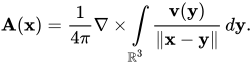
Then 


A generalization of this theorem is the Helmholtz expansion , according to which any vector field can be represented as the sum of a solenoidal vector field and a vortex-free vector field .
The ambiguity of the choice of potential
The vector potential of a solenoidal vector field is determined ambiguously. If a is a vector potential for also it is
Where - any continuously differentiable scalar function. This is a consequence of the fact that the gradient rotor is zero.
In electrodynamics, this gives ambiguity in determining the potentials of the electromagnetic field and is solved by imposing an additional calibration condition on the potential.
Vector Potential in Physics
Maxwell Equations
One way to write Maxwell's equations is to formulate it in terms of vector and scalar potentials. Vector potential is introduced in such a way that
- (in SI system).
In this case, the equation satisfied automatically.
Expression substitution for at
leads to the equation
according to which, just as in electrostatics, a scalar potential is introduced. However now in both scalar and vector potential contribute:
From the equation should
Using equality , the equations for the vector and scalar potentials can be written as
The physical meaning of the vector potential
In classical electrodynamics, the vector potential has often been interpreted as a quantity that does not have a direct physical meaning, formally introduced only for the convenience of calculations, although the vector potential comes in such a direct way in the structure of action for classical electrodynamics that this suggests its fundamental nature.
In quantum theory, this has a transparent physical meaning of the direct influence of the vector potential on the phase of the wave function of a particle moving in a magnetic field. Moreover, it was possible to carry out quantum experiments, which showed that the vector potential is accessible to measurement that is quite direct in a sense (at least, we are talking about the fact that the vector potential can affect the quantum particle in an observable manner even when the magnetic field strength in the regions accessible to the particle is everywhere equal to zero, that is, the magnetic field cannot affect the particle through tension, but only directly through the vector potential; see Aaronov-Bohm effect ).
Just as the scalar potential is associated with the concept of energy , the vector potential reveals a close connection with the concept of momentum . So, in the case of a quick shutdown of the magnetic field, the particle located in it receives an additional momentum qA.
See also
- Scalar potential
- The main theorem of vector analysis
- Vector potential of the electromagnetic field
- Hertz Vector
- Vector potential calibration