New Zealand cat-headed shark [1] , or cat-headed shark [2] , or checkered shark [2] , or Japanese big-headed shark [2] ( Cephaloscyllium isabellum ) - one of the species of the big-headed sharks , the family of cat sharks ( Scyliorhinidae ). It is an endemic of New Zealand . The maximum size is 1 m. Propagated by laying eggs.
| New Zealand Feline Shark |
 |
| Scientific classification |
|---|
| No rank : | Bilateral symmetrical |
| View: | New Zealand Feline Shark |
|
| International scientific name |
|---|
Cephaloscyllium isabellum ( Bonnaterre , 1788) |
| Synonyms |
|---|
Cephaloscyllium formosanum Teng , 1962
Scyllium lima Richardson , 1843
Squalus isabella Bonnaterre , 1788
Squalus isabella gmelin , 1789 |
| Area |
|---|
|
| Security status |
|---|
Least ConcernedIUCN 3.1 Least Concern : 41752 |
|
Content
French naturalist Pierre Joseph Bonaterr originally described a cat-headed shark as Squalus isabella in 1788 in the issue of “Tableau encyclopédique et méthodique des trois règnes de la nature” . He based his report on the L'Isabelle article attributed to Pierre-Marie-Auguste Brusson in the 1780 study Histoire de l'Académie Royale des Sciences . The primary holotype was lost. Later authors attributed this species to the genus of big-headed sharks Cephaloscyllium [3] .
Cat-headed sharks are very similar to Cephaloscyllium umbratile and the Australian big- headed shark , which at different times were considered by different authors as one species of cat-headed sharks. Cephaloscyllium laticeps . Feline-headed sharks differ from the Australian big-headed sharks in the color and shape of the capsule in which the eggs are enclosed [4] , and from Cephaloscyllium umbratile in color and morphological parameters [5] .
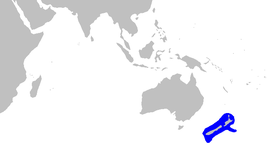
Feline-headed sharks live exclusively in the coastal waters of New Zealand, including the Snares Islands, the Chatham archipelago and Stewart Island on the continental and island shelves at a depth of 0 to 400 m.These are bottom fish that prefer rocky reefs and the adjacent soft bottom. Females and females keep separate [6] [7] .
As a rule, feline-headed sharks do not exceed 1 m in length, although individuals with a length of 1.5 are occasionally found. The maximum recorded size is 2.4 m, but it was probably the flat- headed seven-gill shark Notorynchus cepedianus or some other species. Females are larger than males [4] . These sharks have a dense, spindle-shaped body, which gradually narrows to a rather thin tail stalk. The head is short, wide and slightly flattened. The muzzle is wide and rounded. Oval eyes are high and have a rudimentary third eyelid . Under the eyes are strong horizontal protrusions. The nostrils are bordered by folds of skin that do not reach the mouth. The mouth is very large and curved. Upper teeth are visible even when the mouth is closed. Furrows at the corners of the mouth are absent.
Pectoral fins large and wide caudal margins slightly concave. Dorsal fins shifted to tail. The first dorsal fin is located above the ventral fins. The second dorsal fin is significantly smaller and is located above the anal fin. Male pterygopodia are very short and thick. Anal fin larger than second dorsal fin. The caudal fin is short and wide, with a well-developed lower lobe and a deep ventral notch at the tip of the upper lobe. The skin is thick, covered with scattered placoid scales of an arrow-shaped shape with three horizontal ridges. Color, as follows from one of the accepted names, is a dark spot (from 1 to 11) scattered on a golden brown background, the belly is lighter [4] [7] .
During the day, cat-headed sharks fall into a state similar to lethargy, and hide in crevices and caves on reefs [4] [6] , and hunt at night. Their diet consists of a variety of fish and invertebrates , including, quatrains , cod, perches , squids , octopuses , gastropods , crabs , shrimps and worms .
Like other big-headed sharks, cat-headed sharks are able to pump with water and swell in case of danger; in this way they wedge in the cracks and do not allow themselves to be seized and even scare away the predator. Being caught and washed ashore they can be inflated with air. Deflating, they make sounds similar to the barking of a large dog [8] . This species multiplies, laying two eggs at a time, enclosed in a soft cream-colored capsule 12 cm long. The spiral processes in the corners allow the capsule to attach to underwater objects [6] . Newborns have a length of 16 cm. Males and females reach puberty with a length of 60 cm and 80 cm, respectively [5] .
Cat-headed sharks are quite common. They do not pose a danger to humans. Often by-catch in trawl nets, as well as when catching lobsters. Most sharks released back into the sea seem to survive, as they can be in the air for quite some time. From 1988 to 1991, sharks were hunted in New Zealand to obtain fat from the liver. The reports mention that the catch of cat-headed sharks in that period was 74-540 tons per year. After the cessation of production, this figure dropped to 5 tons per year. The International Union for Conservation of Nature has assigned this species a conservation status of “Least Concerns” [6] .
- ↑ Gubanov E.P., Kondyurin V.V., Myagkov N.A. Sharks of the World Ocean: A Guide-Guide. - M .: Agropromizdat, 1986. - S. 83 .-- 272 p.
- ↑ 1 2 3 Reshetnikov Yu.S. , Kotlyar A.N. , Russ T.S. , Shatunovsky M.I. The pagan language dictionary of animal names. Fish. Latin, Russian, English, German, French. / edited by Acad. V. E. Sokolova . - M .: Rus. Yaz., 1989 .-- P. 25 .-- 12,500 copies. - ISBN 5-200-00237-0 .
- ↑ Eschmeyer, WN and R. Fricke (eds.) Catalog of Fishes electronic version (15 January 2010). Retrieved on February 8, 2010.
- ↑ 1 2 3 4 Compagno, Leonard JV Sharks of the World: An Annotated and Illustrated Catalog of Shark Species Known to Date. - Rome: Food and Agricultural Organization, 1984. - S. 298-299. - ISBN 92-5-101384-5 .
- ↑ 1 2 Compagno, Leonard JV, Dando, M .; Fowler, S. Sharks of the World. - Princeton: Princeton University Press, 2005 .-- S. 216-217. - ISBN 9780691120720 .
- ↑ 1 2 3 4 Francis, MP (2003). Cephaloscyllium isabellum. In: IUCN 2008. IUCN Red List of Threatened Species. Downloaded on January 31, 2010.
- ↑ 1 2 Michael, SW Reef Sharks & Rays of the World. Sea Challengers. - 1993. - S. 52. - ISBN 0-930118-18-9 .
- ↑ Martin, RA Do Sharks Make Any Sounds? (archived from Google Cache). ReefQuest Center for Shark Research. Retrieved on February 8, 2010.