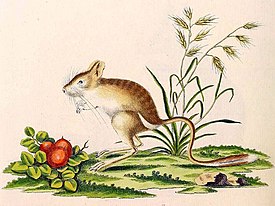
The boreal jerboa [1] , or the jerboa-arrow [2] ( lat. Dipus sagitta ) is the only species from the genus of the birch jerboa of the jerboa family.
| Boreal jerboa |
 |
| Scientific classification |
|---|
| No rank : | Bilateral symmetrical |
| Squadron : | Euarchontoglires |
| Gender: | Boreal jerboas ( Dipus Zimmermann , 1780 ) |
|
| International scientific name |
|---|
Dipus sagitta ( Pallas , 1773 ) |
| Security status |
|---|
Least ConcernedIUCN 3.1 Least Concern : 6705 |
|
Content
The boreal jerboa inhabits sandy deserts and semi-deserts of the southeast of the European part of Russia , Kazakhstan , Central and Central Asia , the south of Altai Territory , as well as Northern Iran [3] . It dwells among various types of sand, from dune to hilly, but avoids arrays of bare sand dune [4] .
To the west of the Volga lives in Tersko-Kumsk, Lower Volga and Volga-Don sands to the north to the mouth of the Medveditsa River , to the south to the Terek River. In the Volga-Ural - to the north to Urda, and along the Ural River to the latitude of the village of Indeborsk [4] .
In Central Asia, it is widely distributed in the Karakum and Kyzyl Kum . The isolated location of jerboa is known in southern Kyrgyzstan in the eastern part of the Alai valley near Irkeshtam [5] . In the Irtysh valley, the range of bogey jerboa reaches 52 ° N, and to the east - to the tape forests of the Altai steppes, Ubsunur depression in South Tuva [4] .
The species has a pronounced geographical variation, which manifests itself in the size and proportions of the skull, as well as in the color of the fur [6] . Animals from the southern and southeastern part of the range are larger and brighter in color, in which ocher and reddish tones appear instead of gray ones, as in animals from the northern and northwestern part of the range [7] . Several subspecies are grouped:
- Semipalatinsk bore-legged jerboa ( Dipus sagitta sagitta Pallas, 1773 ). Ribbon pine forests on the right bank of the Irtysh within the Semipalatinsk and Pavlodar regions of Kazakhstan and the south of the Altai Territory.
- Zaysan boreal jerboa ( Dipus sagitta zaissanensis Selevin, 1934 ). Sands of the Zaysan Basin . Outside the former USSR, it is probably found in Northwest China ( Dzungaria ).
- Gobian shaggy jerboa ( Dipus sagitta sowerbyi Thomas, 1908 ) (syn. Ds ubsanensis Bannikov, 1947). South Tuva, Mongolia ( Ubsunur and Achitnur hollows , Central Khangai , Valley of Big Lakes , Gobi Lakes Basin , Gobi Altai , Zaaltai , Middle and East Gobi ), Northern China ( Alashan and Ordos ).
- Ciscaucasia birch jerboa ( Dipus sagitta nogai Satunin, 1907 ). Dagestan , Kalmykia , Astrakhan region , the left bank of the Middle Don .
- Volga-Ural birder jerboa ( Dipus sagitta innae Ognev, 1930 ). Sandy deserts and semi-deserts of the Volga-Ural interfluve.
- South Ural bog jerboa ( Dipus sagitta austrouralensis Shenbrot, 1991 ). Sandy deserts and semi-deserts between the rivers of the Urals and Emba .
- Aral Sea birder jerboa ( Dipus sagitta lagopus Lichtenstein, 1823 ). Sands Big and Small Badgers , Aral Karakum , sands of the lower reaches of Turgay and Sarysu .
- Turanian bogey jerboa ( Dipus sagitta turanicus Shenbrot, 1991 ). Karakum , Kyzyl Kum , Sundukuli sands, island sand massifs of Mangyshlak .
- Muyunkum tufted jerboa ( Dipus sagitta megacranius Shenbrot, 1991 ). Prichuy Muyunkum .
- Balkhash bore- legged jerboa ( Dipus sagitta usuni Shenbrot, 1991 ). Sandy massifs of the Southern Balkhash and the Ili Basin . [eight]
In addition to the above, the following subtype forms belonging to the sagitta group are also accepted:
- Dipus sagitta deasyi Barret-Hamilton, 1900 . Southwestern Kashgar .
- Dipus sagitta halli Sowerby, 1920 . Inner Mongolia, Northwest China.
- Dipus sagitta aksuensis Wang, 1964 . Northern Kashgar.
- Dipus sagitta fuscocanus Wang, 1964 . North-Eastern Kashgar.
- Dipus sagitta bulganensis Shenbrot, 1991 . Mongolian Dzungaria [9] .
Jerboas of medium size. Sexual dimorphism is not expressed [10] . The overall appearance of a typical jerboa. The body is short. The tail is long (1.2-1.3 times longer than the body), not thickened, with a well-developed banner. The forelimbs are short, the hind limbs are long (foot length is 47-51% of the body length), three-fingered [11] . The head is large, with a pronounced cervical interception. The muzzle is shortened, wide. Piglet is well defined. The ears are relatively short, rounded [12] .
The hair is thick and soft. The color of the top of the head and back, as well as the cheeks and outer surfaces of the hips, varies greatly depending on the habitat: from pale sandy-yellow to dark grayish-brown with pronounced longitudinal dark streaks. The remaining hairs of the top of the head and back are three-colored: the main part is ashen-gray (about 70% of the length), then a light yellowish-brown or yellowish-buffy belt (20% of the length), the top (about 10% of the hair) is black or dark brown [12] . The sides of the body and cheeks are covered with slightly brighter and brighter hair than the back. The outer surface of the hips is brighter than the back. The lips, throat, chest, belly and inner thighs are pure white. The rings around the eyes and the spots behind the ears are grayish-white. The foot is covered with short, pure white hair from above, and from the bottom with a brush of long soft hairs (the outer hair of the brush is painted white and the lower ones are dark brown or white). The tail shaft above and on the side is light yellow, yellowish-brown or yellowish-ocher in color, and below it is pure white. At the end of the tail there is a long, two-color brush (banner): its main part is black (in young animals) or dark brown (in old animals), and the end is pure white [12] .
The diploid number of chromosomes is 48, the number of autosome shoulders is 90-92. The only species among jerboas for which both intrapopulation chromosomal polymorphism and interpopulation chromosome variation are known [13] .
Active and mobile animal. Activity occurs at dusk and night [14] . The maximum running speed is 8.1 m / s, the maximum jump length is 200 cm [15] . The day is spent in burrows. In total, 4 types of bony jerboa norm stand out: protective, diurnal summer, brood, wintering [16] . Permanent burrows have a length of up to 5-6 m and a depth of 3 m, with 1-3 emergency exits [7] .
In the northern regions it falls into hibernation , and in the southern regions it is active throughout the winter period, with the exception of very severe winters [4] . For example, in Dagestan, hibernation lasts from late October to mid-March [17] .
Relatively generalized herbivorous species. Before the beginning of the growing season in early spring, bogey jerboas feed exclusively on last year's seeds, with the beginning of the growing season, the green and underground parts of plants prevail in the diet. In summer and autumn they feed mainly on ripened seeds and fruits. They also feed on insects and their larvae, but in small quantities [18] [7] . The feed is collected in the surface layer, although it also climbs well along the branches of shrubs [19] .
Reproduction varies greatly geographically. Depending on climatic conditions, the breeding period can last from 3 to 8 months. During the season, the female can bring from one to three broods [17] . In overwintered females, the number of litters is 2-3, and in arrived animals of the first brood - 1 [7] . In the brood, from 1 to 8 cubs, and from north to south the size of the brood increases. The duration of pregnancy is 25-30 days [20] .
- ↑ Complete Illustrated Encyclopedia. "Mammals" Prince. 2 = The New Encyclopedia of Mammals / Ed. D. MacDonald . - M .: Omega, 2007 .-- S. 444. - 3000 copies. - ISBN 978-5-465-01346-8 .
- ↑ Sokolov V.E. The pagan dictionary of animal names. Mammals Latin, Russian, English, German, French. / edited by Acad. V. E. Sokolova. - M .: Rus. Yaz., 1984. - S. 193. - 10,000 copies.
- ↑ Schoenbrot et al, 1995 , p. 219.
- ↑ 1 2 3 4 Gromov et al, 1995 , p. 231.
- ↑ Schoenbrot et al, 1995 , p. 221.
- ↑ Schoenbrot et al, 1995 , p. 221.
- ↑ 1 2 3 4 Gromov et al, 1995 , p. 232.
- ↑ Schoenbrot et al, 1995 , p. 224-226.
- ↑ Schoenbrot et al, 1995 , p. 226.
- ↑ Schoenbrot et al, 1995 , p. 213.
- ↑ Schoenbrot et al, 1995 , p. 212.
- ↑ 1 2 3 Schoenbrot et al, 1995 , p. 216.
- ↑ Schoenbrot et al, 1995 , p. 218.
- ↑ Schoenbrot et al, 1995 , p. 240.
- ↑ Schoenbrot et al, 1995 , p. 241.
- ↑ Schoenbrot et al, 1995 , p. 238.
- ↑ 1 2 Schönbrot et al, 1995 , p. 243.
- ↑ Schoenbrot et al, 1995 , p. 232.
- ↑ Schoenbrot et al, 1995 , p. 236.
- ↑ Schoenbrot et al, 1995 , p. 244.
- Gromov I.M., Erbaeva M.A. Mammals of Russia and adjacent territories. Hare-like and rodents. - St. Petersburg: Nauka, 1995 .-- 522 p. - (Series "Keys to the fauna of Russia, published by the Zoological Institute of the Russian Academy of Sciences. Issue 167").
- Shenbrot G.I., Sokolov V.E., Geptner V.G., Kovalskaya Yu.M. Jerboa-like. - M .: Nauka, 1995 .-- 576 p. - (Series "Mammals of Russia and adjacent regions"). - ISBN 5-02-004764-3 .