Sparrow -bird [1] ( lat. Forpus passerinus ) is a bird of the parrot family.
| Parrot |
 |
| Scientific classification |
|---|
| No rank : | Bilateral symmetrical |
|
| International scientific name |
|---|
Forpus passerinus Linnaeus , 1758 |
| Security status |
|---|
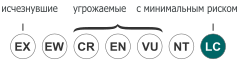
Least ConcernedIUCN 3.1 Least Concern : 22685926 |
|
Content
Body length 12–13 cm, tail 4 cm; weight 30 g. The color of the plumage is grassy-green, the back in the lower part and the sacrum are blue, therefore they are sometimes called blue-tailed. The lower hiding feathers are dark blue. The wing and secondary wing feathers are ultramarine blue. The ends of the feathers reach the end of the tail. Their tail is short, rounded. The lower body is lighter. In males , unlike females , on the inner side of the wing there are blue feathers, in females, the color of plumage is light green.
They live in Guyana , Suriname , Colombia , Venezuela , Bolivia , Paraguay and northern Brazil .
Inhabit mangrove forests , various shrubs, secondary undersized forests, edges and clearings. They gravitate to rivers and the sea coast. In addition to plant foods, insects and their larvae, spiders, millipedes and molluscs are included in their diet.
Nest in hollows and hollows of stumps, in niches of deformed bitches and branches, as well as in termite mounds . In clutch there are from 3 to 6 eggs , which the female incubates for 19-21 days. The male feeds the female and spends a lot of time in the nest, however, does not take part in incubation. Eggs are laid at intervals of 1-2 days, chicks hatch at different times.
The locals take these parrots from their nests at chicks and keep them at home. They take root well, become gullible and pretty funny. Adult parrots are less adaptable to home maintenance.
The view includes 5 subspecies:
- Forpus passerinus cyanochlorus ( Schlegel , 1864 )
- Forpus passerinus cyanophanes ( Todd , 1915 )
- Forpus passerinus deliciosus ( Ridgway , 1888 )
- Forpus passerinus passerinus ( Linnaeus , 1758 )
- Forpus passerinus viridissimus ( Lafresnaye , 1848 )
- ↑ Boehme R. L. , Flint V. E. The Bilingual Dictionary of Animal Names. Birds. Latin, Russian, English, German, French / Ed. ed. Acad. V. E. Sokolova . - M .: Rus. lang., "RUSSO", 1994. - S. 119. - 2030 copies. - ISBN 5-200-00643-0 .