Big - headed sharks [1] [2] , or cat-headed sharks [3] ( lat. Cephaloscyllium ) - a genus of the family of cat sharks (Scyliorhinidae). These sharks have the ability to pump the body with water and swell to protect against predators. These bottom fish are widespread in the tropical and temperate coastal waters of the Indian and Pacific Oceans. They have a dense, spindle-shaped body with a short, wide and flattened head. The maximum size is 1 m. The diet consists of a variety of fish and invertebrates. Propagate by laying two eggs at a time. They are harmless and do not represent commercial value.
| Big sharks |
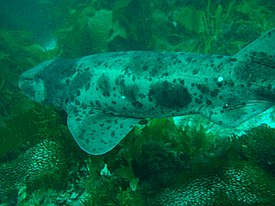
Australian big-headed shark ( Cephaloscyllium laticeps ) |
| Scientific classification |
|---|
| No rank : | Bilateral symmetrical |
|
| International scientific name |
|---|
Cephaloscyllium (TN Gill , 1862) |
|
The big-headed sharks have a dense, spindle-shaped body, tapering at the caudal stem. The head is short (no more than 1/5 of the total length), wide and flattened. The muzzle is very short and dull. The nostrils on the sides are surrounded by skin folds. The eyes are oval, horizontally extended, located high, equipped with a rudimentary blinking membrane , the pupils resemble pupils of cats. There are wide combs under the eyes. The mouth is very large and wide, and the jaws are equipped with numerous teeth. The teeth are visible even when the mouth is closed (with the exception of the Indian big-headed shark ). Furrows at the corners of the mouth are absent.
The pectoral fins are large and wide, and the ventral fins are small. Dorsal fins shifted to tail. The base of the first dorsal fin is located behind the base of the ventral fins, while the second dorsal fin is opposite the anal fin. The first dorsal and anal fins are significantly larger than the second dorsal fin. The tail is short, the caudal fin is wide, with a pronounced lower lobe and a large ventral notch at the tip of the upper lobe. The skin is thick, covered with heavily calcined placoid scales . The color is grayish or brownish with spots that form a variety of patterns [4] . In some species, the color of young individuals is significantly different from the color of adults. Big-sharks can be divided in size into two groups. One of them consists of dwarf species, such as the striped big-headed shark and the Indian big- headed shark , whose size does not exceed 50 cm, and the other - large species, including Cephaloscyllium umbratile and the California bloated shark , reaching 1 m in length.
Big-headed sharks live in the temperate and tropical waters of the Pacific and Indian oceans, but not at the equator . A variety of species of big-headed sharks are common off the coast of Australia and in the western and central parts of the Pacific Ocean, among them there are several endemic species. The widest range is for an inflating big- headed shark ( Cephaloscyllium sufflans }, which is found off the southeast coast of India , a California swelling shark ( Cephaloscyllium ventriosum ), distributed along the eastern coast of North and South America and the species Cephaloscyllium umbratile , which inhabits the north-western Pacific Ocean One hypothesis suggests that the genus of big-headed sharks came from Australia and New Guinea and gradually spread during a series of migrations, reaching the shores of Africa and America [5] .
Big-headed sharks are bottom fish that occur from the tidal zone to a depth of 670 m on the continental and island underwater slopes [6] .
In general, big-headed sharks are slow, inactive fish that swim, wriggling like eels [5] . Their diet consists of a variety of bottom animals, including other sharks and stingrays , bony fish , crustaceans, and mollusks [7] . Big-headed sharks are known for their ability to pump up water and swell in case of danger - in this way they wedge in the crevices, not allowing themselves to be caught, and even scare away the predator. This species reproduces by laying 2 eggs at a time, one from each ovipositor. The eggs are enclosed in a capsule in the shape of a flask, equipped with antennae at the corners, which allow it to be fixed at the bottom [4] .
The name of the genus Cephaloscyllium was proposed by the American ichthyologist Theodore Gill in the issue of Annals of the Lyceum of Natural History of New York [4] [6] . It comes from the Greek words Greek. κεφάλι - “head” and Greek. σκυλόψαρο - “sea dog”. However, most of Gill's contemporaries, especially in Europe, preferred to attribute the big-headed sharks to the genus Scyllium (synonymous with Scyliorhinus ). The name Cephaloscyllium was not widespread until Samuel Garman published the article “The Plagiostomia” in the 1913 issue of Memoirs of the Museum of Comparative Zoology , in which he officially recognized three species: Cephaloscyllium isabellum , Cephaloscyllium ventriosum and Cephaloscyllium 4 umbratile .
For a long time there was a taxonomic ambiguity associated with the genus of big-headed sharks and due to several factors, including a diverse appearance (especially differences between young and adult individuals), the existence of many undescribed species and type specimens, and the use of unreliable sources. Until recently, 3-5 species were officially recognized, and there were 5 undescribed species that lived in the waters of Australia , the western and central parts of the Pacific Ocean, and in the Indian Ocean [6] . In 2008, efforts were made to introduce taxonomic clarity of the genus of big-headed sharks, as a result of which the number of described species reached 19 [6] [5] [8] .
- Cephaloscyllium albipinnum Last , Motomura & WT White , 2008
- Cephaloscyllium circulopullum Yano , A. Ahmad & Gambang , 2005
- Cephaloscyllium cooki Last , Séret & WT White , 2008
- Cephaloscyllium fasciatum WL Chan , 1966 - Striped, big-headed shark [2]
- Cephaloscyllium hiscosellum WT White & Ebert , 2008
- Cephaloscyllium isabellum Bonnaterre , 1788 - Cat - headed shark , or Drafts shark , or Japanese-headed shark [2]
- Cephaloscyllium laticeps Duméril , 1853 - Australian Great Shark [2]
- Cephaloscyllium maculatum Schaaf-Da Silva & Ebert , 2008
- Cephaloscyllium pardelotum Schaaf-Da Silva & Ebert , 2008
- Cephaloscyllium pictum Last , Séret & WT White , 2008
- Cephaloscyllium sarawakensis Yano , A. Ahmad & Gambang , 2005
- Cephaloscyllium signourum Last , Séret & WT White , 2008
- Cephaloscyllium silasi Talwar , 1974 - Indian Big-Shark [2]
- Cephaloscyllium speccum Last , Séret & WT White , 2008
- Cephaloscyllium stevensi et , 2011
- Cephaloscyllium sufflans Regan , 1921 - Inflated big-headed shark [2]
- Cephaloscyllium umbratile DS Jordan & Fowler , 1903
- Cephaloscyllium variegatum Last & WT White , 2008
- Cephaloscyllium ventriosum Garman , 1880 - California swelling shark , or California cat-headed shark [2]
- Cephaloscyllium zebrum Last & WT White , 2008
Phylogenesis and Evolution
Morphological and molecular phylogenetic studies have revealed that the closest relative to the genus of big-headed sharks is the genus of feline sharks ( Scyliorhinus ) and together with the genus of mustachioed feline sharks ( Poroderma ) they form the subfamily Scyliorhininae , which is the most basic clade of the carcharhiniformes [Carcharhiniformes ] ] .
The earliest fossils of large sharks found in California date from the Miocene era (22.3–5.3 million years ago), although, given the level of DNA divergence in sharks, the genus origin should be attributed to the Cretaceous (145–65 million years) back).
Big-headed sharks are not dangerous for humans and practically have no commercial value. Sometimes, by-catch is caught in fishing nets. Some species, such as Cephaloscyllium umbratile and the California swelling shark , are known for their survivability - they can live without water for more than a day and adapt well in captivity [7] [9] .
- ↑ Lindberg, G.W. , Gerd, A.S. , Russ, T.S. Dictionary of the names of marine commercial fish of the world fauna. - Leningrad: Nauka, 1980 .-- S. 83. - 562 p.
- ↑ 1 2 3 4 5 6 7 Reshetnikov Yu.S. , Kotlyar A.N. , Russ T.S. , Shatunovsky M.I. Pyatilingual dictionary of animal names. Fish. Latin, Russian, English, German, French. / edited by Acad. V. E. Sokolova . - M .: Rus. Yaz., 1989 .-- P. 25 .-- 12,500 copies. - ISBN 5-200-00237-0 .
- ↑ Gubanov E.P., Kondyurin V.V., Myagkov N.A. Sharks of the World Ocean: A Guide-Guide. - M.: Agropromizdat, 1986 .-- S. 36 .-- 272 p.
- ↑ 1 2 3 4 5 Compagno, LJV Sharks of the order Carcharhiniformes. - Blackburn Press, 2003. - P. 110-115, 392. - ISBN 1-930665-76-8 .
- ↑ 1 2 3 4 Schaaf-Da Silva, JA (December 2007). A Taxonomic Revision of the North Pacific Swell Sharks, Genus Cephaloscyllium . M.Sc. Thesis, San José State University.
- ↑ 1 2 3 4 Schaaf-Da Silva, JA and DA Ebert (September 8, 2008). "A revision of the western North Pacific swellsharks, genus Cephaloscyllium Gill 1862 (Chondrichthyes: Carcharhiniformes: Scyliorhinidae), including descriptions of two new species." Zootaxa 1872: 1-8.
- ↑ 1 2 Michael, SW Reef Sharks & Rays of the World. Sea Challengers. - 1993. - P. 52-53. - ISBN 0-930118-18-9 .
- ↑ Last, PR, WT White and JJ Pogonoski (eds). Descriptions of new Australian Chondrichthyans .. - CSIRO Marine and Atmospheric Research Paper, 2008. - Vol. 022. - ISBN 1-921424-18-2 .
- ↑ Whitley, GP (1940). The Fishes of Australia, Part 1. Royal Zoological Society of New South Wales. p. 92.
