The decorated grass parrot [1] ( lat. Neophema elegans ) is a bird of the parrot family.
| Decorated Grass Parrot |
 |
| Scientific classification |
|---|
| No rank : | Bilateral symmetrical |
| View: | Decorated Grass Parrot |
|
| International scientific name |
|---|
Neophema elegans ( Gould , 1837 ) |
| Area |
|---|
|
| Security status |
|---|
Least ConcernedIUCN 3.1 Least Concern : 22685197 |
|
Content
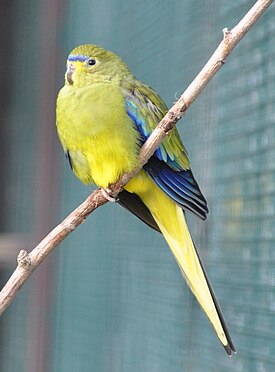
Body length 22-23 cm. The color of the plumage is olive-green; the strip passing through the forehead and above the eyes is blue; the same color and folds of wings. The middle feathers of the tail are gray-blue, the rest are light yellow. The male on the belly has a pale orange spot, the female and young chicks do not have such a spot.
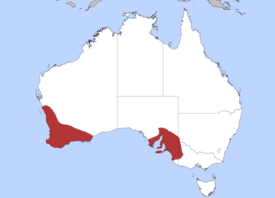
It lives in South and Western Australia .
Inhabit open areas and sparse forests with grassy vegetation. The main feed is the seeds of herbaceous plants. Fruits and fruits of wild plants are also consumed.
Nest once a year from August to October. They are nests in voids in large branches of trees or rotten stumps. In clutch from 4 to 5 white eggs of a rounded shape. One female incubates, the male at this time is nearby and feeds the female once a day. Hatching lasts 19-21 days. Chicks hatch blindly, well pubescent. At the age of 32-35 days, young parrots leave the nest, but parents feed them about another 10-12 days. They live in captivity for 12 years or more.
The view includes 2 subspecies:
- Neophema elegans carteri (Mathews, 1912)
- Neophema elegans elegans (Gould, 1837)
- ↑ Boehme R. L. , Flint V. E. The Bilingual Dictionary of Animal Names. Birds. Latin, Russian, English, German, French / Ed. ed. Acad. V. E. Sokolova . - M .: Rus. lang., "RUSSO", 1994. - S. 122. - 2030 copies. - ISBN 5-200-00643-0 .