Surtsey ( Isl. Surtsey ) - an uninhabited island in Iceland , the southernmost point of the country, a World Heritage Site . One of the objects of the group of the volcanic complex Vestmannaeyyar .
| Surtsey | |
|---|---|
| fig. Surtsey | |
 Surtsey in 1999 | |
| Specifications | |
| Square | |
| Highest point | 154 m |
| Population | 0 pax (2010) |
| Location | |
| Water area | Atlantic Ocean |
| A country |
|
| Region | Ciudurland |

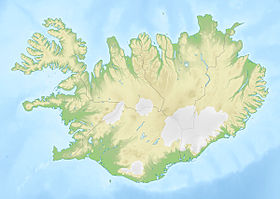

Surtsey is one of the few islands that have appeared in modern times, and almost the only one on which, from the first moment of the appearance of hard rock above sea level, scientific research has been carried out.
Content
History
The island appeared on November 14, 1963 . A few days earlier, at an depth of 130 meters, an eruption of an underwater volcano began south - west of the islands of Vestmannaeyyar . Until June 1967, there were about a hundred eruptions, after which the island reached an area of 2.7 km² . However, then erosion and wave washing reduced the area of the island to 1.5 km² in 2000 .
The island was called Surtsey, which in Icelandic means "island of Surt ", in honor of the lord of the fire giants. In addition to the main island, several small islands formed.
The Appearance of Life
Surtsey consisted only of volcanic pumice , but attracted the attention of scientists from all over the world, as on his example it was possible to observe the appearance of life on the island. Access here “for the purity of the experiment” was limited.
Scientists determined that bacteria and other microorganisms settled on Surtse already in the first hours of the island’s birth.
Gradually, plants began to appear here. At first it was mosses and lichens , which were on the island already in 1965 ; the first among them were , Bryum argenteum and Trapelia coarctata . In the mid -1980s, there were already over 20 plant species. The first flowering plant discovered on the island was seaside mustard, or seaside mustard ( Cakile maritima ) from the Kapustny family, a bit later sandy chamomile ( Ammophila arenaria ), buterlacidae honkenenya ( Honckenya peploides ) and seaside mertensia ( Mertensia ) were also found. In 1998, the first shrub was discovered - the willow tree ( Salix phylicifolia ). By 2008, 69 species of plants were found on the island.
Surtsey lies on the flight path of many species of birds. Of course, birds , both migratory and those living on Vestmannaeyare, land, fertilizing the badlands of the island with their litter , which, in addition to organic and mineral substances, contains undigested seeds of plants, which contributes to the spread of new species. Studies have shown that about 75% of the seeds were brought to the island by birds, 14% by wind, and 11% by water.
The first on the island were spotted petrels and huts . In 1986, a colony of gulls nesting on Surtse was discovered. In addition, the island is visited by birds such as swans , wild geese and ravens . In the 21st century , nests of tupiks were discovered.
Other animals have also been discovered on Surtsey: worms , spiders , beetles , flies , ticks .
Marine life on the island is characteristic of this area and is rich in fish and plankton .
Erosion
Erosion of the island is one of the main problems of Surtsey and the surrounding islets. Over the 40 years of its existence, the area of the island has almost halved, but since the mid -1980s, the rate of erosion has slowed sharply. According to experts, the island in a few [ how much? ] years will cease to decrease in size.
The small island of Joulnir ( Isl. Jólnir), formed next to it as a result of the release of lava to the surface in December 1965, towered 70 meters above sea level, and a year later the ocean washed it out and there was nothing left of it.
Climate
The climate is typical of Vestmannaeyara and the southern coast of Iceland. The ocean near the island does not freeze, floating ice in this area is very rare. The temperature of the coldest period ( January - February ) exceeds zero (+1 - +1.5 ° C ), the warmest ( July - August ) - +10.5 ° C. It rains often throughout the year, sometimes in winter snow falls, which quickly melts. The annual rainfall is about 1600 millimeters .
See also
- Vestmannaeyjar (volcano)
Links
| UNESCO World Heritage Site No. 1267 Russian • English • fr. |
- Website of The Surtsey Research Society
- Weather observations on Surtsey
- Webcam on surtsey
- Aerial photos, maps and volcanic geology of Surtsey. (inaccessible link) . Archived December 16, 2002.
- Visit Westman Islands
- Surtsey topography
- The Surtsey Research Society , which administers the island
- A notice from the Environmental & Food Agency declaring Surtsey a protected area
- Explore North site illustrates postage stamps.
- Extensive information about plant and bird life on the island