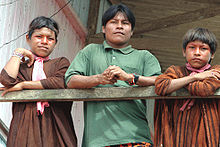
Ashaninka , or ashenka (obsolete - kampa), is one of the peoples of Peru living in the basins of the Ukayali , Apurimak , and Pachitea rivers. The number is estimated at 41 thousand people (2000). The vast majority live in Peru, and some live in Brazil . A traditional social organization is a community of several related paired families. The marriage is patrilocal , the relationship is bilateral .
| Auchaninka | |
|---|---|
| Abundance and area | |
| Total: 41,000 (2,000) | |
| Peru , Brazil | |
| Tongue | Auchaninka |
Content
Religion and Language
Mostly profess Catholicism . The official language is Kampa . Dialects: actually Kampa, anti, Autaniri, Kamatika, Katongo, Kimbiri, Karinairi, Pangoa, Tampa, Ugunichiri, Unini, Chicheren. Quechua and Spanish are also common.
Activities
The main occupation is agriculture, which is carried out by manual slashing-fire method . They grow sweet cassava , corn , beans , sweet potatoes . They are also engaged in hunting and fishing . The main crafts are weaving and pottery . Camps are also self-employed in logging and cotton picking .
Material culture of the Creole type.
Kampa Traditional Social Organization
They live in hemispherical huts for one paired family. The village consists of several such huts and huts for bachelors.
Literature
- Kampa // Peoples and religions of the world / Chap. ed. V.A. Tishkov . M .: Big Russian Encyclopedia, 1999.
- Kampa // Encyclopedia of the peoples of the world / Ethnolog.ru
- Srapyan E., Fedorov A. Auchaninka . amazonasproject.com.
- Srapyan Elena. It’s good to live together . nplus1.ru (04.25.2018).