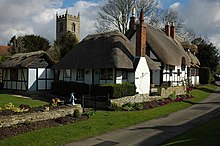

Cottage (from the English cottage ) - an individual urban or rural low-rise (usually two-story) residential building with a small plot of adjacent land [1] for permanent or temporary residence of one nuclear family . The ground floor is occupied by such premises as a living room , kitchen , bathroom , boiler room, often a garage for a car; the second is bedroom (s).
The Russian term cottage should not be confused with English. cottage . In English, a cottage is a simple house, usually located in the countryside [2] [3] , or a farmer's house [4] .
Materials and Designs
In relation to the whole world practice, the classic building materials of the cottage are: natural stone and red brick , wood, concrete and reinforced concrete . In recent decades, cottages from sandwich panels and aerated concrete have become widespread.
Roofing materials range from straw or wood to various types of tiles (metal, concrete, clay, stone, bitumen-polymer, etc.).
History

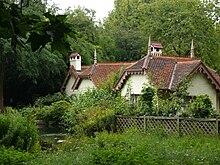
In British English, the term now refers to a small dwelling of a traditional building, although it can also be applied to a modern building built to resemble traditional houses ("false cottages"). Cottages can be separate houses or terraces , for example, built to house workers in mining villages. provided to farm workers was usually a cottage, see .
The word "cottage" came from , where it originally denoted a small house of the tenant-" tenant" - "cotter" [5] - with a barn and a plot of land . In England, starting in the 9th century, agricultural wage laborers lived in these small houses. The peasants who worked for the landowner gave him half the harvest or rent for using the land. Those houses were called cottages .
Since the 16th century, England has become a powerful colonial power, a leading trading nation, which leads to the emergence of a new class of wealthy people. All this leads to the fact that suburban estates and estates become the determining type of English housing. It was in the XVI century that a huge number of those classic English cottages appeared , which today represent that rural England, which you can see with your own eyes during travels. These houses have typical features:
- the house has a roof with many slopes, with a roof made of tiles or straw, with steep slopes and a mandatory chimney;
- climbing plants always plant along the walls of the house; in the decoration of facades, stone and plaster are most often used;
- An important place in the architecture of the cottage is occupied by a fenced and always well-groomed garden.
Modern Russian cottages are often made in the English style. Cottages in the English sense of the word are also widely distributed in other European countries (mainly in the Scandinavian countries) and in the USA , Canada , Australia , New Zealand , South Africa . There, the cottage is not a luxury item and serves as a symbol of the middle class .
In the USSR, cottages were built mainly in the 1920s, mainly in new factory towns. However, in the estate of one of the Grand Dukes near St. Petersburg - Boris Vladimirovich - as early as the 19th century a cottage was built entirely made from imported English materials, as the landlord boastfully punished: “Without a single Russian nail!” [6] .
In 1970-1990, residential buildings for their workers were built on the central estates of Soviet collective and state farms . Along with typical apartment buildings from 2 to 5 floors high, individual or twin residential buildings, also called cottages, could be built in the village [7] . The "state farm cottages" differ from the "old" village houses by the material of the walls - as a rule, a widespread silicate brick was used - and by the availability of communal amenities: centralized water supply and sewage , main natural gas , central or autonomous gas heating , asphalt porch. As a rule, a cottage had a plot of land on which a garden, farm buildings and a garage could be located. In addition to individual, semi-detached “state farm cottages” with isolated entrances and land were built.
In post-reform Russia, the cottage, like many foreign borrowings, experienced a truly phantasmagoric transformation. In the early 90s of the XX century, someone successfully joked in the media , calling the red-brick “castles” of the “era of initial capital accumulation” - “cottages on six hundred parts”. The name stuck - and the so-called "cottage" became an integral element of the life of the " new Russians " (which, apparently, the author did not understand the subtle English humor). In the suburban area near the highway appeared “guarded cottage villages”, which would be more correct to call “castle” or “palace”. The cottages in them are only houses for security and servants.
In modern Russia there is no large city that would not be surrounded by "cottage villages". So it’s legitimate to talk about the appearance of the term “Russian cottage” - a house (often a mansion , a manor , an estate ), comparable in size to a British villa or even a mansion [8] , and including an appropriate piece of land [9] .
exists in many cultures under different names. In American English, "cottage" is one of the terms for such holiday homes , although they can also be called "house", " chalet " or even "camp". In some countries (for example, in Scandinavia , the Baltic States and Russia ) the term “cottage” has local synonyms: in Finnish mökki , Estonian suvila , Swedish stuga , Norwegian hytte (from the German word Hütte ), Slovak chalupa , in Russian is a summer residence (a summer residence, which may belong to a summer house / summer house, often located near a pond).
American cities have cottage-style homes that were built primarily to house slaves.
In places like Canada, a “cottage” has no size connotations compared to a vicar or a monastery.
Modern use in different countries
North America
Although the Oxford English Dictionary states that the term cottage is used in North America to mean “summer cottages” (often on a large and luxurious scale) at a watering hole or in a health or leisure resort, most Americans perceive the cottage, especially the cottage, as a relatively small building, possibly unfinished house. Various editions of the typical American Webster Dictionary define it as a “small house; any modest or suburban home ”(5th edition), and in the eleventh edition, even a holiday cottage is called“ an ordinary small vacation home ”.
In North America, most of the buildings known as cottages are used by city dwellers for weekends or summer holidays. Cottage owners often rent their property to tourists as a source of income. In St. John , Virgin Islands , USA, most cottages are holiday rentals for weekends or summer holidays. In Michigan, a cottage usually means a cottage away from the north, next to the lake. An example of a colonial-era home in North America is a small stone house called in , one of the oldest surviving houses in the city (1678–1684).
In the lingo of Quebec's English-speaking real estate industry, a cottage is any two-story house, not a bungalow . However, “cottages” in eastern Canada are typically located near lakes, rivers, or the ocean in forested areas. They are used as a place to relax with friends and family, and to host common events, including swimming, canoeing , water skiing , fishing, hiking and sailing . There are also many famous . Living in cottages is one of the most popular tourist attractions in Ontario ( Canada ), parts of which came to be referred to as (see Cottage Village ). The term usually refers to the northern and southern shores , , Chaliberton , and , but has also been used to describe several other Canadian regions. The practice of renting cottages has become widespread in these regions, especially in connection with the growth of property taxes on the waterfront.
What East Canadians call "cottages" (seasonal homes) are usually called "houses" in most countries of North America. This is most noticeable in the Midwest and Western United States, as well as in Western Canada. In much of northern Ontario , New England, and summer cottage by the pond is known as a camp . In the 1960s and 1970s, the house became a popular cottage style in northern America.
In the 1920s and 1930s, many gas stations were built in the style of Old World cottages. Including about a third of the stations built in the USA in those years, the objects with a picture in the cottages evoked a colorful home-like atmosphere, and it was easier for them to get approval than more stylized or eye-catching projects, also widely used at the dawn of the automobile era [10] .
UK
In the popular contemporary culture of Great Britain and Ireland, the term "cottage" is used in a more general and romantic context and can be found in any era, but this term is usually applied to houses built in a modern style. Old, pre-Victorian cottages are usually of limited height, and often have load-bearing wooden building structures, sometimes overlooking the living space. In modern reconstructions of such dwellings, an attempt is often made to reassemble wooden beams, rafters, posts, etc., which were covered with modern finishes, in an attempt to establish the alleged historical authenticity.
Old cottages are usually modest, often semi-detached or terraced, with only four main rooms (“two at the top, two at the bottom”), although subsequent modifications can create more spacious rooms. The one-room house of a worker or fisherman, often attached to a larger property, is a special type of cottage and is called penty . The term cottage has also been used for a larger home that is practical rather than pretentious: see the Jane Austen House Museum .
Ireland
Irish cottages ( Irish teachín ) have historically been the homes of agricultural workers and workers, but in recent years the term has gained a romantic connotation , especially when it comes to cottages with thatched roofs ( Irish teach ceann tuí ). These straw cottages could once be seen all over Ireland, but most of them were dilapidated due to new and modern developments. However, the restoration of these old cottages has recently been restored, and people want a more traditional home. Today, straw cottages are currently mainly built for the tourism industry, and many of them are rented as housing [11] .
Scandinavian countries
Statistics Finland defines a cottage ( Fin. Mökki , Finnish Swedish : stuga or villa ) as “a residential building that is used as housing for recreation or recreation and is constantly being built or erected on its own site” [12] . Finnish cottages are traditionally built from logs, but other wooden structures have become commonplace. They are usually located close to the water, and almost everyone has a sauna .
In 2005 in Finland there are 474,277 cottages, in the country there are 187,888 lakes and 179,584 islands, including rented cottages owned by hotel companies, but excluding holiday villages and buildings on garden plots. The reports reported 4,172 new cottages built in 2005. Most of the cottages are located in the municipalities of Kuusamo (6 196 cottages as of January 1, 2006), Kuopio (5 194), Ekenas ( Tammisaari - 5 053), Mikkeli (4 649) and Mäntyharju (4 630).
The formal Swedish term for cottages is fritidshus (country house) or stuga , which in Sweden totals 680,000 (2007). According to Statistics Sweden, about 50% of the population of Sweden has access to a cottage [13] . In everyday conversation, the Swedes call their cottages lantstället (country house) or stugan (cottage). Most holiday homes in Sweden can be found along the coast and around major cities. Prices vary greatly by location; a modern seaside house near Stockholm can cost 100 times more than a simple cottage in the interior of northern Sweden.
Until the end of World War II, only a small rich Swedish elite could afford holiday homes - often a large seaside house and a hunting lodge in the north. During rapid urbanization in the 1950s and 1960s, many families were able to preserve their old farmhouses, village cottages and fishing houses and turn them into holiday homes. In addition, economic growth has allowed even low-income families to buy small plots in rural areas where they can build simple houses. Former holiday homes near major cities have gradually turned into permanent homes as a result of .
The traditional Swedish cottage is a simple, wooden paneling house painted in red . They can contain 1-3 small bedrooms, as well as a small bathroom. In the combined kitchen and living room ( English storstuga - "storstuga") there is usually a fireplace. Today, many cottages have been expanded to include “open-air rooms” (semi-heated outdoor spaces with glass walls and a thin roof) and large wooden terraces . As a result of the reform of the in 1979, many cottage owners built additional guesthouses on their plots.
The official Norwegian term for cottages is Hytte or Fritidsbolig (holiday home). Otherwise, it is very similar to a Swedish cottage.
CIS
The first famous “cottages” were built in Russia in the 19th century [14] , when British culture was popular.
Немецкие коттеджи — народное название сталинских малоэтажных домов , возводившихся немецкими военнопленными в послевоенный период. Название «немецкие коттеджи» распространено в Санкт-Петербурге [15] и Киеве [16] .
Гонконг
Коттеджи обычно встречаются в районе новых территорий Гонконга . Городские жители стекаются в эти коттеджи в праздничные и летние месяцы, чтобы укрыться от шума и суеты Гонконга .
Большинство коттеджей Гонконга представляют собой трёхэтажные кирпичные строения с балконами на верхних этажах. Часто есть открытая крытая площадка для еды и развлечений. Эти жилища имеют полноценные комнаты и кухни.
Южная Африка
Как и в остальном мире, в коттеджах Южной Африки размещались сельскохозяйственные рабочие, их друзья и семьи. Ряд коттеджей были также построены для рыбаков вдоль западного и южного побережья страны в течение XVIII и XIX веков.
Большинство коттеджей представляют собой одноэтажные двух-четырёхкомнатные строения, часто вытянутого типа англ. langhuis («лангуис», от англ. long cottage , чит. — «лонг коттедж», пер. — «длинный коттедж»). Иногда коттеджи устраиваются с мансардой для хранения припасов. Большинство коттеджей расположено в районе Западно-Капской провинции Южной Африки, они имеют соломенные крыши и каменные или глинобитные стены , которые традиционно побелены.
Большое количество оставшихся коттеджей в стране занесено в список объектов наследия.
In art
The cottage as the home of the Soviet people of the future is mentioned in the science fiction novel The Expulsion of the Lord (1946). There is a movie called Cottage .
Famous Cottages
Famous cottages in different parts of the world, which have become museums and monuments:
- Cottage is a 17th-century cottage on Newton Road, , England, known for being the orphanage of , one of the first two bishops of the (now the United Methodist Church ) in the United States.
- is an 18th-century private cottage on the outskirts of Makhinleta ( Wales ), best known for its association with the English rock band Led Zeppelin .
- is a house on the outskirts of in the Lake District of England.
- is a historic cottage in Melbourne , Victoria , Australia, built in 1839 by Charles La Trobe and his first family superintendent of Port Philippe County in New South Wales .
- is a tiny 16th century cottage in , Surrey , United Kingdom.
- - a house in the village of county ( County Antrim , Northern Ireland ), is the ancestral home of Chester A. Arthur , 21st US President.
- , a home in , Dorset , is a small thatched-brick building with the birth of the English writer Thomas Hardy .
- - A Swiss cottage located in the village of Kilcommon ( Eng. Kilcommon ) near the city of Cair , County Tipperary in Ireland [17] .
Gallery
Church Cottage, , Herefordshire
Thatched Cottage, Simpson, Milton Keynes
, Worcestershire
Cottage designed by John Nash at , Bristol
, , Warwickshire
Thatched Cottage, , Lincolnshire
Cottage, , Somerset
Cottage, , Devon
Other cottages
Round Cottage in , Cornwall
Cottage in the Sand Dunes of Denmark
Hansel and Gretel Cottage in the Efteling theme park, Netherlands
Snow Cottages Near Curarreue , Chile
Cottage ( German: Cotter , German: Kotten or German: Katen - Cotter , Cotten or Katen ) near Solingen , Germany; now used as a summer residence
See also
- - a term in the field of tourism that means the temporary rental of a furnished apartment or cottage to tourists as an alternative to the hotel.
- style is an internal architectural style, very popular between 1935 and 1950, mainly in the Argentine resort town of Mar del Plata, and common in other coastal cities like and .
- Villa
- Country house
- Hacienda
- Ranch
- Penthouse
- Townhouse
- Lane house
Notes
- ↑ GRAMOTA.RU - reference and information Internet portal "Russian Language" | Dictionaries | Verification of the word . gramota.ru. Date of treatment November 19, 2017.
- ↑ cottage (English) Definition of a cottage in American English from the Oxford Dictionaries.
- ↑ COTTAGE (English) The meaning of the word in the Cambridge English Dictionary.
- ↑ Cottage (English) Definition of a cottage according to Merriam-Webster.
- ↑ Cottar (English) - definition from the Oxford dictionaries online.
- ↑ Ignatiev A.A. Fifty years in service . - M .: Military Publishing , 1986.- 752 p. - ISBN 5-203-00055-7 .
- ↑ A.I. Kursakov. Polygons Semipalatinsk and Sary-Shagan. Personal look. . nuclear-poligon.ru. Date of treatment December 17, 2016.
- ↑ mansion definition from the Oxford dictionaries online
- ↑ Harit M.D. "New century of the Russian estate". Popular encyclopedia of architecture. t.1. 2001, ed. AST (publishing house) , Moscow, ISBN 5-17-008121-9
- ↑ Granger, Susan. National Register of Historic Places Inventory — Nomination Form: Lundring Service Station : journal. - National Park Service, 1985. - June.
- ↑ Travelmania-ireland.com . www.travelmania-ireland.com . Date of treatment March 14, 2018.
- ↑ Finland, Statistics Statistics Finland . www.stat.fi. Date of treatment March 14, 2018.
- ↑ Statistics Sweden . scb.se. Date of treatment March 14, 2018.
- ↑ Manaev, Georgy . The dacha: uniquely Russian country homes (en-IN) (June 15, 2015).
- ↑ Houses in St. Petersburg - German cottages . domavspb.narod.ru. Date of treatment December 17, 2016.
- ↑ Disappeared Kiev: Sotsgorod or German Quarter
- ↑ Swiss Cottage . Heritage Ireland. Date of treatment February 10, 2015. Archived February 11, 2015.
Literature
- Literature in Russian
- Cottage // Brockhaus and Efron Encyclopedic Dictionary : in 86 volumes (82 volumes and 4 additional). - SPb. , 1890-1907.
- Cottage - an article from the Great Soviet Encyclopedia .
- Actual editions in different languages
- Sayer, Karen. “Country cottages: cultural history” = “Country cottages: a cultural history”. - , 2000.
- Woodforde, John. “ The Truth About Cottages: A History and an Illustrated Guide to 50 Types of English Cottage”: The History and Illustrated Guide to 50 Types of English Cottage. - IB Tauris & Co Ltd , 2007.
- Beyond copyright (free download) in different languages
- Papworth, John B. Rural residences: a series of designs for cottages (London, R. Ackermann, 1818).
- Downing, AJ Cottage Residences (New York: J. Wiley & son, 1873).
- Dawber, EG & Davie, WG Old cottages and farmhouses in Kent and Sussex (London, BT Batsford, 1900).
- Ditchfield, PH Picturesque English cottages and their doorway gardens (JC Winston Co., 1905).
- Holme, Charles. Old English country cottages ( The Studio office, London, New York, Paris, 1906).
- Green, WC & Davie, WG Old cottages & farm-houses in Surrey (London, BT Batsford, 1908).
- Ditchfield, PH & Quinton, AR The cottages and the village life of rural England (London, JM Dent & sons ltd., 1912).
- Elder-Duncan, JH Country cottages and week-end homes (London, Cassell and Co., 1912).
- Holme, Charles (Ed). The village homes of England ( The Studio , London, New York, Paris, 1912).
- Kirby, JH Modern cottages (self pub.nd ).