
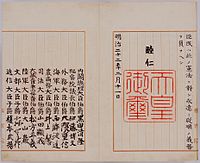
Seal of the Emperor of Japan ( п 璽, ぎ ょ じ ) , [ gʲoːd͡ʑi ] - the official seal of the Emperor of Japan , one of the symbols of his power. Used to approve government documents. After the defeat of Japan in World War II and the adoption of a new Constitution , which limited the rights of the Emperor, has ceremonial significance.
Content
Quick Details
The imperial seal of Japan is made of pure gold in the form of a cube , a side height of 9.09 cm and a weight of 3.55 kg. It contains a cliche with the hieroglyphic inscription "The Seal of His Majesty the Emperor of Japan " ( Japanese 天皇 御 璽 ) . The expression " Seal of His Majesty " ( 御 璽 я ) , consisting of two characters, located on the left, and the phrase " Emperor of Japan " ( 璽 皇 ) , also consists of two characters located on the right. The imperial seal has approximately the same parameters as the State Seal of Japan .
The first mention of the use of the Imperial Seal dates back to the 8th century. Its parameters were determined by the Taiho Code . The seal had the shape of a square cube, side height 9.09 cm. It was made of copper or bronze . Other seals in the country could not be larger than the seal of the Emperor.
Due to frequent use, the Imperial Seal has been repeatedly remade. Its final form was approved in 1874 , during the Meiji restoration . In the Japanese Empire , the Minister of Press was responsible for the storage and use of the Imperial Seal . After 1945, it was led by employees of the Office of the Imperial Court of Japan . The seal is stored in a special leather case wrapped in lilac and white silk scarves. As well as for the State Press, cinnabar red is used for its prints. According to tradition, the print of the stamp partially steps on the signature .
See also
- Imperial Seal of Japan
- Seal of the Japanese State
- Seal of the Khan's Wang of the Japanese country On
Literature
- Printing (in Japanese) // Encyclopedia of Nipponica : 26 vol. 2nd edition. - Tokyo: Shogakkan, 1994-1997.
Links
- Decree on the Production of the Emperor's Seal (Jap.) // National Parliamentary Library of Japan