Lap [1] [2] - Russian two-row diatonic hand harmonica [3] .
| Lame | |
|---|---|
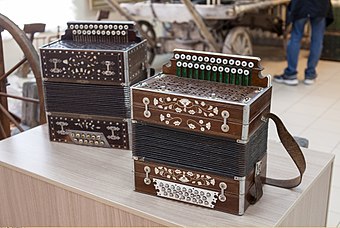 Keyboards with 23 × 12 and 25 × 25 keyboards | |
| Classification | Hand harmonica |
Content
History
Created at the beginning of the XX century in Vologda by the master Nikolai Vladimirovich Smyslov. Originally had the name "Northerner". Unlike the already existing two-row “German” and “Vienna” harmonics [4] , the sound of the “northerner” did not depend on the direction of movement of the fur. The chromatic harmonics (button accordions) had the same property; due to this similarity, the northerner began to be called lame [1] . After about 10-15 years, she gained popularity among the people [5] .
In 1925–30, lame completely replaced Vienna (“wreath”) and other types of harmonies from mass use [6] , becoming the main type of diatonic harmony in Russia to date [7] .
Keyboards
At the beginning of its appearance, on the right keyboard there were 21 keys, on the left keyboard there were 12 keys with separate sounds (basses) and chords (diagram 3) . After a long period of time, 23 keys were placed on the right keyboard. Currently, the most common type of harmony of lameness is lameness with 25 keys in the right and 25 keys in the left keyboard (symbol: 25 × 25 ) [1] .
The lame harmony has a certain, of several possible tonality, for example, La, Do, Re, Fa - this means the tonality of the major scale , which can be extracted in harmony.
Note : the examples of notes given below correspond to harmony with the key of To .
Despite its name, the lame harmonium (short for the word chromatic ) is a diatonic musical instrument, that is, the scale of this harmony is based on the diatonic natural major (and parallel minor ) scale. The major scale has notes: Do, Re, Mi, Fa, Sol, La, Si ; minor scale: A, C, Do, Re, Mi, Fa, Salt .
The vertical rows of buttons on the right and left keyboards are numbered, starting from the fur.
Right
| 2 | one |
|---|---|
| Mi 2 | |
| Fa 2 | |
| Salt 1 | |
| Re 1 | |
| Up to 1 | |
| Fa 1 | |
| Mi 1 | |
| La 1 | |
| Salt 1 | |
| Up to 2 | |
| Si 1 | |
| Mi 2 | |
| Re 2 | |
| Salt 2 | |
| Fa 2 | |
| Si 2 | |
| La 2 | |
| Re 3 | |
| Up to 3 | |
| Fa 3 | |
| Mi 3 | |
| La 3 | |
| Salt 3 | |
| Up to 4 | |
| Si 3 | |
Scheme 1. Legend: the subscript next to the notes indicates the octave number.
A melody is played on the right keyboard. The number of vertical rows of buttons is 2, the number of buttons is 25.
The range of the right keyboard is three major scales (3 incomplete octaves ), the tone of which corresponds to the harmony tone: sounds from To the first octave to To the fourth octave.
Separately, at the very top of the keyboard, there are 3 additional chromatic ( altered ) sounds: Soldier of the first octave, Mibemole and F-sharp of the second octave. Lame with 27 keys in the right keyboard, in addition to the indicated sounds, C sharp and B flat are added.
Number of votes
Lamenesses differ in the maximum number of simultaneously sounding reeds (voices) when you press one button on the right keyboard. Harmonies with more than one voice have different reed settings: drill tongues with bottling sound a little higher than drill ones , octave lower than drill ones by an octave, piccolo higher than drill ones by an octave.
| Type of harmony | Combatant | Combatant with bottling | Octave | Piccolo |
|---|---|---|---|---|
| 2 voice | one | one | ||
| 3 voice | one | one | one | |
| one | one | one | ||
| 4 voice | one | one | one | one |
Left
| |||||||||||||||||||||||||||||||||||||||
| |||||||||||||||||||||||||||||||||||||||
Schemes 2 and 3. Legend: B - major triad, M - minor triad, 7 - seventh chord. The notes are a large octave .
The accompaniment for the melody ( accompaniment ) is performed on the left keyboard. The number of vertical rows of buttons is 3, the number of buttons is 25.
The range of the left keyboard is one major scale (bass (low) notes from Do to C of a large octave ), the key of which corresponds to the key of harmony, and one chromatic sound of F-sharp .
The first vertical row of buttons (the one closest to the fur) is called auxiliary , it contains buttons only with certain bass sounds that repeat, except for the topmost F-sharp button, in the other two vertical rows of the keyboard. The sounds of A and D are duplicated three times. Duplication of buttons is necessary for the convenience of playing the accordion.
In addition to individual bass sounds, the left keyboard also has buttons, when pressed, a whole chord sounds, namely:
- Three major triads : Fa, Do, Salt - in the third row.
- Two minor triads : Re, La - in the second row.
- Three seventh chords : Re - in the third, Mi, C - in the second row.
A simplified view of the cripple [9] in the left keyboard has 12 buttons with 6 notes and 6 chords: 2 major and minor triads from the tonic and subdominant , and 2 dominant Sept chords (Scheme 3) . There are 21-23 buttons in the right keyboard. It was widely distributed in Russia and Ukraine. It was made during the times of the USSR by Rosmuzprom-Armavir Factory. The price was 26 rubles.
Artists
- Zavolokin, Gennady Dmitrievich
- Pleshivtsev, Ivan Antonovich
- Rasteryaev, Igor Vyacheslavovich
- Shipkov, Igor Vadimovich
Notes
- ↑ 1 2 3 Mirek A. Handbook of harmonics, 1968 .
- ↑ Fadeev, Kuznetsov, 1971 .
- ↑ Musical Encyclopedia, 1982 .
- ↑ Mirek A. Harmonica Handbook, 1968 , Two-row German and Vienna harmonics, p. 69-72.
- ↑ Mirek A. Reference to the harmonics circuit, 1992 , p. 31.
- ↑ Fadeev, Kuznetsov, 1971 , p. 13.
- ↑ Rosenfeld N.G., Ivanov M.D. Harmonies, button accordions, accordions. - 2nd ed., Rev. and add. - M .: Light Industry, 1974. - S. 15. - 288 p.
- ↑ Kuznetsov L.A. Acoustics of musical instruments. - M .: Legprombytizdat, 1989 .-- S. 270. - 368 p.
- ↑ Fadeev, Kuznetsov, 1971 , p. 45.
Literature
- Mirek A.M. Lame // Handbook of harmonics. - M .: Music, 1968. - S. 75-78. - 131 p.
- Mirek A.M. Northerner-lame // Reference to the harmonics circuit. - M .: Alfred Mirek, 1992 .-- S. 31 .-- 60 p.
- Banin A.A. Harmonious lame // Russian instrumental music of folk tradition. - M .: State. rep. center rus. folklore, 1997 .-- pp. 168-174. - 247 p.
- Fadeev I.G., Kuznetsov I.A. Repair of harmonics, button accordions and accordions. - 2nd ed., Rev. and add. - M .: Light Industry, 1971. - S. 3-16, 44-48. - 246 p.
- Lame // Musical Encyclopedia. - M .: Soviet Encyclopedia, 1982. - T. 6. - S. 92. - 1008 p.