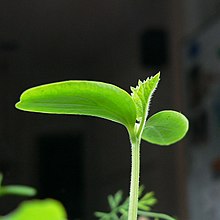
Shoot ( lat. Córmus ) - one of the main vegetative organs of higher plants , consisting of a stem with leaves and buds located on it.
Content
- 1 Escape phylogenesis
- 2 Ontogenesis of escape
- 3 The main organs of escape
- 4 Features of shoot growth
- 5 Branching shoots
- 5.1 Branching types
- 5.1.1 Dichotomous branching
- 5.1.2 Monopodial branching
- 5.1.3 Sympodial branching
- 5.2 Evolution of branch types
- 5.1 Branching types
- 6 Modifications of shoots (metamorphosis)
- 6.1 Modification of underground shoots
- 6.2 Modifications of aboveground shoots
- 7 See also
- 8 Notes
- 9 Literature
- 10 Links
Escape Phylogenesis
In phylogenesis, shoots arose as an adaptation to the terrestrial way of life as a result of the transformation of leafless cylindrical organs - telomes - in rhinophytes . The emergence of shoots (i.e., leafy stems) is the largest aromorphosis in the history of the plant world on Earth. Due to the flat shape of the leaves, the photosynthetic surface increased dramatically, and the associated increase in transpiration contributed to the development of true roots in plants as perfect organs for absorbing water and mineral salts.
Escape Ontogenesis
In ontogenesis, the shoot develops from the kidneys of the embryo or from the axillary or accessory (adventitious) kidney . Thus, the kidney is an embryonic shoot. When a seed germinates from an embryonic kidney , the first shoot of a plant is formed - its main shoot , or a first-order shoot .
Side shoots , or shoots of the second order , are formed from the main shoot, and when the branching is repeated, they are of the third order, etc.
The adnexa are formed from the adnexa.
Thus, a system of shoots is formed, represented by the main shoot and side shoots of the second and subsequent orders. The shoot system increases the total area of contact of the plant with the air.
Depending on the function performed, vegetative, vegetative-generative and generative shoots are distinguished. Vegetative (non-modified) shoots, consisting of a stem, leaves and buds and vegetative-generative (partially modified), additionally consisting of a flower or inflorescence , perform the functions of air nutrition and provide the synthesis of organic and inorganic substances . In generative (fully modified) shoots, photosynthesis most often does not occur, but sporangia are formed there, the task of which is to ensure the reproduction of the plant (a flower also belongs to such shoots).
The shoot on which the flowers are formed is called a flower stalk , or flower stalk (sometimes the term "flower stalk" is understood in a narrower sense - as a section of the stem on which the flowers are located).
Major escape organs
An vegetative unmodified shoot is a single organ of a plant, consisting of a stem , leaves and buds , formed from a common array of meristem (shoot cone) and having a single conductive system. The stems and leaves, which are the main structural elements of the shoot, are often regarded as its constituent organs, that is, second-order organs. In addition, the obligatory accessory of the shoot is the kidney. The main external feature that distinguishes the shoot from the root is the presence of leaves.
Escape is characterized by metamerism , that is, the alternation of the same parts - metamers . The leaves are arranged on the stem in a certain order, in accordance with the type of leaf arrangement , and the section of the stem at the level of leaves leaves is called a node . If the base of the leaf completely surrounds the stem, the node is called closed, otherwise open. The spacing of the stem between adjacent nodes is called internodes . Each repeated segment of the shoot, which includes a node with an internode located under it, as well as leaves and buds located on this segment, is called a metamer. The angle between the leaf and the overlying internode is called the leaf sinus, or leaf sinus.
Features of shoot growth
In the seasonal climate of temperate latitudes, the growth and development of shoots from the kidneys is periodic . In shrubs and trees , as well as in most perennial grasses, this happens once a year - in spring or early summer, after which wintering buds of the next year are formed, and at the end of summer - in the autumn, the growth of shoots ends. Shoots growing from buds for one vegetative period once a year are called annual .
However, the formation of new shoots from the kidneys during the astronomical year can be repeated. In plants, when their vegetation cycle consists of several periods of growth, separated by weakly expressed periods of dormancy, growing shoots are called elementary . So, two elementary shoots per year are often formed in oak : the first - in the spring, the second - in the middle of summer; shoots of the summer period are called Ivanovo . At citrus fruits , tea bush , many tropical trees, 3–7 elementary shoots are formed per year. In many perennial herbs, annual and elementary shoots are not clearly distinguished.
The shoot system of grassy polycarpics consists of shoots that, after fruiting, do not die off completely, and their basal areas with renewal buds are preserved. These are the so-called monocarpic shoots . Depending on the length of the period from the opening of the buds to fruiting, they are divided into monocyclic (the developmental cycle of the shoot ends within one growing season), dicyclic (two years) and polycyclic (three or more years). Shoots, dying, not reaching flowering and fruiting, are called shoots with an incomplete development cycle .
Branching shoots
Branching is the process of formation of new shoots and the nature of their mutual arrangement on the stem, perennial branch and rhizome [1] .
Since the shoot is an axial organ, it has an apical meristem , which provides an unlimited increase in length. Such growth is accompanied by more or less regular branching of the shoot. In lower plants, as a result of branching, a branched thallus (thallus) appears, in higher plants , shoot and root systems are formed. Branching allows you to repeatedly increase the photosynthetic surface and provide the plant with organic substances.
Branching Types
In various plants, several types of branching are observed: dichotomous , monopodial , sympodial . With dichotomous branching, the growth cone splits in two. With monopodial branching, the apical kidney functions throughout life, forming the main shoot (first-order axis), on which second-order axes develop on the acropetal sequence, third-order axes develop on them, etc. During sympodial branching, one of the upper axillary buds forms the axis second order, which grows in the same direction as the axis of the first order, shifting to the side of its dying part. Such a division was first proposed by the German botanist Pfitzer at the end of the 19th century.
Dichotomous branching
Dichotomous branching is the most primitive type of branching; it is observed both in lower plants and in some higher plants (for example, in Mosses [2] , Plainaids [3] , and some vascular spores [4] ). With dichotomous branching, the growth cone is divided in two, the newly formed apexes are also divided in two, and so on.
There are so-called isotomic dichotomous branching (the formed branches are equal in size) and anisotomic (in which the formed branches are unequal) [1] .
Monopodial Branching
Monopodial branching is the next stage in the evolution of branching shoots. In plants with a monopodial type of shoot structure, the apical bud remains throughout the shoot life. The monopodial branching type is often found among gymnosperms [5] , and also occurs in many angiosperms (for example, in many species of palm trees , as well as plants from the Orchidaceae family - gastrochilus , phalaenopsis, and others). Some of them have a single vegetative escape (for example, Phalaenopsis is pleasant ).
Monopodial plants - the term most often used in the description of plants of tropical and subtropical flora, as well as in the popular science literature on indoor and greenhouse floriculture .
Monopodial plants can vary significantly in appearance. Among them there are rosette, with an elongated shoot, bushy.
Phalaenopsis braceana . Botanical illustration from JD Hooker; A Century of Indian Orchids, 1895
Phalaenopsis amabilis . Botanical illustration from a book
Frederick Sander, Reichenbachia I, 1888Gastrochilus pseudodistichus . A botanical illustration from G. King and R. Pantling. The Orchids of the Sikkim-Himalaya, 1898
Vanda cristata . A botanical illustration from Curtis's botanical magazine vol. 73 ser. 3 nr. 3 tab. 4304, 1847
Sympodial branching
In plants with a sympodial type of shoot structure, the apical bud , upon completion of development, dies or gives rise to a generative shoot. After flowering, this shoot no longer grows, and a new one begins to develop at its base [6] . The shoot structure in plants with a sympodial branching type is more complicated than in plants with a monopodial type ; sympodial branching is an evolutionarily more advanced type of branching. The word "sympodial" is formed from dr. Greek. συν- (“together”) and πούς (“leg”).
Sympodial branching is characteristic of many angiosperms: for example, linden , willow [7] and many orchids .
In orchids, in addition to apices, in some sympodial orchids lateral inflorescences also form, developing from buds located at the base of the shoot ( Pafinia crestus ). The part of the shoot pressed against the substrate is called a rhizome. It is located, as a rule, horizontally and does not have real leaves, only scaly. Reduced, almost indistinguishable rhizome occurs in many masdevalliums, dendrobiums and oncidiums; clearly distinguishable and thickened in Cattleya and Lelia, elongated in Bulbofillum and colegin, reaching 10 or more centimeters. The vertical part of the shoot is often thickened, forming the so-called tuberidium , or pseudobulb. Pseudobulbs can be of various shapes - from almost spherical to cylindrical, conical, club-shaped and elongated, resembling reed stems. Pseudobulbs are storage organs.
Sympodial plants - the term most often used in the description of plants of tropical and subtropical flora, as well as in the popular science literature on indoor and greenhouse floriculture .
Bulbophyllum grandiflorum . Curtis's botanical magazine vol. 127 ser. 3 nr. 57 tab. 7787, 1901
Cirrhopetalum macraei . Curtis's botanical magazine vol. 127 ser. 3 nr. 57 tab. 7787, 1901
Oncidium dasystyle . Curtis's botanical magazine vol. 127 ser. 3 nr. 57 tab. 7787, 1901
Dendrobium senile . Curtis's botanical magazine vol. 127 ser. 3 nr. 57 tab. 7787, 1901
At the first stages of evolution, the apical meristems of both branches of each fork grow at the same rate, which leads to the formation of identical or almost identical daughter branches. Such equal dichotomy (isotomy) is the initial type of dichotomous branching. It was characteristic of some rhinophytes, but it is also found in some modern plaid-like and fern-shaped, as well as in the psilot ( Psilotum ). As a result of the uneven growth of two daughter branches, when one of the branches is slightly ahead of the other, an equal dichotomy turns into an unequal dichotomy (anisotomy), which is very clearly expressed in the primitive extinct Devonian genus, chorneophyte ( Horneophyton ).
Branch Type Evolution
Modifications of shoots ( metamorphosis )
Escape is the most variable organ of the plant in appearance. This is due not only to the general multifunctionality of the autonomic organs that arose in the process of evolution , but also to the changes that occur during the ontogenesis of plants, due to adaptation to a variety of environmental conditions, and in cultivated plants under the influence of humans.
The range of shoot metamorphoses is very wide: from a slight deviation from a typical structure to strongly altered forms. The main and lateral shoots of plants, buds and leaves can be metamorphosed.
The main type of shoot of a green plant is an aerial (air) assimilating shoot, bearing green leaves of the middle formation on the axis. However, assimilating shoots are not the same. Often, along with the main function of photosynthesis in these shoots, there are others: deposition of reserves and support function (mostly in perennial stems), vegetative propagation (creeping shoots, lashes).
Modification of underground shoots
The shoots living underground, under the influence of a complex of conditions that are very different from the terrestrial environment, almost completely lost the functions of photosynthesis and acquired other, no less important vital functions, such as contributing to the transfer of the adverse period, storage of nutrients, vegetative renewal and reproduction of plants. Underground modified shoots include: rhizome , caudex , underground stolon and tuber , bulb , corm .
Rhizome , or rhizome , is an underground shoot with scaly leaves of the lower formation, buds, and accessory roots. Thick, highly branched creeping rhizomes are typical for wheatgrass , short and rather fleshy for baten , iris , very thick for egg capsules , water lilies .
Caudex is a perennial organ of the shoot origin of perennial grasses and shrubs with a well-developed stem root that lasts throughout the life of the plant. Together with the root, it serves as a place for the deposition of reserve substances and bears on itself many kidneys of renewal , some of which may be dormant. There are a lot of Caudex plants among umbellate ( femur , ferula ), legumes ( alfalfa , lupins ), and Asteraceae ( dandelion , wormwood , and rough cornflower ).
Underground stolon - an annual elongated thin underground shoot with underdeveloped scaly leaves. At the thickened ends of the stolons, plants can accumulate reserve substances, forming tubers or bulbs ( potatoes , hedgehogs , adoxa ).
Stem tuber is a modified shoot with a pronounced storage function of the stem, the presence of scaly leaves that peel off quickly, and buds formed in the axils of the leaves and called the eyes ( potatoes , Jerusalem artichoke ).
Bulb is an underground (less often above-ground) highly shortened specialized shoot in which reserve substances are deposited in leafy scales and the stem is transformed into the bottom . The bulb is a typical organ of vegetative renewal and reproduction. Bulbs are characteristic of monocotyledonous plants from the family Liliaceae ( lily , tulip , onion ), Amaryllis ( amaryllis , daffodil , hyacinth ) and others. As an exception, they are also found in dicotyledons - in some types of sour and ginger .
Corm is a modified underground shortened shoot with a thick stem storing assimilates , adventitious roots growing on the underside of the corm, and the remaining dried leaf bases (membranous scales), which together constitute a protective cover. Corms have colchicum , gladiolus , ixia , saffron .
Modifications of aerial shoots
An unusual way of life and / or adaptation to the special conditions of the existence of plants lead to various modifications of the shoots. At the same time, shoots can serve not only for storing nutrients, reproduction and reproduction of plants, but also perform other functions. There are frequent cases when not the entire shoot is modified, but only its leaves, and some of their metamorphoses are outwardly and functionally similar to shoot metamorphoses ( spines , antennae ).
Elevated stolons and whiskers - a metamorphosis of the shoot , which serves for vegetative propagation, is a sympathy consisting of elevated shoots of vegetative propagation of aerial order. Serves to capture the area and resettlement of daughter individuals . For example, in a perennial whip (Ajuga reptans) , it carries green leaves, participates in photosynthesis , and the reproduction function in this way is not the only one. But in some plants, such shoots are specialized exclusively for propagation - they do not carry green leaves, they are thin and fragile, they have very elongated internodes , and after rooting of their apical bud, they quickly collapse. An example is the mustache of wild strawberries (Fragaria vesca) .
Thorn - a highly ligniferous leafless, shortened shoot with a sharp tip. Spines of shoot origin mainly perform a protective function. In wild apple trees , wild pears , laxative buckthorn ( Rhamnus cathartica ), shortened shoots with limited growth and ending with a spike turn into thorns. In Gleditsia ( Gleditschia triacanthos ), powerful branched thorns are formed on trunks from sleeping buds. Many species of hawthorn have spines formed from axillary buds of leaves, which topographically corresponds to lateral shoots.
Antenna - a bundle-like, branched or unbranched shoot of a metameric structure, typically deprived of leaves. Stem antennae, as a highly specialized shoot, perform a supporting function. The non-branching straight part of the antennae is the first internode of the axillary shoot, and the twisting part corresponds to the leaf. Antennae are characteristic of plants that cannot independently maintain a vertical (orthotropic) position. In the blue passionflower ( Passiflora edulis ), the antennae are axillary shoots of monopodia located in the axils of the leaves, like flowers. The branched tendrils of grapes ( Vitis ) are the ends of the lateral shoots of monochasia . In girlish grapes ( Parthenocissus ), the ends of the antennae are transformed into attachment suckers . Antennas of shoot origin are also formed in representatives of the Pumpkin family ( cucumber , melon , watermelon , pumpkin ).
Head of cabbage is a succulent organ formed in ordinary cultivated cabbage. The adaptive shape of the head arose as a modification of part of the outlet.
Cladody is a modified lateral shoot that has the ability to grow for a long time, with green flat long stems that act as a leaf . As an organ of photosynthesis , cladody has a well-developed chlorophyll- bearing tissue located under the epidermis . Platoid plants include clover mullenbeckia ( Muehlenbeckia platyclada ), Decembrist cactus ( Zygocactus truncatus ), southern karmichelia ( Carmichaelia australis ), collection ( Colletia cruciata ) and prickly pear ( Opuntia ).
Phyllocladium is a modified leaf-shaped flattened lateral shoot that has limited growth and functions as a leaf. Phyllocladia develops from the lateral kidneys, so it is always in the sinus of a small membranous or scaly leaf. Performing the function of photosynthesis, shoots of phyllocladia and externally acquire similarities with the leaf, which is manifested in limited growth and complete loss of the metameric structure. The phenomenon of phyllocladium is characteristic of plants such as needle tree , bold , species of the genera Asparagus , phyllanthus ( Phyllanhtus ). Phyllocladia is found not only in angiosperms , but also in some gymnosperms , in particular, in a coniferous plant from the family Noglodniknye - phyllocladus .
Rosette shoots - a) shoots with greatly shortened internodes, as a result of which all leaves are arranged in the form of a rosette. There are basal rosettes , such as for plantain (Plantago) , and bracts , like cyperus (Cyperus)
b) abnormal shoots formed on pines as a result of harm caused to pines by some harmful insects, for example, a nun butterfly , etc. such shoots are extremely short and have bundles of short and wide needles.
Rosette shoot: basal rosette (Plantago lanceolata)
Rosette Escape: Bract Rosette (Cyperus diffusus)
Phyllochladia in the needle (Ruscus aculeatus)
Head of cabbage (Brassica oleracea)
Cladody at Mühlenbeckia (Muehlenbeckia complexa)
See also
Short shoots
Notes
- ↑ 1 2 Branching // Biologyː Encyclopedia / Ed. M.S. Gilyarova. - M .: Big Russian Encyclopedia, 2003 .-- S. 93b . - ISBN 5-85270-252-8 .
- ↑ http://www.int-res.com/articles/meps/206/m206p135.pdf
- ↑ Plaunaid (Inaccessible link) . Date of treatment January 15, 2009. Archived on October 25, 2011.
- ↑ Root, stem and leaf // Biological Encyclopedia
- ↑ Branching plants
- ↑ Symposium / from Greek sýn - together and pús genus case podós
- ↑ Branching
Literature
- Andreeva I.I., Rodman L.S. Botanika. - M .: KolosS, 2005 .-- S. 172-175. - 3,000 copies. - ISBN 5-9532-0114-1 .
- Barabanov E.I., Zaichikova S.G. Botany: Textbook. for stud. universities. - M .: Publishing Center "Academy", 2006. - S. 82-85. - 3,000 copies. - ISBN 5-7695-2656-4 .
- Botany. Textbook for high schools: in 4 vol. T. 1. Cellular biology. Anatomy. Morphology. Based on the textbook of E. Strasburger / Ed. A.K. Timonina, V.V. Chuba. - M .: Publishing Center "Academy", 2007. - T. 1. - S. 261-266. - 3,000 copies. - ISBN 978-5-7695-2744-9 .
- Botany with the basics of phytocenology: Anatomy and morphology of plants: Textbook. for universities / Serebryakova T.I. et al. - M .: IKK Akademkniga, 2007. - P. 341—365. - 2,000 copies. - ISBN 978-5-94628-237-6 .
- Korovkin O. A. Anatomy and morphology of higher plants: glossary. - M .: Bustard, 2007 .-- 272 p. - ISBN 978-5-358-01214-1 .
- Lotova L.I. Botany: Morphology and anatomy of higher plants: Textbook. - M .: KomKniga, 2007 .-- S. 312—321. - 1,500 copies. - ISBN 978-5-484-00698-4 .
- Nukhimovsky E. L. Fundamentals of biomorphology of seed plants: Habitus and growth forms in the organization of biomorphs. - M .: Overlay, 2002 .-- T. 2 .-- 859 p. - 750 copies. - ISBN 5-85493-067-6 .
- Smirnova E. S. Morphology of orchid shoot systems. - M .: Nauka, 1990.
- Timonin A. K. Botanica: in 4 volumes. - M .: Publishing Center "Academy", 2007. - V. 3. - P. 52-69. - 3,000 copies. - ISBN 978-5-7695-3184-2 .
- Tropical and subtropical plants. Foundations of the Main Botanical Garden of the USSR Academy of Sciences (Cactaceae-Compositae). - M.: Science, 1976.
- Yakovlev G.P., Chelombitko V.A. Botanika: textbook. for stud. universities. - SPb. : Spetslit, publishing house SPKhFA, 2003. - S. 129-132. - 5,000 copies. - ISBN 5-299-00237-8 .
Links
- Escape - an article from the Great Soviet Encyclopedia .