Battle of Daegu - the battle between the UN and North Korean forces at the beginning of the Korean War , fighting continued from 5 to 20 August 1950 in the vicinity of the city of Daegu in South Korea . The battle was part of the battle for the Pusan perimeter and became one of a series of several large-scale battles that took place simultaneously. The battle ended with the victory of the UN forces after their troops repelled the offensive of the North Korean divisions, who were trying to cross the Naktong River and go to the storming of the city.
| Battle for Daegu | |||
|---|---|---|---|
| Main conflict: part of the defense of the Pusan perimeter , the Korean War | |||
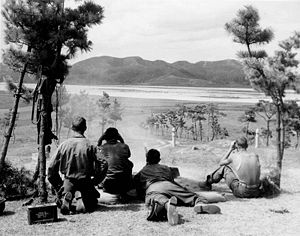 American machine gun crew 2nd baht., 7th regiment, 1st kav. The divisions are firing on North Korean patrols on the north bank of the Naktong River, August 26, 1950. | |||
| date | August 5–20, 1950 | ||
| A place | Daegu , South Korea | ||
| Total | United Nations victory | ||
| Opponents | |||
| |||
| Commanders | |||
| |||
| Forces of the parties | |||
| |||
| Losses | |||
| |||


Five divisions of the North Korean army gathered around the city in preparation for crossing the Naktongan River and attacking the city from the north and west. The city was defended by the first American cavalry division and the 2nd corps of the South Korean army. A series of battles followed in each of them. The North Korean divisions tried to cross the Naktongan River and attack a defensive enemy. The success of these attacks was different in some areas, in the sector defended by the 1st American Cavalry Division, the attacks were repelled. North Korean attacks on the South Korean sector were characterized by great success.
In the course of the battle, North Korean troops took American troops unawares at an altitude of 303 and captured them. At the end of the battle, prisoners were shot from machine guns (the so-called massacre at a height of 303 ). Despite this, the UN forces were able to drop most of the North Korean troops. A further battle to decide the fate of the city took place in the so-called. Bowling Valley.
Content
Preface
Start of War
During the North Korean invasion of the Republic of Korea (South Korea) and the beginning of the Korean War on June 25, 1950, the UN Security Council voted to send troops to defend South Korea. The United States, as a permanent member of the Security Council, immediately began deploying the armed forces (army, navy, and air force units) in the southeastern part of the Korean Peninsula . This was facilitated by the fact that the units were located near the bases in Japan and Okinawa , since they carried out the occupation of Japan (in 1952). The reinforcements from Australia , Canada , Greece , New Zealand , and Turkey were overseas and required more time to arrive.
The purpose of the Americans was to reinforce the forces of the South Korean Army that remained in the ranks in repelling the North Korean invasion (only in the southeastern part of the peninsula around the main seaport of Pusan ) to prevent the South Korean army and government from collapsing completely. Unfortunately, the American armed forces in the Far East declined significantly after the end of World War II (in August 1945). On the orders of Emperor Hirohito, the Japanese people did not put up obstacles to the American occupying forces; the Japanese restored their devastated country. By the mid-1950s, American troops were not present in South Korea. The number of US troops in Japan has fallen sharply.
By the time of the North Korean invasion, the 24th Infantry Division , stationed in Japan, was the nearest US ground unit. This division has never been fully equipped, most of its equipment is outdated due to cuts in military spending undertaken by Congress. However, the 24th Infantry Division, the only one from the American Army, could quickly come to the aid of South Korea [1] .
Thus, the 24th Infantry Division of the first of the American armed forces was sent to South Korea with the task of stopping the North Korean army and creating a protective perimeter around Busan ( Pusan perimeter ) with the help of the Air Force, Navy and Marine Corps. General Douglas MacArthur, UN High Commander in the region, decided that US and South Korean forces should dig around Busan and hold on until he gathered a powerful army (10th Corps of the US Army) to conduct a mechanized landing of troops in Incheon , in the north-western part of South Korea , near Seoul at the end of 1950. Since that time, the 24th Infantry Division, together with the South Korean allies, has been left alone for several weeks [2] . The Americans and South Koreans held the Pusan perimeter, waiting for reinforcements and launching a counterattack against the North Koreans.
Among the arriving US units that strengthened the Pusan perimeter were the 1st American Cavalry Division (of course without horses), the 7th Infantry Division, and the 25th Infantry Division, along with other parts of the 8th US Army, providing logistics, medical and intelligence support [2] . The advance units of the 24th Infantry on July 5 suffered a heavy defeat in the battle of Osan (the first clash between the American and North Korean troops) [3] . The first month after the Battle of Osan, the 24th Division was thrown back and retreated under the pressure of surpassing the number of North Korean troops equipped with T-34 tanks (made in the USSR and formerly one of the main Soviet tanks during the Great Patriotic War ) [4] [5] .
The troops of the 24th Division were systematically rejected to the south-east in the battle of Chochhivon, the battle of Chonan, and the battle of Pyongthek , as in the smaller armed clashes [4] . The 24th Division offered desperate resistance in the battle for Daejeon and suffered heavy losses, but it managed to hold off the North Korean offensive until July 20. [6] . By this time, the number of combat forces of the Eighth Army was approximately equal in size with the North Korean forces continuing attacks on the Pusan perimeter, while fresh UN forces from America, Australia, New Zealand and other countries arrived almost daily [7] .
North Korean offensive
With the fall of Daejeon, the North Korean army began to surround the Pusan perimeter in the north and west in an attempt to crush it. The 4th and 6th North Korean divisions were advancing south with a wide flank maneuver. These two North Korean divisions attempted to bypass the forces of the United States and South Korea from the left flank and capture Busan from the southwest, but during the maneuver the North Korean forces stretched. They were also subjected to repeated air attacks from the US Army and Navy. North Korean troops attacked the Americans with superior forces with the support of T-34 tanks, but the UN troops with the help of aviation and fleet units were able to stretch the Pusan perimeter south to the East China Sea and repel all North Korean attacks on Busan [8] . Perhaps the decisive factor that ensured the retention of the Pusan perimeter was the air superiority of American aircraft using airfields in Japan and aircraft carriers of the 7th fleet in the Sea of Japan .
American troops were thrown back until they were able to finally stop the North Korean offensive in a series of battles on the edge of the Pusan perimeter. On July 27, the forces of the 3rd Battalion of the 29th Infantry Regiment, who had recently arrived at the Korean Theater, were ambushed and defeated near the village of Hadon, which opened the way to Busan for further North Korean attacks [9] [10] . Soon after that, the North Koreans took Jinju, which further increased access for the KPA to the Pusan area [11] . On August 2, the American forces managed to smash and throw the North Koreans back in the battle for the Night. After suffering heavy losses, the North Korean units retreated to the west, where they were reformed for several days and received reinforcements. Both sides used a breather to prepare for new battles for the Pusan perimeter [12] [13] .
Daegu
Meanwhile, the commander of the Eighth Army, Lieutenant-General Walton Walker, located his headquarters in Daegu [14] , which was located to the right of the center of the Pusan perimeter line and is the exit to the valley of the Naktongan River , through which large masses of North Korean troops could advance, supporting each other. The natural barrier in the form of the river Naktongan in the south and the mountains in the north are closed around Daegu, which was the main transportation hub and the last major South Korean city inside the Pusan perimeter remaining under the control of UN forces [15] . From the north to the south, the city was defended by the 1st Cavalry Division of the US Army , the 1st and 6th South Korean Infantry Divisions as part of the 2nd Infantry Corps. The 1st Cavalry Division of the US Army was stretched in a long line in the south along the Naktongan River, its regiments: the 5th and 8th Cavalry held the 24-kilometer line along the river to the south of Vagwan , turned to the west. The 7th Cavalry Regiment, holding the position to the east, was waiting in reserve with the artillery, ready at any moment to come to the aid where the enemy could try to force the river. The 1st South Korean Division held the northwestern line in the mountains north of the city and the 6th South Korean division held a position in the east, defending a narrow valley through which the road to Kunvi went inside the Pusan perimeter [16] .
Five North Korean divisions were concentrated against the UN forces at Daegu: the 10th [17] , the 3rd, 15th, 13th [18] and the 1st were occupying a broad line from south to north surrounding Taegu from Tucsong-dong and around Vagwan to Kunwi [19] The command of the North Korean army planned to use the natural corridor in the form of the Naktongan valley from Sangju to Daegu as the main axis of the further advance to the south. The North Korean divisions had to go through the valley and cross the Naktongan River in several places through the lowlands of the area [20] . The attack was supposed to support the 105th North Korean armored division [16] [21] .
Battle
On the night of the 4th to the 5th of August, the 13th North Korean Division began crossing the Naktong River at Naktong-ni, 64 km north-west of Daegu. The crossing was not opened until August 5, until South Korean artillery and mortars began firing, thus letting know about it. For three nights, North Korean soldiers from three regiments crossed the river on rafts or ford carrying weapons and equipment over their heads. By the 7th of August, the North Korean division in full force had crossed over and gathered a few miles from the position of the South Korean 1st Division, which was preparing for defense [16] .
At this time, from the 6th to the 8th of August, the 1st North Korean Division crossed by barges across the river between Hamchang and Sanju in the sector of the 6th South Korean Division. This advance was immediately detected by American reconnaissance aircraft and the 1st North Korean division immediately engaged the South Korean forces. Two divisions fought in the battle of Kunvi until August 17th, the North Korean division met with strong resistance, was subjected to powerful air attacks and suffered heavy losses [16] .
Initial maneuvers
The South Korean forces immediately attacked the 13th North Korean division after it had completed the crossing, throwing the scattered North Korean forces into the mountains. The division reassembled in the east and launched a concerted night attack, broke through the South Korean defenses and launched an offensive, being 20 miles southeast of Naktong-ni on the main road to Daegu. During the week, the 1st and 13th North Korean divisions concentrated in the Tabu-dong area 24 km north of Daegu [22] .
On August 5, the 15th North Korean division, the next of the North Korean divisions on the line to the south, received 1500 reinforcements from Kumchon, its strength increased to 6500 soldiers. The next day, the 45th regiment of this division went north-east to the Naktongan River, on August 7th it passed through the Sonsan and crossed the river to the southeast of this city, being attacked by American aircraft. Crossing the river, the regiment headed for the mountains and initially met no resistance. The 48th and 50th regiments of the 15th division of the DPRK army left Kumchon later and before dawn on August 8th they began to cross the Naktong river between Indong and Vaghwan, collecting underwater bridges to cross their vehicles. The North Koreans supported the crossing of tanks by direct fire from the west by fire. The 15th North Korean division captured the heights of 201 and 346 on the east bank of the river at the crossing, and then began to move east to the mountains towards Tabu-dong (11 km from there) [22] . The next day, the 1st South Korean Division again captured the heights at the crossing and drove the North Korean forces further to the mountains. From the 12th to the 16th of August, three regiments of the 15th North Korean division joined on the east side of the Naktong River near Juhak-san, 8 km east of the crossing and 4.8 km north-west of Tabou Dong. The 13th North Korean division entered into battle with the 1st South Korean division that had blocked its advance in Juhak-san [23] [24] .
To the south of Vagwan, more than two North Korean divisions stood ready to cross the Naktongan River in a coordinated attack with the participation of divisions in the north [23] . The battle-hardened 3rd North Korean division, concentrated near Sondju, and the undetermined 10th North Korean division, concentrated in Koryon district, were ready to attack. [25] . They crossed into the sector of the 1st American Cavalry Division. On August 9, at 03:00, the 7th regiment of the 3rd North Korean division began to cross at Noche, 3 km south of the bridge in Vaghwan [23] . Having discovered the crossing of part of the 5th American Cavalry Regiment, they opened fire with automatic weapons at the North Koreans and demanded artillery shelling at the already adjusted positions at the crossing [25] . Although the North Korean regiments suffered some losses, the advance units reached the eastern shore and moved inland towards the mountains. Half an hour later, the 8th and 9th regiments began crossing to the south [23] . The 5th Cavalry Regiment, fully alert, noticed and exterminated parts of two North Korean regiments, throwing them back to the west bank [25] . Only a small part of the North Koreans reached the east coast. The following night, some were captured by UN troops, while others disappeared and retreated across the river [23] .
Fight for heights 268
At dawn on the 9th of August, the division commander, Major General Hobart R. Gay, who was at the headquarters of the First Cavalry Division in Daegu, learned that the enemy was crossing the river in the area of his division south of Vagwan. The first reports were unreliable, and General Gay decided to suspend counterattacks until the situation was clarified [26] . He soon learned that about 750 North Korean infantry gathered at an altitude of 268 (also known as Triangulation Hill) for triangulation 4.8 km southeast of Vaghwan and 16 km northwest of Daegu [27] . General Gay ordered the division to attack the enemy and throw him over the river. Generals Gay and Walker thought that this North Korean attack could be distracting and that the enemy could undertake a larger attack in the north. The main Korean road from north to south and the main railway Seoul-Pusan skirted the height of 268 [26] .
At 9:30, General Gay ordered the 1st Battalion of the 7th Cavalry Division to resist enemy penetration. The battalion moved out of its camp, located on the outskirts of Daegu, it was accompanied by 5 tanks of company A of the 7th heavy tank battalion. This motorized detachment proceeded to the sole of a height of 268. Meanwhile, the 61st Field Artillery Battalion subjected the height to heavy shelling [26] .
At 12:00 the artillery preparation height of 268 ended and the 1st battalion went on the attack with the order to continue the advance to the south-west to a height of 154. The height of 268 was covered with dense bushes 1.2 m high and trees 3 m high. The day was very hot and many American soldiers received heat strokes during the attack. The attack itself was not sufficiently coordinated with artillery fire. North Koreans repelled the attack.
The next morning, on August 10, air raids and shelling covered a height of 268, mowing down the North Korean battalion. General Gay ordered five American tanks to move along the road to Vagwan and fire back slopes from the north-west. The fire of tank guns found the North Koreans hiding from artillery fire by surprise. Caught between the two lights, they began to leave their positions. A further attack by the American infantry allowed them to occupy the altitude without much difficulty, by 4:00 pm the battle was over. The Americans moved artillery and mortar fire to the west, cutting off the retreat of the North Korean troops. The 61st Field Artillery Battalion covered white phosphorus shells in the village where the North Korean troops gathered, preparing to retreat and they had to move back to the American infantry, losing over 200 people. That evening, the 1st Battalion of the 7th Cavalry Division returned to the positions of the division and moved to the division reserve. Fighters of the 5th Cavalry Regiment finished stripping a height of 268 [28] .
During the two-day battle, the 1st Battalion of the 7th Cavalry Division lost 14 men killed and 48 wounded. The 7th regiment of the 3rd North Korean division was destroyed at altitude [28] . A total of 1000 fighters of the 7th regiment who crossed the river lost 700, most from artillery and mortar fire [27] . Turning to the east bank of the river Naktong, the regiment did not receive any food or ammunition [28] . On the night from 10 to 11 August, about three hundred survivors retreated to the other side of the river [27] . An attempt by the 3rd Division to cross the Naktongan River to the south of Vagwan ended in disaster. When the remnants of the 7th regiment joined the division on August 12, this once powerful unit was reduced and turned into a disorganized formation of 2500 fighters. The command of the North Korean army sent the division to the reserve for re-formation [27] [29] .
Crossing at Yong-on
The North Korean plan to attack Daegu from the west and south-west directions suggested that the North Korean 10th Division would launch a coordinated attack along with the 3rd North Korean division. The 10th Division, also far from proven in battle, left Sukchon on July 25 and reached the front by rail. In Cheonan, the division unloaded from the trains and traveled south on foot, proceeded through Daejeon, and on August 8 reached the Naktong River opposite Vagwan. The division received orders to cross the Naktong River near Tuksong-dong, penetrate east and cut the main supply artery of the UN troops from Busan to Daegu. On August 11, the division forces gathered at Koren [29] .
Two regiments of the 10th North Korean division (29th in the south and 25th in the north) were to take the assault, the 27th regiment remained in reserve. The 2nd Battalion of the 29th Regiment became the forward part of the division that crossed the river [30] and on the night of August 11-12, secretly for the UN, ford the river west of Hyonpon [27] . Then the battalion occupied a height of 265 on the northern spur of height 409 3.2 km south-west of Huongpong and installed machine-gun nests. The remaining two battalions proceeded behind the advanced battalion and occupied an altitude of 409. Soon the North Koreans occupying 409 were ambushed by a patrol of the 21st infantry regiment of the 24th American infantry division which moved north trying to establish contact with the 7th cavalry regiment during the battle for bridgehead at the river Naktongan, which was at that time further south [30] .
In the north, the 25th Regiment at 03:00 on August 12 began crossing the Naktongan River near Tucson-dong along the Koren-Daegu road. The 2nd Battalion of the 7th Cavalry Regiment covered the ferry area 23 km south-west of Daegu. By dawn, 300 or 400 North Koreans penetrated to Wichon-dong and engaged in close combat with the 2nd Battalion of the N. Company. North Koreans attacked firing automatic weapons and throwing grenades at the Americans. They managed to capture the advanced positions of the company, the post observation of mortar fire and the position of heavy machine guns. The North Koreans probably had orders to seize the heights east of Yong-po in order to provide cover for the crossing of the main units, which was to begin after this [30] . However, by 09:00, the 2nd Battalion, supported by the 77th Field Artillery and Aviation Battalion, rejected the North Koreans from Yong-po and dispersed them [27] .
Yong-by's Second Crossing Attempt
On three days, from 10 to 12 August, the Naktongan River became shallow due to the lack of rain and hot weather. The depth reached three feet, in many places the water reached the shoulders. This facilitated attempts to cross the river [21] [30] .
On the morning of August 14, the North Koreans began the crossing near the blown-up bridge between Tucson-dong and Yong-ref name = "Alex142" />. By 06:20, about 500 North Korean soldiers marched to Yong-po. Fifteen minutes later, the 2nd Battalion of the 7th Cavalry Division entered the battle with the North Koreans at Wichon-dong a mile from the crossing. At 08:00, General Gay ordered the first battalion of the seventh cavalry division to move to Jong-po and support the second battalion [31] .
North Korean artillery and tanks from the west bank of the river supported an infantry crossing with fire. A large number of North Koreans crossed the barges at the bridge under the strikes of American aviation and artillery. This attack also stalled, the North Koreans were able to advance farthest from Samuni-dong 2.4 km from the blown-up bridge. The combined fire of American light weapons, mortars and artillery threw the North Koreans back to the river [24] . By 12:00, large groups of North Koreans tried to move back to the west side of the river, but the American artillery continued to strike at them, inflicting heavy losses [31] .
By nightfall, the 7th Cavalry Regiment destroyed the North Korean bridgehead at the Young-po [31] . Only one ferry was crowned with success, the 25th and 27th regiments of the 10th North Korean division suffered heavy losses and crossed the river along the prepared ferry. According to the estimates of the command of the 7th Cavalry Regiment of the 1,700 North Koreans who tried to cross the river, 1500 died. Two days after the battle, Company H reported that they had buried 267 corpses in front of their lines. Company G counted in front of its position 150 enemy bodies. During the battle, the company lost only two dead and three wounded [32] . In its first combat mission to cross the Naktongan River, the 10th North Korean division lost 2500 fighters [27] [32] .
303 height
Almost simultaneously with the 10th North Korean division crossing the southern part of the sector of the 1st cavalry division near Tucson-dong and Yong-po, the North Korean units north of Vagwan on the border between the sectors of the 1st cavalry division and the 1st South Korean division attacked. The extreme position in the north of the right flank of the 1st cavalry division was occupied by company G of the 5th cavalry regiment. She held a height of 303, it was the most remote position on the edge of the right flank of the 8th Army. North was the 1st South Korean division, the first division on the line of the army of South Korea [32] .
For several days, reconnaissance of the combined forces received reports from their sources about the high concentration of North Koreans from Naktongan who were opposed to the 1st South Korean division. In the early morning of August 14, the North Korean regiment crossed the Naktongan River through an underwater bridge (located 9.7 km from Vagwan) in the sector defended by the 1st South Korean Division. In the afternoon, the North Koreans attacked the southerners, occupying a height north of the border with the American units. After sunset, the submarine bridge was partially destroyed by an airstrike. The North Koreans continued to attack further south and, at 12:00, fired at the positions of company G of the 5th Cavalry Regiment at a height of 303 of light rifle weapons. Instead of moving east (across the mountains to the plains), the North Koreans turned south and headed for Vagwan [33] .
At 03:30 on August 15, soldiers of company G, at an altitude of 303, noticed how fifty of North Korean infantrymen, supported by two T-34 tanks, moved south along the river valley to the base of the mountain. Another column was also seen moving around the rear of the Americans. This enemy convoy immediately entered into a shootout with company F. After receiving an order to avoid enemy encirclement, company F retreated to the south, but company G did not begin to retreat. By 08:30, the North Koreans had completed the encirclement of company G and its supporting platoon of mortar companies of company H at a height of 303. Thus, the Americans were cut off at the height. The deblocking column, composed of company B, the 5th cavalry regiment, and the American tank platoon attempted to break through to company G, but could not break through the North Korean ring around height 303 [33] .
Later that day, Company B, with the support of several tanks, attempted to recapture the height, which was already defended by a battalion of 700 soldiers. The 61st Field Artillery Battalion and units of the 82nd Field Artillery Battalion fired altitude all day. That night, company G was able to retreat from a height [34] . Before dawn on August 17, an American detachment made up of the 1st and 2nd battalions of the 5th Cavalry Regiment with the support of Company A of the 70th Tank Battalion attacked a height of 303, but heavy mortar shelling from the North Koreans stopped the attack on the outskirts of Vagwan [35] . In the morning, American artillery subjected North Korean positions to high altitude to shelling [34] .
During the air raid of the UN forces on August 17 at 14:00 the altitude was treated with napalm, bombs, rockets and machine-gun fire. The attack and the shelling forced the North Koreans to leave the height. As a result, about 500 North Koreans were killed or wounded, and those who survived in complete disarray fled after an air attack. At 15:30, after the raid, the infantry attacked the height left unprotected and cleared it by 16:30. 60 people from the mouths E and F occupied the top [34] .
After capturing the height of 303 at noon on August 17, the 5th Cavalry Regiment fighters found the bodies of 26 mortar gunners from company H, with their hands tied behind their backs and gunshot wounds to the back [35] [36] . The first information about what happened here was obtained when the scouts discovered private automatic Roy Manring, who was wounded by automatic fire, from a platoon of heavy mortars. Manring crawled from a height until he noticed the scouts [34] . Of the 45 Americans who were executed, only five survived the slaughter [37] . The total number of those executed at the height is unknown, since the bodies of several people with signs of execution were subsequently found in other places around the height [38] . Disgruntled, General Douglas MacArthur , the commander-in-chief of the UN forces in Korea, radioed the North Korean command, warning that they would be held responsible for the crime [35] [39] . However, the intercepted documents indicate that the North Korean command was concerned about the behavior of the troops and issued orders to limit the execution of prisoners of war [36] .
Carpet Bombing
In the mountains northeast of Vagwan and at a height of 303, the 1st South Korean Division repulsed North Korean attacks throughout the middle of August. Never have the North Koreans held the South Korean division for so long under pressure. Under the command of Brig. Gen. Paque Sönöp [40], the division conducted extremely bloody defensive battles for the mountain approaches to Daegu [41] . American strategists believed that the main North Korean offensive would come from the west, and therefore the American command concentrated its forces west of Daegu. The American command mistakenly believed that 40 thousand North Korean troops were located near Daegu, which exceeded the actual number of North Korean troops 70 thousand along the entire perimeter [27] . The artillery of the 1st American Cavalry Division supported the South Koreans in this sector. The 13th Regiment of the division still held positions along the river while the 11th and 12th regiments fought North Koreans in the highlands of Suam-san and Juhak-san, west and north-west of Tabou Dong and in 6 , 4 km east of the Naktong River. The North Koreans continued to cross the underwater bridge across the Naktongan River, 9.7 km north of Vägwan, this was their main supply artery and the transportation of reinforcements. UN forces tried to cover the bridge, even firing direct-fire from 155-mm howitzers , but could not seriously damage the bridge [41] .
Throughout the middle of August, the North Koreans incessantly attacked the sectors occupied by the South Korean 13th Regiment and the American 5th Cavalry Regiment. This assault and the increasing strong pressure on the main forces of the South Korean 1st Division in the Tabu Dong area began to wrest control of the Daegu from the hands of the UN forces. On August 16, 750 South Korean police officers stationed on the outskirts of the city went to the front to reinforce the wavering army units. Due to the influx of refugees, the population of Daegu increased from 300 thousand to 700 thousand. [41] There was a threat of a crisis among the population when several North Korean artillery shells fell on Daegu [21] . The shells fell near the railway station, damaged the locomotive depot, destroyed the engine yard, killed one civilian and injured eight. Subsequently, the Korean provincial government issued an order to evacuate Daegu, President Lee Seung Man sent the national leaders to Busan [36] . During the evacuation, crowds of panicked refugees were thrown over the roads leading out of the city, threatening to stop all military traffic, but the Eighth Army eventually managed to stop the evacuation [21] [41] .
On August 14, General MacArthur ordered Lieutenant General George E. Stratmayer to bombard a rectangular sector of 70 km² on the west side of the Naktongan River opposite the first South Korean division [27] . Intelligence assumed that in this area there was the highest concentration of enemy troops, according to various estimates, in 4 divisions and several armored regiments, only 40 thousand people who periodically used the area as a springboard for attacks on Daegu. General Gay, commander of the 1st Cavalry Division, repeatedly requested the bombardment of the provinces northeast of Vaghwan. His requests were rejected because the bombing could cause losses to the troops of the 1st Cavalry Division and the South Korean 1st Division [42] . Strathmyer did not think that his planes would be able to carry out a successful carpet bombing of an area of more than 4.8 km², but nevertheless carried out MacArthur’s order [43] .
On August 16, at 11:58, the first of the 98 B-29 Superformatress bombers from the 19th, 22nd, 92nd, 98th and 307th bomber groups of the Pacific Air Force arrived in the target area, flying out of bases in Japan and Okinawa . At 12:24 the last aircraft struck a bomb strike. A total of approximately 960 tons of 500-pound and 1000-pound bombs were dropped [42] [44] . The attack required the entire Air Force reserve of the Far East, 3084,500-pound (230 kg) bombs and 150 1,000-pound (450 kg) bombs were dropped. It was the largest air force operation after landing in Normandy in World War II [43] .
The next day, General Walker reported to MacArthur that the damage to the North Koreans was not clear due to the rising smoke and dust, the ground forces could not reach the area due to the North Korean fire [42] . Subsequently, information was received from the North Korean prisoners that the enemy divisions, which, according to the calculations of the Far Eastern command, were on the west bank of the Naktong river, had already moved to the east bank and thus left the bombing area [45] . There is no evidence that the bombing killed at least one North Korean soldier [43] . However, the bombs destroyed a significant number of North Korean artillery batteries. In the future, UN force commanders and air force commanders resisted massive carpet bombing against enemy combat forces without accurate information on the concentration of enemy troops and if the situation did not become critical [45] . Instead, they recommended the use of fighter-bombers and dive-bombers , which could provide more effective support to ground forces [43] . Subsequently, the commanders canceled the second bombardment of the region on the east bank of the Naktongan River, scheduled for August 19th [44] [45] .
Afterword
During the fighting for Daegu, part of the North Korean divisions attempted to seize the city by undertaking repeated attacks, but they were stopped or slowed down by American or South Korean forces and air attacks. The five North Korean divisions suffered heavy losses, each of them came into disorder under the influence of increasing losses and a lack of supply. Some parts of these divisions were able to scatter in the mountains, and then gather again to take part in various battles [45] . These units were eventually defeated in a battle in the Bowling Valley [21] .
The American 1st Cavalry Division suffered relatively small losses: 600 people, 200 were killed in battle (including those killed at an altitude of 303). The US troops, who were in prepared positions, were able to smash the North Korean units that crossed the Naktongan River in open areas with artillery and air strikes [46] . The exact number of captured and executed is difficult to determine and compare with the number killed in battle, due to disagreement in the reports on the number of prisoners killed at an altitude of 303 [47] . North Korean troops suffered more significant losses, a higher percentage died in battles. 2500 soldiers were killed at Young-po [32] , 500 at an altitude of 303 [34] , 700 at an altitude of 268 [27] . A total of 3,700 people were killed in the battle, although the exact death toll during the carpet bombing is unknown, since later UN patrols were unable to reconnoiter this area [45] .
Literature
- Alexander, Bevin (2003), Korea: The First War We Lost , Hippocrene Books , ISBN 978-0-7818-1019-7
- Appleman, Roy E. (1998), South to the Naktong, North to the Yalu: United States Army in the Korean War , Department of the Army , ISBN 978-0-16-001918-0 , < http: // www. history.army.mil/books/korea/20-2-1/toc.htm >
- Catchpole, Brian (2001), The Korean War , Robinson Publishing , ISBN 978-1-84119-413-4
- Ecker, Richard E. (2004), Battles of the Korean War: A Chronology, United States of America Citations , McFarland & Company , ISBN 978-0-7864-1980-7
- Fehrenbach, TR (2001), This Kind of War: Korean Classic History - Fiftieth Anniversary Edition , Potomac Books Inc., ISBN 978-1-57488-334-3
- Leckie, Robert. Conflict: The History Of The Korean War, 1950–1953. - Da Capo Press , 1996. - ISBN 978-0-306-80716-9 .
- Paik, Sun Yup (1992), From Pusan to Panmunjom , Riverside, NJ: Brassey Inc., ISBN 0-02-881002-3
- Varhola, Michael J. (2000), The Korean War, 1950–1953 , Da Capo Press , ISBN 978-1-882810-44-4
Notes
- ↑ Varhola, 2000 , p. 3
- ↑ 1 2 Alexander, 2003 , p. 52
- ↑ Catchpole, 2001 , p. 15
- ↑ 1 2 Varhola, 2000 , p. four
- ↑ Alexander, 2003 , p. 90
- ↑ Alexander, 2003 , p. 105
- ↑ Fehrenbach, 2001 , p. 103
- ↑ Appleman, 1998 , p. 222
- ↑ Appleman, 1998 , p. 221
- ↑ Alexander, 2003 , p. 114
- ↑ Catchpole, 2001 , p. 24
- ↑ Catchpole, 2001 , p. 25
- ↑ Appleman, 1998 , p. 247
- ↑ Fehrenbach, 2001 , p. 135
- ↑ Appleman, 1998 , p. 335
- ↑ 1 2 3 4 Appleman, 1998 , p. 337
- ↑ Appleman, 1998 , p. 253
- ↑ Appleman, 1998 , p. 254
- ↑ Leckie, 1996 , p. 112
- ↑ Appleman, 1998 , p. 336
- ↑ 1 2 3 4 5 Catchpole, 2001 , p. 31
- ↑ 1 2 Appleman, 1998 , p. 338
- ↑ 1 2 3 4 5 Appleman, 1998 , p. 339
- ↑ 1 2 Leckie, 1996 , p. 113
- ↑ 1 2 3 Alexander, 2003 , p. 141
- ↑ 1 2 3 Appleman, 1998 , p. 340
- ↑ 1 2 3 4 5 6 7 8 9 10 Alexander, 2003 , p. 142
- ↑ 1 2 3 Appleman, 1998 , p. 341
- ↑ 1 2 Appleman, 1998 , p. 342
- ↑ 1 2 3 4 Appleman, 1998 , p. 343
- ↑ 1 2 3 Appleman, 1998 , p. 344
- ↑ 1 2 3 4 Appleman, 1998 , p. 345
- ↑ 1 2 Appleman, 1998 , p. 346
- ↑ 1 2 3 4 5 Appleman, 1998 , p. 347
- ↑ 1 2 3 Alexander, 2003 , p. 144
- ↑ 1 2 3 Fehrenbach, 2001 , p. 136
- ↑ Ecker, 2004 , p. sixteen
- ↑ Ecker, 2004 , p. 17
- ↑ Leckie, 1996 , p. 114
- ↑ Paik, 1992 , p. 28
- ↑ 1 2 3 4 Appleman, 1998 , p. 351
- ↑ 1 2 3 Appleman, 1998 , p. 352
- ↑ 1 2 3 4 Alexander, 2003 , p. 143
- ↑ 1 2 Fehrenbach, 2001 , p. 137
- ↑ 1 2 3 4 5 Appleman, 1998 , p. 353
- ↑ Ecker, 2004 , p. 14
- ↑ Ecker, 2004 , p. 15