Wold's theorem is the statement of mathematical statistics , according to which each weakly stationary time series can be represented as a moving average of infinite order . This representation is called the moving average representation for time series.

Established by Herman Wold .
Formally:
- ,
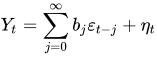
Where:
- - considered time series ,
- - white noise at the input of the line filter ; also applies the term "innovation" ( eng. innovation ) [1]
- - a sequence of moving average coefficients (parameters or weights)
- - deterministic component; equals zero if y no trends .


Odds satisfy the following conditions:
- row absolutely converges :
- no members with
- constant (independent of )


Notes
- ↑ Diebold FX Elements of Forecasting. - 4. - South-Western College Pub, 2007. - P. 124. - 384 p. - ISBN 032432359X .
Literature
- Anderson, TW (1971) The Statistical Analysis of Time Series . Wiley.
- Wold, H. (1954) A Study in the Analysis of Stationary Time Series , Second revised edition, with an Appendix on “Recent Developments in Time Series Analysis” by Peter Whittle. Almqvist and Wiksell Book Co., Uppsala.
- Scargle, JD (1981) Studies in astronomical time series analysis. I - Modeling random processes in the time domain ,, '1981, Astrophysical Journal Supplement Series, 45, pp. 1-71.