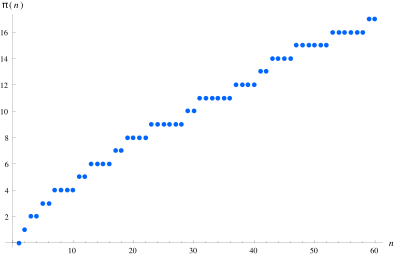
In mathematics , the distribution function of primes or pi-function Is a function equal to the number of primes less than or equal to the real number x . [1] [2] It is designated (this has nothing to do with pi ).
History
Of great interest in number theory is the growth rate of the pi-function. [3] [4] At the end of the 18th century, Gauss and Legendre suggested that the pi-function is estimated as

in the sense that
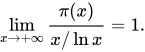
This statement is a prime number distribution theorem . It is equivalent to the statement
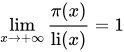
Where 
More precisely growth 

Where 


Proofs of the prime number theorem that do not use the zeta function or complex analysis were found in 1948 by Atle Selberg and Paul Erdös (mostly independently). [five]
Tables for pi function, x / ln x and li ( x )
The following table shows the growth of functions. by degrees 10 [3] [6] [7] [8] .
x π ( x ) π ( x ) - x / ln x li ( x ) - π ( x ) x / π ( x ) π ( x ) / x (fraction of primes) ten four −0.3 2.2 2,500 40% 10 2 25 3.3 5.1 4,000 25% 10 3 168 23 ten 5,952 16.8% 10 4 1,229 143 17 8,137 12.3% 10 5 9 592 906 38 10,425 9.59% 10 6 78,498 6 116 130 12,740 7.85% 10 7 664 579 44,158 339 15,047 6.65% 10 8 5 761 455 332,774 754 17,357 5.76% 10 9 50 847 534 2 592 592 1,701 19,667 5.08% 10 10 455 052 511 20,758,029 3 104 21,975 4,55% 10 11 4 118 054 813 169 923 159 11 588 24,283 4.12% 10 12 37 607 912 018 1 416 705 193 38,263 26,590 3.76% 10 13 346 065 536 839 11 992 858 452 108 971 28,896 3.46% 10 14 3 204 941 750 802 102 838 308 636 314,890 31,202 3.20% 10 15 29 844 570 422 669 891 604 962 452 1,052,619 33,507 2.98% 10 16 279 238 341 033 925 7 804 289 844 393 3,214,632 35,812 2.79% 10 17 2 623 557 157 654 233 68 883 734 693 281 7 956 589 38,116 2.62% 10 18 24 739 954 287 740 860 612 483 070 893 536 21 949 555 40,420 2.47% 10 19 234 057 667 276 344 607 5 481 624 169 369 960 99 877 775 42,725 2.34% 10 20 2 220 819 602 560 918 840 49 347 193 044 659 701 222 744 644 45,028 2.22% 10 21 21 127 269 486 018 731 928 446 579 871 578 168 707 597 394 254 47,332 2.11% 10 22 201 467 286 689 315 906 290 4,060,704,006,019,620,994 1 932 355 208 49,636 2.01% 10 23 1 925 320 391 606 803 968 923 37 083 513 766 578 631 309 7 250 186 216 51,939 1.92% 10 24 18 435 599 767 349 200 867 866 339 996 354 713 708 049 069 17 146 907 278 54,243 1.84% 10 25 176 846 309 399 143 769 411 680 3 128 516 637 843 038 351 228 55 160 980 939 56,546 1.77% 10 26 1 699 246 750 872 437 141 327 603 28 883 358 936 853 188 823 261 155 891 678 121 58,850 1.70% 10 27 16 352 460 426 841 680 446 427 399 267 479 615 610 131 274 163 365 508 666 658 006 61,153 1.64%
In OEIS, the first column of values Is the sequence A006880 , Is the sequence A057835 , and Is the sequence A057752 .
Pi-function calculation algorithms
Easy way to find , if a not very large - this is the use of the sieve of Eratosthenes issuing simple, not superior and count them.
A more thoughtful way to calculate was given by Legendre : given , if a - various primes, then the number of integers not exceeding and not dividing into everything equally
(Where denotes the integer part ). Therefore, the resulting number is equal to
if numbers Are all prime numbers not exceeding .
In a series of articles from 1870-1885, Ernst Meissel described (and used) a practical combinatorial method . Let be - first simple, we denote the number of natural numbers not exceeding which are not divisible by any . Then
Take natural , if a and if then
Using this approach, Meissel calculated for .
In 1959, Derrick Henry Lemer expanded and simplified the Meissel method. We define for real and for natural value as the number of numbers not exceeding m having exactly k prime factors, all of which exceed . In addition, we put . Then
where the sum obviously always has a finite number of nonzero terms. Let be - a whole such that and put . Then and at . Consequently
Calculation can be obtained in the following way:
On the other hand, computing can be performed using the following rules:
Using this method and IBM 701, Lehmer was able to calculate .
Further improvements to this method were made by Lagarias, Miller, Odlyzko, Deleglise, and Rivat. [9]
The Chinese mathematician Hwang Cheng used the following identities: [10]
and assuming performing the Laplace transform of both parts and applying the sum of the geometric progression with received the expression:
Other functions that count prime numbers
Other functions that count primes are also used, since they are more convenient to work with. One of them is the Riemann function, often denoted as or . She has a 1 / n jump for simple degrees , and at the jump point its value is equal to half the sum of the values on both sides of . These additional details are needed so that it can be determined by the inverse Mellin transform . Formally, we will define as
where p is prime.
We can also record
Where - Mangoldt function and
Mobius formula gives
Using the well-known relation between the logarithm of the Riemann zeta function and the Mangoldt function , and using the Perron formula we get
Riemann function has a generating function
Chebyshev functions are functions that calculate the powers of primes with weight :
Formulas for functions that count prime numbers
Formulas for functions that count prime numbers come in two forms: arithmetic formulas and analytical formulas. Analytical formulas for such functions were first used to prove the prime number theorem . They come from the work of Riemann and Mangoldt and are generally known as explicit formulas . [eleven]
The following expression exists for Chebyshev functions:
Where
Here runs through zeros of the zeta function in the critical strip, where the real part lies between zero and one. The formula is true for everyone . A series of roots converges conditionally, and can be taken in order of the absolute value of the increase in the imaginary part of the roots. Note that a similar sum over trivial roots gives the last term in the formula.
For we have the following complex formula
Again, the formula is true for everyone where - non-trivial zeros of the zeta function, ordered by their absolute value, and, again, the last integral is taken with a minus sign and is the same sum, but with trivial zeros. Expression in the second term can be considered as where Is an analytic continuation of the integral exponential function onto a complex plane with a branch cut along a straight line .
Thus, the Mobius inversion formula gives us [12]
true for where
called the R-function also after Riemann. [13] The last row in it is known as the Gram series [14] and converges for all .
The sum over the nontrivial zeros of the zeta function in the formula for describes fluctuations , while the remaining terms give the smooth part of the pi-function, [15] so we can use
as the best approximation for for .
The amplitude of the “noisy” part is heuristically estimated as , therefore, fluctuations in the distribution of primes can be explicitly represented -function:
Extensive value tables available here. [7]
Inequalities
Some inequalities for .
The left inequality holds for , and the right - with [sixteen]
Inequalities for prime number :
The left inequality is true for , and the right - with .
The following asymptotics holds for prime number :
Riemann hypothesis
The Riemann hypothesis is equivalent to a more accurate boundary of the approximation error integral logarithm, and hence the more regular distribution of primes
In particular, [17]
See also
- Prime number distribution theorem
- Bertrand's Postulate
- Squuse number
Notes
- ↑ Bach, Eric. Section 8.8 // Algorithmic Number Theory. - MIT Press, 1996. - Vol. 1. - P. 234. - ISBN 0-262-02405-5 .
- ↑ Weisstein, Eric W. Prime Counting Function on the Wolfram MathWorld website.
- ↑ 1 2 How many primes are there? . Chris K. Caldwell. Date of treatment December 2, 2008. Archived on September 20, 2012.
- ↑ Dickson, Leonard Eugene. History of the Theory of Numbers I: Divisibility and Primality. - Dover Publications, 2005. - ISBN 0-486-44232-2 .
- ↑ K. Ireland, M. Rosen. A Classical Introduction to Modern Number Theory. - Second. - Springer, 1998 .-- ISBN 0-387-97329-X .
- ↑ Tables of values of pi (x) and of pi2 (x) . Tomas Oliveira e Silva . Date of treatment September 14, 2008. Archived on September 20, 2012.
- ↑ 1 2 Values of π (x) and Δ (x) for various x's . Andrey V. Kulsha. Date of treatment September 14, 2008. Archived on September 20, 2012.
- ↑ A table of values of pi (x) . Xavier Gourdon, Pascal Sebah, Patrick Demichel. Date of treatment September 14, 2008. Archived on September 20, 2012.
- ↑ Computing? (X): The Meissel, Lehmer, Lagarias, Miller, Odlyzko method . Marc Deleglise and Joel Rivat, Mathematics of Computation , vol. 65 , number 33, January 1996, pages 235-245. Date of treatment September 14, 2008. Archived on September 20, 2012.
- ↑ Hwang H., Cheng . Demarches de la Geometrie et des Nombres de l'Universite du Bordeaux, Prime Magic conference.
- ↑ Titchmarsh, EC The Theory of Functions, 2nd ed .. - Oxford University Press, 1960.
- ↑ Riesel, Hans ; Gohl, Gunnar. Some calculations related to Riemann's prime number formula (English) // Mathematics of Computation : journal. - American Mathematical Society, 1970. - Vol. 24 , no. 112 . - P. 969–983 . - ISSN 0025-5718 . - DOI : 10.2307 / 2004630 .
- ↑ Weisstein, Eric W. Riemann Prime Counting Function ( Wolfram MathWorld) .
- ↑ Weisstein, Eric W. Gram Series on the Wolfram MathWorld website.
- ↑ The encoding of the prime distribution by the zeta zeros . Matthew Watkins. Date of treatment September 14, 2008. Archived on September 20, 2012.
- ↑ Rosser, J. Barkley ; Schoenfeld, Lowell. Approximate formulas for some functions of prime numbers (Ill.) // Illinois J. Math. : journal. - 1962. - Vol. 6 . - P. 64-94 . - ISSN 0019-2082 .
- ↑ Lowell Schoenfeld. Sharper bounds for the Chebyshev functions θ ( x ) and ψ ( x ). II (Eng.) // Mathematics of Computation : journal. - American Mathematical Society, 1976. - Vol. 30 , no. 134 . - P. 337-360 . - ISSN 0025-5718 . - DOI : 10.2307 / 2005976 .
Literature
- C. Prahar. The distribution of primes. - World, 1967.
- V.I. Zenkin. The distribution of primes. Elementary methods. Kaliningrad, 2008.
Links
- Chris Caldwell, The Nth Prime Page at The Prime Pages .