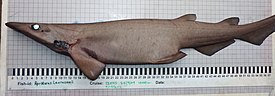
It is a deep-sea species that lives in the northwestern Atlantic Ocean off the coast of Massachusetts , Delaware , in the north of the Gulf of Mexico , and also in the eastern Atlantic Ocean off the coast of Iceland , southwestern Ireland , the Canary Islands , Madeira and South Africa , between 67 ° N and 11 ° N at a depth of 560 to 2060 m.
Nakaya and Sato in 1999 divided the genus Apristurus into three groups: longicephalus (2 species), brunneus (20 species) and spongiceps (10 species). Apristurus laurussonii belongs to the brunneus group, whose representatives are characterized by the following features: short, wide muzzle, from 13 to 22 spiral intestinal valves , the upper labial groove is much longer than the lower groove; intermittent supraorbital sensory canal.
The maximum recorded size is 72 cm. The smallest caught sexually mature female had a length of 59.2. The diet consists of crustaceans , squid and small fish. Propagates by laying eggs enclosed in a hard capsule. The capsule size is 6 cm long and 2.5 wide. There are two fibrous filaments at the anterior end of the capsule; at the posterior end there are also two small processes at the corners ending in spiral filaments. They probably serve to attach the capsule to the bottom. The surface of the capsule is covered with short, thin fibers.
In the Gulf of Mexico and the Northeast Atlantic, by-catch in deep-sea nets. Data to assess the state of conservation of the species is not enough [2] .