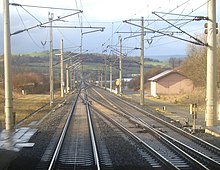
Track exit - connection of two railway tracks using turnouts (on which rolling stock can move from one track to another). Congresses are a typical element of the railway development of railway stations .
By design, the congresses are divided into single and double cross .
A single congress consists of two turnouts and connecting paths.

The double crossroads congress consists of 4 turnouts and a blind intersection of connecting paths and is the union of two congresses of opposite directions, combined in space.
Coat and anti-wool congresses
As for the turnouts, they distinguish between the woolly and the anti-wool directions of movement along the ramp: the rolling stock can deviate along the anti-wool exit, but not. For right-hand traffic along the double-track line, the woolly congress has the shape of the letter “I” in plan and the anti-woolly congress has the letters “N”.
Anti-wool exits represent a potential danger of derailment or a collision of trains in the event of a malfunction (for example, an anti-wool cut arrow ). The descent with the subsequent turn of the car across the track was one of the factors that exacerbated the severity of the railway accident near Eshed . Therefore, they try to minimize the number of anti-wool exits on double-track lines, and their locations are carefully selected.
See also
- Strelochnaya street
Links
- Trip Congress - Encyclopedia of Railways