The uprising of May 2, 1808 in Madrid ( Spanish: Dos de Mayo ) is an uprising of the inhabitants of Madrid against the occupation of the city by the troops of the French emperor Napoleon Bonaparte , which served as a prelude to a protracted guerrilla war .
| Uprising in Madrid on May 2, 1808 | |||
|---|---|---|---|
| Main Conflict: Napoleonic Wars | |||
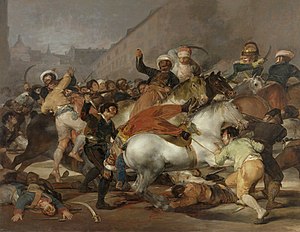 " The uprising of May 2, 1808 in Madrid ." Francisco Goya , 1814 | |||
| date of | May 2 - 3, 1808 | ||
| A place | Madrid , Spain | ||
| Total | The uprising is brutally crushed, but unrest spreads throughout Spain, the war for the independence of Spain begins | ||
| Opponents | |||
| |||
| Commanders | |||
| |||


Content
- 1 Background
- 2 The beginning and course of the uprising
- 3 Consequences of the uprising
- 4 Literature and art
- 5 notes
- 6 References
Background
Madrid was occupied by Napoleon’s troops on March 23, 1808 . King Charles IV was forced to recant in favor of his son Ferdinand VII , but Napoleon lured both into French territory and arrested him in the city of Bayonne . The attempt by the French commander Joachim Murat to remove the daughter and youngest son of Charles IV from the country also led to a popular uprising in Madrid, which was crushed after several hours of fierce street fighting. The brutal suppression of the uprising and the subsequent proclamation by the king of Spain of the brother of Napoleon Joseph led to the spread of unrest throughout Spain .
The beginning and course of the rebellion
The spark that ignited the rebels was the attempt of the French marshal Murat to send the daughter and youngest son of Charles IV, Francisco de Paula, to Bayonne. Initially, the city’s governing council refused to comply with Murat’s demand, but ultimately agreed after receiving a letter from Ferdinand VII in Bayonne.
On May 2, a crowd began to gather in front of the Royal Palace in Madrid . The crowd entered the building to prevent the expulsion of Francisco de Paula. Murat sent a battalion of grenadiers from the imperial guard and artillery. Artillery opened fire on the gathered crowd, and the uprising began to cover other parts of the city.
Poorly armed city dwellers engaged in street battles with French troops. Murat declared martial law and introduced most of his troops inside the city, fierce fighting began around Puerta del Sol and Puerta de Toledo . The civil administration of the city was dissolved. Gradually, French troops established control of the city, hundreds of residents died in battle. The fierce fighting is transmitted in Goya 's painting " The Uprising on May 2, 1808 in Madrid ." Spanish troops stationed in the city, according to orders received, remained in the barracks. The only units that joined the rebels were artillerymen from the Monteleon barracks. The commanders of this unit are Pedro Velarde and Luis Daois to this day are considered the heroes of the uprising. Both died during the French attacks on the barracks.
Consequences of the rebellion
The suppression of the uprising was followed by severe repression. On the evening of May 2, Murat set up a military tribunal under the chairmanship of General Pear . The Tribunal pronounced death sentences on anyone captured with weapons in their hands. In an order issued on the same day, Murat wrote: “The inhabitants of Madrid, who had allowed themselves to be led on the wrong path, indulged in rebellion and murder. French blood was spilled. It takes revenge. All those arrested during a riot with weapons in their hands will be shot ” [1] . All public gatherings were banned, an order was issued to hand over weapons to the French authorities. Hundreds of captured city dwellers were executed on the night of May 3, this scene is reflected in Goya's painting “ The Third of May 1808 in Madrid ”.
News of the uprising in Madrid, arriving on the same day May 2 in the nearby town of Mostoles , prompted Juan Perez Villiamil , the secretary of the Admiralty and the prosecutor of the Supreme Military Council, and the leaders ( alcalds ) of the town to sign a declaration of declaration of war with an appeal to the Spaniards to fight for the expulsion of the invaders. By the name of the town, this document was called the Declaration of the Alcaldes of Mostoles .
The French invaders hoped that their quick and brutal repressions would show the population that they were masters of Spain, but in fact the uprising gave a strong impetus to the resistance. In the following weeks and months, the number of armed uprisings against the French began to increase. May 2 date the beginning of the War on the Iberian Peninsula .
May 2 is considered a public holiday in the metropolitan area . At the place where the Monteleon barracks were located, there is now Dos de Mayo Square (May 2 Square). The surrounding neighborhoods are called the Malasaña district, after the teenage girl Manuela Malasaña , who died during the uprising.
Several monuments to the heroes of the uprising were erected in Madrid, including the Monument to the Fallen for Spain
Literature and Art
- Francisco Goya 's painting The Uprising of May 2, 1808 in Madrid .
- Roman Arturo Perez-Reverte "Day of Anger"
Notes
- ↑ Jon Cowans. "Modern Spain: A Documentary History." University of Pennsylvania Press, May 2003. ISBN 0-8122-1846-9