Omri ( Omri ; Hebrew עָמְרִי , Greek Αμβρι ) is the 6th king of the kingdom of Israel , who ruled for 12 years (1 Kings 16:23 ). Founder of the new capital of Samaria and the Omrid dynasty.
| Omri | |||||||
|---|---|---|---|---|---|---|---|
| Heb. עָמְרִי | |||||||
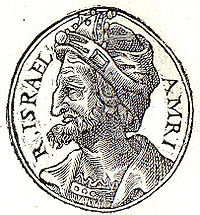 Portrait from the collection of biographies Promptuarii Iconum Insigniorum ( 1553 ) | |||||||
| |||||||
| Predecessor | Zimri | ||||||
| Successor | Ahab | ||||||
| Birth | |||||||
| Death | 873 BC e. | ||||||
| Children | Ahab | ||||||
Biography
According to the Book of Kings , Omri was a military leader of King Ela and commanded an army in a campaign against the Philistine city of Gavafan. When Elah died in a conspiracy organized by Israeli commander Zimri , the soldiers, outraged by regicide, proclaimed king Omri. Omri led his army to the capital of Israel, Tirzu (Firzu), and besieged it, but could not capture Zimri alive, because after the fall of the city he burned himself along with the royal palace. Meanwhile, half of the people sided with another pretender to the throne - Favnia, son of Gonafov (Tibni bin Ginat). However, after a long and difficult struggle, the Omri party prevailed, and the struggle for power ended in the death of his rival.
The first six years, Omri lived in Fierza (1 Kings 16:23 ); then he acquired a hill in the Ephraim Mountains, on which he built the city of Samaria (Shomron), named after the former owner of the land, Shemer (Samir), and made it the capital of his kingdom. Samaria remained the capital and political center of the kingdom of Israel until its very last days.
Omri realized that the rivalry between the kingdoms of Judea and Israel harms the power and prestige of both states. Therefore, he invited the king of Judea, Asa, to make peace, which was finally done, and mutual friendship and respect were established between the two kingdoms, fixed by the marriage of Asa Jehoshaphat's son to Omri's daughter.
The most difficult political issue for Omri was his relationship with Aram (Syria), a powerful northern neighbor. To pacify Aram, he was forced to cede his land and city. At the same time, he expelled the Philistines from the border cities temporarily occupied by them, and subjugated the people of Moab , forcing him to pay tribute to Israel.
One of Omri's most important political accomplishments was the re-established good relations with Sidon , the country of the Phoenicians, whose friendship once contributed to the increase in wealth and power of King David and King Solomon . Here Omri also secured the political union by marriage. His son Ahab married Jezebel , the daughter of King Tyrus and Sidon Itobaal I. However, the close alliance between the two countries had a very bad impact on the religious and cultural life of Israel. Omri himself was no better than his predecessors. Like all other kings of the kingdom of Israel, beginning with Jeroboam, he did not follow the ways of God. Under the ever-increasing influence of the Phoenicians, the degeneration of the royal house of Omri progressed and reached its zenith under the rule of his son Ahab and Queen Jezebel.
The reign of Omri lasted twelve years. Although the years of the reign of Omri can be considered the time of far-reaching political achievements, the result of which was a significant consolidation of the kingdom of Israel, it still did not increase the people's lifestyle in a spiritual sense. On the contrary, the idolatry and depravity of the royal house plunged the whole country into an abyss of spiritual degeneration.
Omri was buried in the city of Samaria (Sebastia, Shomron). He was succeeded by his son Ahab .
Omri and his son are referred to as the kings of Israel in the stele of Mesh , which describes in detail the interaction of the kingdom of Moab with the surrounding countries. The Assyrian black obelisk of Salmanasar III includes the image of King Jehu (Jehu) "Bet-Khumri" ("from the house of Omri" or "son of Omri").
Literature
- Ryzhov K.V. All monarchs of the world: Ancient East. - Veche, 2001. - ISBN 5-7838-0829-6 .
- Amvriy // Brockhaus and Efron Encyclopedic Dictionary : in 86 volumes (82 volumes and 4 additional). - SPb. , 1890-1907.
- Israel Finkelstein and Neil Asher Zilberman . The unearthed bible. A new look at archeology. Ch. 7. The forgotten first kingdom of Israel (884-842 BC) (inaccessible link)