George Percy Aldridge Grainger ( Eng. George Percy Aldridge Grainger ; 1882-1961) - American pianist, arranger and composer of Australian descent.
| Percy granger Percy grainger | |
|---|---|
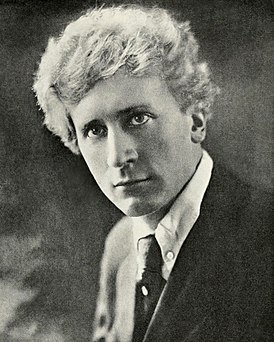 1922 | |
| basic information | |
| Date of Birth | July 8, 1882 |
| Place of Birth | Melbourne |
| Date of death | February 20, 1961 (78 years old) |
| A place of death | New York |
| A country |  USA USA |
| Professions | pianist , composer |
| Instruments | The piano |
Biography
Granger left Australia at the age of 13 to study at the Hoch Conservatory in Frankfurt . Between 1901 and 1914 he lived in London , where he established himself first as a public pianist, and then as a concert performer, composer and collector of original folk melodies. While his reputation grew, he met with many of the significant figures in European music, formed friendships with Frederick Delius and Edward Grieg . He became an adherent of northern music and culture. He often expressed his enthusiasm in private letters in clearly racist and anti-Semitic terms.
In 1914, Granger moved to the United States , where he lived until the end of his life, although he traveled extensively throughout Europe and Australia. He served as an orchestra for some time in the U.S. Army during the years 1917-18 and took American citizenship in 1918. After the suicide of his mother in 1922, he began to participate more actively in educational work. He also experimented with mechanical music, which he hoped to replace human interpretation. In 1930, he created the Granger Museum in Melbourne , in his homeland, as a monument to his life and work and a future research archive. In old age, he continued to give concerts, and also reviewed and changed his own compositions, while he composed little new. After World War II, illness reduced his level of activity, and he considered his career a failure. He gave his last concert in 1960, less than a year before his death.
During his long and innovative career, he played a prominent role in reviving interest in British folk music in the early years of the 20th century. He also made many adaptations of the work of other composers. Although most of his creations were experimental and unusual, the part of his legacy with which he is most associated is his piano arrangement of folk dance, the tune “Country of Gardens”.
Artwork
- For orchestra (including chamber):
- Mock Morris (1911),
- Irish tunes of County Derry (Irish tunes from county Derry, processing, 1911),
- Colonial song (Colonial song, with 2 soloists, 1912).
- Suites:
- In a nutshell (“In a nutshell”; In a nutshell, with piano, 1905-16),
- Danish folk song (Danish folk-song, 1937),
- Youth (Youthful suite, 1899-1943),
- Harvest Anthem (Harvest Hymn, 1933).
- For wind opcestra:
- The power of Rome and the Christian heart (The power of Rome and the Christian heart, 1919; treatment for wood and brass - 1937, 2nd edition - 1948),
- English dance (English dance, with organ, 1925),
- Two hill songs (Hillsongs, for 23 and for 24 solo instruments, 1902 and 1907).
- Pieces for a military orchestra;
- Chamber-instrumental ensembles (including pieces for piano 4 and 6 hands);
- Choirs - March-song of democracy (Marching song of democracy, with organ and orchestra, 1916), choirs (with chamber ensemble) to the words of Rudyard Kipling , with brass band, with piano, and chapel , including processing of folk songs;
- Songs.