Bitter's magnet (solenoid or Bitter coil) is a type of electromagnets used to create stationary (not pulsed) very strong magnetic fields . Invented by Francis Bitter in 1933 . Using such magnets, a field with a magnetic induction exceeding 35 T (2008) [2] is obtained.
Content
Device
Bitter's magnet (coil) consists of a set of metal discs cut along the radius (Bitter Plate). The discs alternate with disc-shaped dielectric pads, forming a double helix. After the formation of a spiral in the disks, several hundreds of through holes are made through which the fluid is pumped in order to cool the installation.
In the first Bitter magnet, built in 1936, copper discs were used as coils, insulated from each other by mica plates. 800 gallons of water per minute were pumped through 600 holes (50 liters per second [3] ). The electrical capacity of the plant was 1.7-2 MW. The achieved magnetic field strength was up to 10 Tesla (100 thousand Gs ), while the installation was briefly operational up to 15.2 T. This magnet functioned until 1962 , while until 1958 it remained the most powerful magnet in the world with a long-lasting constant field.
In modern Bitter magnets, the shape of the disk cut is changed (curved cut instead of straight radial) and the location and shape of the cooling holes (holes are used in the form of a gap instead of round). In modern magnets, the shape and size of the coils-plates located on the ends of the magnet can vary smoothly.
The main disadvantage of Bitter solenoids is their high power consumption due to resistive heating. But they are used to create strong magnetic fields that are unattainable for superconducting magnets (the critical field that destroys superconductivity, for common superconductors is 8-28 T, magnets up to 10-20 T are actually used).
Record setups
In 2011, the National High Magnetic Field Laboratory (Tallahassee, Florida, USA) installed a Bitter magnet with a maximum stationary field of 36.2 T. Several hundred Bitter plates are used, arranged in 4 cylindrical magnetics nested into each other. Electric power - 19.6 MW, 139 liters of water per second are pumped for cooling [4] .
More powerful constant fields, up to 45 T, are achieved in Bitter magnets installed inside a superconducting magnet [2] .
Interesting Facts
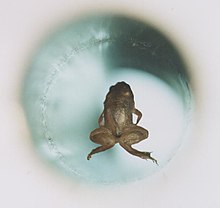
- The hamster named “HAMS ter Tisha”, which was “directly involved” in levitation experiments [5] [6], co-authored an article on observing the rotation of the Earth using levitating diamagnetic gyroscopes in a field created by a Bitter magnet.
Notes
- ↑ Diamagnetic Levitation - High Field Magnet Laboratory
- ↑ 1 2 Coyne, Kristin Magnets: from Mini to Mighty (not available link) . Magnet Lab U. National High Magnetic Field Laboratory (2008). The appeal date is August 31, 2008. Archived September 19, 2012.
- ↑ Magnet over three millennia. Part II Archived copy dated April 1, 2012 on the Wayback Machine “Bitter:„ the secret is in cooling “”
- The National High Magnetic Field Laboratory - Meet the Magnets: 36.2 Tesla Resistive Magnet Unsolved . The appeal date was December 29, 2011. Archived May 17, 2008.
- ↑ doi: 10.1016 / S0921-4526 (00) 00753-5
- ↑ http://www.aps.org/publications/apsnews/200910/physicshistory.cfm "co-authored a paper with his favorite hamster," he insures that “HAMS ter Tisha” contributed to the levitation experiment „most directly." ”
Links
- http://www.ebiblioteka.lt/resursai/Uzsienio%20leidiniai/Uspechi_Fiz_Nauk/1966/4/r664d.pdf // UFN1966 April, volume 88 issue 4
- SUPER-STRENGTH MAGNETIC FIELDS // Physical Encyclopedia. In 5 volumes. - M .: Soviet encyclopedia. Editor in Chief A. M. Prokhorov. 1988
- https://web.archive.org/web/20170327080411/http://www.valtar.ru/Magnets2/mag_2_9.htm