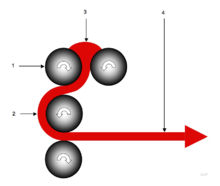
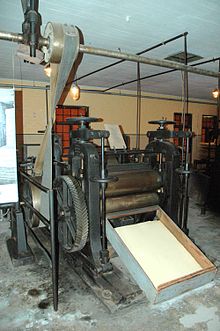
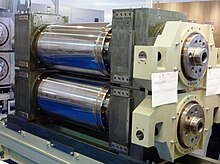
Calender (from French calandre from other Greek κύλινδρος “roller, roller” [1] ) is a machine for the continuous formation of a sheet of polymer or paper by passing it through the gap between the rotating shafts. As a result of calendering, a web of the required thickness and width is obtained. The main characteristics of the calender is the number of rolls, their length, diameter and relative position.
The geometry of the calender rollers is a determining factor for the surface quality of the sheet. To protect the rollers from wear, high-speed gas-flame spraying of hard alloys is used (longer protection) or galvanic chrome plating (more common).
The calendering process is also used in the manufacture of stretch textile ceilings. A knitted fabric uniformly impregnated with polyurethane is dried, squeezed and imparted the necessary thickness by passing it through rotating shafts.
Calender is an integral part of any laundry with a large turnover of things. Passing through the hot shafts, the clothes undergo ironing and drying at the same time, this procedure significantly reduces the time that could be spent on manual ironing.
When working with a calender, safety precautions must be strictly observed. The likelihood of a person getting into the car is close to zero thanks to the protective bars, upon lifting which the unit stops working, but such cases were and ended in death .
In the cinema
Crush (The Mangler) (1995, USA)
Notes
- ↑ Calender - Explanatory Dictionary of Ushakov (inaccessible link) (inaccessible link from 06/14/2016 [1161 days]) . Also see the etymology for en: Calender from the Merriam-Webster dictionary . Also see etymology for the cylinder in Wiktionary.