| History of science |
 |
| By subject |
|---|
| Maths |
| Natural Sciences |
| Astronomy |
| Biology |
| Botany |
| Geography |
| Geology |
| Soil science |
| Physics |
| Chemistry |
| Ecology |
| Social Sciences |
| Story |
| Linguistics |
| Psychology |
| Sociology |
| Philosophy |
| Economy |
| Technology |
| Computer Engineering |
| Agriculture |
| The medicine |
| Navigation |
| Categories |
Rural farming is a sector of the economy aimed at providing the population with food ( food , food ) and obtaining raw materials for a number of industries .
Content
Neolithic Revolution
The Neolithic revolution, the transition of human communities from the primitive economy of hunters and gatherers to agriculture based on agriculture and animal husbandry , is interpreted by scientists (academician G. B. Polyak, professor A. N. Markov) as a transition from an appropriating to a producing economy. According to archeology , the domestication of animals and plants occurred at different times independently in 7-8 regions . The earliest center of the Neolithic revolution is the Middle East , where domestication began no later than 10 thousand years ago [1] . In the central regions of the World System, the transformation or replacement of hunting and collecting societies by agrarian societies dates from a wide time range from X to III millennium BC. e. , in most peripheral regions, the transition to a productive economy ended much later.
There are several competing theories about the causes of the emergence of agriculture. The following are considered the most common.
- The theory of "oases", adherent of which was Gordon Child himself [2] . It ties economic change to climate change at the end of the ice age.
- Theory of "hilly slopes." It suggests that domestication began on the hilly slopes of the Taurus Mountains in Turkey and Zagros in Iran, where the climate was not arid and the diversity of wild animals and plants was preserved [3] .
- The theory of "fiesta" [4] admits that within the framework of local culture there was a demonstration of its power and power.
- The “demographic theory” proposed by Karl Sauer [5] [6] , suggests that the increase in population was not a consequence, but the reason for the transition to agriculture.
- The theory of “purposeful evolution” [7] considers the domestication of plants as a result of the mutual adaptation of people and plants.
- Another option for linking economic progress with climate change is the assumption that the emergence of agriculture has become possible due to the onset of a long period of stable and predictable climate [8] .
- The hypothesis of a religious revolution. It consists in the fact that the reason that prompted people to a sedentary lifestyle was a new religious idea, according to which the need arose to maintain contact with dead ancestors.
Ancient Centers
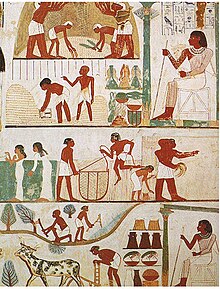
Agriculture has undergone significant changes since the time of early farming. In East Asia , Egypt , and India , the first systematic cultivation and collection of plants that had previously been collected in the wild began. The first cereals were cultivated in the area of the Fertile Crescent - wheat (more precisely, spelled : one- corn and two-corn ), then barley and rye [9] [10] . From the Middle East, these cultures spread to the north of Africa, to the southeast of Europe, to Persia and further to India.
Somewhat later, an independent "discovery" of agriculture occurred in the valleys of the Chinese Yangtze and Yellow River , in the African Sahel , New Guinea , and Mesoamerica . In China , 7000 thousand years BC. e. rice and millet were grown; soy was later domesticated. Two thousand years later, the cultivation of local crops in the Sahel (African rice, sorghum ) began. In New Guinea and Ethiopia , some plants unique to these regions were also domesticated.
The first evidence of the cultivation of wheat and legumes in the Indus Valley dates back to the 6th millennium BC. e. For 4 thousand years BC. e. ancestors of carriers of Indian civilization knew such plants as wheat, peas , sesame , barley, dates , orange and mango . After another 500 years, cotton cultivation began in the Indus Valley.
Native Americans 4 or 5 thousand years ago domesticated corn , tomatoes , pumpkin , potatoes and sunflowers . It is customary to distinguish between three main centers of domestication - South American (northwest of the continent), Central American (mid- Mexico ) and North American ( Mississippi River Valley ). By the beginning of our era in America there were large cities with granaries . The basic crops were corn, pumpkin and beans (the “ three sisters ” system).
Agricultural Intensification
If agriculture is understood as large-scale intensive cultivation of land, monoculture , organized irrigation and the use of specialized labor, the title of “inventors of agriculture” can be assigned to the Sumerians , starting in 5500 BC. Intensive agriculture allows you to contain a much higher population density than using hunting and gathering methods, and also provides the opportunity for the accumulation of excess product for off-season, use, or sale / exchange. The ability of farmers to feed a large number of people whose activities have nothing to do with agriculture has become a decisive factor in the emergence of standing armies .
Legacy of the Arab Caliphate
In the era of the Islamic Golden Age from VIII to XIII century. n e. the “Islamic agrarian revolution” took place — major transformations in the agriculture of the Arab caliphate and the related progress in the sciences of the earth, natural sciences and economics [11] [12] [13] . As a result of the establishment of the Arab caliphate in a vast territory from the west of Europe to Central Asia, a global economy emerged, which allowed Arab and other Muslim traders to conduct wide trade exchanges, spread throughout the caliphate and beyond its many agricultural crops and agricultural technologies, and also adapt these cultures and practices outside the caliphate. In addition to agricultural crops in the Arab world, sorghum (Africa), citrus fruits ( China ), and various cultures of India ( mango , rice , cotton , sugarcane ) were widely spread outside their homeland [11] . A number of researchers call this period “globalization of crops” [14] . The emergence of new crops, the growth of agricultural mechanization led to large shifts in the economy, population distribution, types of crops [15] , agricultural production, population incomes, urbanization, the distribution of labor, infrastructure, cuisine and clothing [11] .
New time
In 1492, the world began an "intercontinental" exchange of plants and animals, known as the Columbus exchange . Crops and animals that were previously known only in the Old World were now brought into the New World , and vice versa. In particular, tomato has become a favorite in European cuisine . Corn and potatoes also became known to the masses.
The British Agricultural Revolution - the development of agriculture in Britain between the 15th and the end of the 19th centuries During this period, one can see a hitherto unprecedented increase in productivity and crop sizes that have stopped the cycles of food shortages [16] . BSR has been going on for many centuries (rather evolution than revolution) and was the forerunner or occurred at the same time with similar changes in Europe and the colonies. The key to the BDS was the development of various agricultural technologies aimed at preventing the loss of nutrients from the earth during agriculture. At the same time, more fruitful plant varieties were bred that could bring a greater yield per acre. Farmers, using the latest tools, could produce more crops with fewer helpers. BSR accelerated as the industrial revolution and advances in chemistry created wealth, scientific knowledge and technology for more organized development of new fertilizers and new, more productive agricultural machinery.
Newest Time
With the rapid growth of mechanization at the end of the 19th and 20th centuries, tractors and, later, combines allowed agricultural work to be carried out at a previously impossible speed and on a massive scale.
The Green Revolution is a complex of changes in agriculture in developing countries that took place in the 1940s - 1970s and led to a significant increase in world agricultural production. It included the active cultivation of more productive plant varieties , the expansion of irrigation , the use of fertilizers , pesticides , and modern technology. The Green Revolution began in Mexico in 1943 with the agricultural program of the Mexican government and the Rockefeller Foundation . The biggest successes under this program were achieved by Norman Borlaug , who bred a lot of highly effective wheat varieties, including a short-stem, resistant to lodging. From 1951 to 1956, Mexico completely provided itself with grain and began exporting it; in 15 years, the country's grain yield has grown 3 times. Borlaug's designs were used in breeding in Colombia , India , and Pakistan ; in 1970 , Borlaug received the Nobel Peace Prize .
Organic farming is a form of farming , within the framework of which there is a conscious minimization of the use of synthetic fertilizers , pesticides , plant growth regulators , feed additives, genetically modified organisms . On the contrary, the effect of crop rotation , organic fertilizers ( manure , composts , crop residues, green manure , etc.), various tillage methods, etc., are more actively used to increase crop yields , provide cultivated plants with elements of mineral nutrition, and control pests and weeds . By 2007 on Earth, approximately 30.5 million hectares are used in accordance with the principles of organic farming [17] .
Notes
- ↑ Farming Was So Nice, It Was Invented at Least Twice . news.sciencemag.org. Date of treatment November 9, 2015.
- ↑ Gordon Childe. Man Makes Himself. - Oxford University Press, 1936.
- ↑ Charles E. Redman. Rise of Civilization: From Early Hunters to Urban Society in the Ancient Near East. - San Francisco: Freeman, 1978.
- ↑ Hayden, Brian. Models of Domestication // Transitions to Agriculture in Prehistory / Anne Birgitte Gebauer and T. Douglas Price. - Madison: Prehistory Press, 1992. - P. 11–18.
- ↑ Sauer, Carl, O. Agricultural origins and dispersals. - Cambridge, MA, 1952.
- ↑ Binford, Lewis R. Post-Pleistocene Adaptations // New Perspectives in Archeology / Sally R. Binford and Lewis R. Binford. - Chicago: Aldine Publishing Company, 1968. - P. 313–342.
- ↑ Rindos, David. The Origins of Agriculture: An Evolutionary Perspective. - Academic Press, 1987. - ISBN 978-0125892810 ).
- ↑ Wright, Ronald. A Short History of Progress. - Anansi, 2004 .-- ISBN 0-88784-706-4 .
- ↑ Jorge Dubcovsky and Jan Dvorak, “Genome Plasticity a Key Factor in the Success of Polyploid Wheat Under Domestication”, Science 316 [Issue 5833], p. 1862, 29 June 2007
- ↑ Saltini Antonio. I semi della civiltà. Grano, riso e mais nella storia delle società umane ,, prefazione di Luigi Bernabò Brea Avenue Media, Bologna 1996
- ↑ 1 2 3 Andrew M. Watson (1974), “The Arab Agricultural Revolution and Its Diffusion, 700–1100,” The Journal of Economic History 34 (1), pp. 8-35.
- ↑ AM Watson (1981), “A Medieval Green Revolution: New Crops and Farming Techniques in the Early Islamic World,” in The Islamic Middle East, 700-1900: Studies in Economic and Social History
- ↑ Zohor Idrisi (2005), The Muslim Agricultural Revolution and its influence on Europe , FSTC
- ↑ The Globalization of Crops , FSTC
- ↑ Andrew M. Watson (1983), Agricultural Innovation in the Early Islamic World , Cambridge University Press, ISBN 0-521-24711-X .
- ↑ Snell, KDM Part 4 // Annals of the Labor Poor, Social Change and Agrarian England 1660–1900. - Cambridge : Cambridge University Press , 1985. - ISBN 0-521-24548-6 .
- ↑ Supplements to the 2007 edition of "The World of Organic Agriculture" (inaccessible link) (February 13, 2007). Archived March 14, 2007.
- Bar-Yosef, O. and Meadows, RH The origins of agriculture in the Near East. In TD Price and A. Gebauer (eds) Last Hunters - First Farmers: New Perspectives on the Prehistoric Transition to Agriculture , pp. 39–94 (1995).
- Bowman, Alan K. and Rogan, Eugene, eds. Agriculture in Egypt: From Pharaonic to Modern Times (1999). 427 pp.
- Cohen, MN The Food Crisis in Prehistory: Overpopulation and the Origins of Agriculture (1977)
- Collingham, EM The Taste of War: World War Two and the Battle for Food (2011)
- Crummey, Donald and Stewart, CC, eds. Modes of Production in Africa: The Precolonial Era (1981). 256 pp.
- Jared Diamond , Guns, germs and steel. A short history of everybody for the last 13'000 years , 1997.
- Federico, Giovanni, Feeding the World: An Economic History of Agriculture 1800-2000 (2005) 416pp. highly quantitative
- Rupert Gerritsen , Australia and the Origins of Agriculture (2008) ( online Google Books preview )
- Grew, Raymond. Food in Global History (1999) online edition
- Habib, Irfan. Agrarian System of Mughal India (2nd ed. 1999).
- Heiser, Charles B. Seed to Civilization: The Story of Food (1990).
- Hillman, GC Late Pleistocene changes in wild plant-foods available to hunter-gatherers of the northern Fertile Crescent: Possible preludes to cereal cultivation. In DR Harris (ed.) The Origins and Spread of Agriculture and Pastoralism in Eurasia , pp. 159–203. (1996).
- Kerridge, Erik. "The Agricultural Revolution Reconsidered." Agricultural History , 1969 43: 4, 463-75. in JSTOR in Britain, 1750–1850
- Ludden, David, ed. New Cambridge History of India: An Agrarian History of South Asia (1999). excerpt and online search from Amazon.com ; also online edition
- McNeill, William H. "How the Potato Changed the World's History." Social Research 1999 66 (1): 67–83. Issn: 0037-783x Fulltext: Ebsco , by a leading historian
- Mazoyer, Marcel, and Laurence Roudart ' A History of World Agriculture: From the Neolithic Age to the Current Crisis , New York: Monthly Review Press, 2006, ISBN 1-58367-121-8 , Marxist perspective
- Mintz, Sidney. Sweetness and Power: The Place of Sugar in Modern History (1982)
- Prentice, E. Parmalee. Hunger and history: the influence of hunger on human history (1939). online edition
- Reader, John. Propitious Esculent: The Potato in World History (2008), 315pp a standard scholarly history
- Salaman, Redcliffe N. The History and Social Influence of the Potato, (1949)
- Sato, Y. 2003 Origin of rice cultivation in the Yangtze River basin. In Y. Yasuda (ed.) The Origins of Pottery and Agriculture , pp. 143-150. (2003)
- Tauger, Mark. Agriculture in World History (2008)
- Donald Routledge Hill, Islamic Science And Engineering , Edinburgh University Press (1993), ISBN 0-7486-0455-3
- Morelon, Régis & Roshdi Rashed (1996), Encyclopedia of the History of Arabic Science , vol. 3, Routledge , ISBN 0415124107
- George Sarton, The Incubation of Western Culture in the Middle East , A George C. Keiser Foundation Lecture, March 29, 1950 , Washington DC, 1951
- Maya Shatzmiller (1994), Labor in the Medieval Islamic World , Brill Publishers, ISBN 90-04-09896-8
- Watson, Andrew. Agricultural innovation in the early Islamic world . Cambridge University Press.
- Harrison, LF C. The Common People, a History from the Norman Conquest to the Present. - Glasgow: Fontana, 1989 .-- ISBN 0006861636 .
- Kagan, Donald. The Western Heritage. - London: Prentice Hall, 2004. - P. 535-539. - ISBN 0-13-182839-8 .
- Overton, Mark. Agricultural Revolution in England 1500 - 1850 . - Cambridge, England: Cambridge University Press, 19 September 2002. - ISBN 0-521-56859-5 .
Links
- Early Agricultural Remnants and Technical Heritage is a multidisciplinary project investigating the development of non-industrial agricultural techniques, with a focus on Europe.
- Tracing the Evolution of Organic / Sustainable Agriculture A Selected and Annotated Bibliography. Alternative Farming Systems Information Center, National Agricultural Library .
- The history of the UK countryside The history of the UK countryside, farming and agriculture, a unique 3D animated guide chronicling the last 15000 years in 20 key stages.
- Norman E. Borlaug “Green Revolution”: Yesterday, Today, and Tomorrow // Ecology and Life, No. 4, 2000.
- International Federation of Organic Agriculture Movements (IFOAM) website
- Masanobu Fukuoka “The Revolution of a Straw” (Introduction to Natural Agriculture)
- “Toothy Mother Nature. Interview with Alex Avery, Director of the Hudson Institute’s Center for Global Food Problems, criticizing organic farming, Expert, 10.10.09