Ras Alhaga [9] is the Ophiuchus alpha ( α Oph / α Ophiuchi), the brightest star in the constellation Ophiuchus .
| Ras Alhage, α Ophiuchus | |||
|---|---|---|---|
| Double star | |||
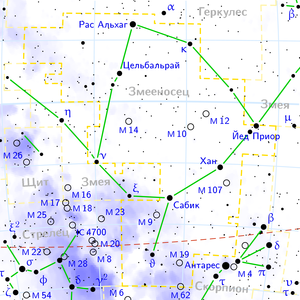 Position in the sky (alternatively named Ras Alhag) | |||
| Observational data ( The Age of J2000) | |||
| Right ascension | |||
| Declination | |||
| Distance | 48.6 ± 0.8 st. years (14.9 ± 0.2 pc ) [1] | ||
| Visible magnitude ( V ) | 2.07 [2] | ||
| Constellation | Ophiuchus | ||
| Astrometry | |||
| Radial velocity ( R v ) | + 12.6 km / s | ||
| Proper motion (μ) | RA: 108.07 mas per year Dec: -221,57 mas per year | ||
| Parallax (π) | 67.13 ± 1.06 mas | ||
| Absolute magnitude (V) | 1.20 [3] | ||
| Specifications | |||
| Spectral class | |||
| Color Indicator ( B - V ) | +0.15 [2] | ||
| Color Index ( U - B ) | +0.10 [2] | ||
| Variability | |||
| Orbit elements | |||
| Period ( P ) | 8.62 years | ||
| Semi-axis ( a ) | 0.427 +0.020 −0.013 " | ||
| Eccentricity ( e ) | 0.92 ± 0.03 [4] | ||
| Inclination ( i ) | 125 + 6 −9 ° v | ||
| Node (Ω) | 232 ± 9 ° | ||
| Periastron Epoch ( T ) | 2452888 ± 53 JD [4] | ||
| Pericenter Argument (ω) | 162 ± 14 [4] | ||
| |||
| Information in databases | |||
| SIMBAD | data | ||
| ARICNS | data | ||
| The star has 2 components Their parameters are presented below: | |||
Sources: [2] [4] [5] [7] [6] | |||
Title
The star has the traditional name Ras Alhag, which is derived from the Arabic رأس الحواء (Rais al Havwa), which means "Ophiuchus head" and refers to the position of the star in the constellation. This name is historically based. The International Astronomical Union officially approved the use of the Rasalhague form as the name of this star on July 20, 2016 [10] .
Description
The location of this star relative to other bright stars can be determined as follows: while Deneb lies on one side of the line connecting Vega with Altair , forming the well - known summer-autumn triangle , Ras Alhaga lies on the other side of it and forms an equilateral triangle with Vega and Altair [ 11] .
Since the 1940s Ras Alhage is known to be a double star with a revolution period of more than 8 years. Measurements of the early 2000s allowed us to estimate the mass ratio of components and the mass of each of them. Component A is 2.4 times as massive as the Sun, and mass of component B is 15% less than solar. More accurate mass estimates can be obtained from observations using interferometers in a period close to the time the component B passed through the periastron , which last occurred in April 2012.
In the atlas of the sky of Jan Hevelius, this star is depicted on the crown of the Ophiuchus head, and in its catalog its apparent magnitude is estimated at 2 m , which is very close to modern measurements. The apparent magnitude of the system is 2.07 m , it is located at a distance of about 48.6 light years from Earth , which gives an absolute magnitude of 1.20 m (in the Sun it is 4.83 m ). Component A of the system is a white giant , and component B is an orange dwarf star of the main sequence belonging to the spectral class K5 V-K7 V. Component A is the brightest representative of the spectral class A5 III, the second seemingly brilliant star of this class is Beta Triangle , having a third apparent magnitude. The surface temperature of component A is 7880–8050 K.
The projection of the rotational speed of component A around its axis at its equator to the line of sight is very large (240 kilometers per second), and therefore its polar radius is one-fifth less than the equatorial one. Acceleration of gravity on the surface of a star is usually characterized by the value of log g - the decimal logarithm of the acceleration due to gravity , expressed in CGS units, that is, in cm / s². In the case of Ras Alhaga, log g = 3.91 [5] , which corresponds to 81 m / s² , is more than three times less than on the surface of the Sun (274 m / s²).
Notes
- ↑ Calculated from parallax equal to 67.13 and parallax error equal to 1.06.
- ↑ 1 2 3 4 5 6 SIMBAD query result for Alpha Ophiuchi (Eng.) . Center de Données astronomiques de Strasbourg. - information from the SIMBAD database. The appeal date is April 24, 2012. Archived September 19, 2012.
- ↑ For the apparent magnitude m and the parallax p , the apparent magnitude M v is calculated by the formula:
- ↑ 1 2 3 4 5 6 7 Hinkley S. et al. The Prototype Rotator: The Improved Astrometric Orbit // The Astrophysical Journal. - 2011. - V. 726 , no. 2 - P. 104. - DOI : 10.1088 / 0004-637X / 726/2/104 . - .
- 2 1 2 3 Malagnini ML, Morossi C. Accurate Absolute luminosities, areas of the field and / or astromphysics Supplement Series. - 1990. - T. 85 , no. 3 - P. 1015-1019. - .
- ↑ 1 2 Zhao M. et al. Imaging and Modeling Rapidly Rotating Stars: α Cephei and α Ophiuchi // The Astrophysical Journal. - 2009. - T. 701 , no. 1 . - P. 209-224. - DOI : 10.1088 / 0004-637X / 701/1/209 . - .
- 2 1 2 3 4 Deupree RG Theoretical p-Mode Oscillation Frequencies for the Rapidly Rotating δ Scuti Star α Ophiuchi // The Astrophysical Journal. - 2011. - T. 742 , no. 1 . - P. 9. - DOI : 10.1088 / 0004-637X / 742/1/9 . - .
- ↑ SIMBAD Astronomical Database
- ↑ Starry sky // Euclid - Ibsen. - M .: Soviet Encyclopedia, 1972. - p. 417-418. - ( Great Soviet Encyclopedia : [in 30 tons.] / Ch. Ed. AM Prokhorov ; 1969-1978, vol. 9).
- ↑ Catalog of names of stars MAS
- ↑ Levitan, E. P. “Snake” constellations // Science and Life . - 1983. - № 2 . - S. 80-83 .