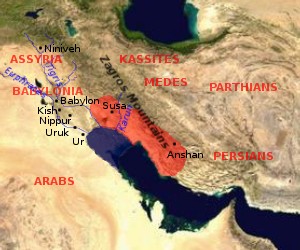

Suza ( Pers. شوش ( Šuš ) - Shush) is one of the oldest cities in the world. Located on the territory of the modern province of Khuzestan in Iran . In III - I thousand BC. er - the capital of Elam . In VI - IV centuries BC. er - the center of Suziana , one of the capitals in the Achaemenid state . In the III century BC. er - III century AD er - One of the capitals in the Parthian kingdom . In III - VII centuries - one of the capitals in the Sassanid state .
Content
Etymology
According to one of the versions, they got their name from the set of lilies (in Elama - susan or shushun), which this area abounded in.
History
Earliest Period
The first traces of habitat date back to 7 thousand BC. er . Painted ceramics, found during excavations, dates back to 5 thousand BC. er Sustainable settlement arose between 7 - 4 thousand BC. er
Elam
In history, Susa gained fame as the capital of the state of Elam . The city is mentioned in early Sumerian documents. In the work of Enmerkar and the Ruler of Aratta it is said that the city is dedicated to the goddess Inanna , the patroness of Uruk . Susa's own patron was the god Inshushinak .
The king of Akkad, Sargon of Akkad, included Susa (Shushan) in the Akkadian Empire - it is estimated that this happened in 2330 BC. er In 2240 BC. er the city was the provincial capital in Akkad, until the ruler of Elam Kutik-Inshushinak rebelled, freeing Susa.
In the New Sumerian epoch, the Susa were again occupied by the third dynasty of Ur , in 2004 BC. er Elam king Kindattu defeated Ur and made Susa his capital.
In 1175 BC. er Elamites led by king Shutruk-Nahhunta robbed the Babylonian temples and, in particular, delivered the trophy Babylon stela with the laws of King Hammurabi to Susa [1] . The Babylonian king Nebuchadnezzar I , 50 years later, plundered Susa in retaliation.
Susa is mentioned in the Book of Jubilees (8:21 & 9: 2) as the place where Shem and his eldest son Elam reigned. Susan is mentioned in 8: 1 as the son (or daughter) of Elam.
In 647 BC. er The battle of Susa was held , in which King Ashurbanipal defeated the Elamites. The city was completely looted and burned. The inscriptions and steles of Ashurbanipal are preserved, in which he boasts victories and devastations. Elam declines and over the next century gradually ceases to exist as an independent state.
Achaemenid Power
Cyrus the Great occupied the city in 538 BC. er The son of Cyrus Camby II transferred his capital to Susa. Darius I found the ancient palace of the Elam kings too built for itself, built on an artificial hill, and rebuilt it according to his taste; under Artaxerxes I, this palace burned down, and a hundred years later, under Artaxerxes II , it was rebuilt again [2] .
Susa is repeatedly mentioned in the Old Testament in the section Ktuvim (Scriptures) in the books of Esther , Nehemiah and the Book of Daniel (3) . The prophets Daniel and Nehemiah lived in Susa after the end of the Babylonian captivity in the 6th century BC. er In Susa, Esther became queen and was able to save the Jews from genocide. Currently, here is the tomb of the Prophet Daniel [4] , which was marked by an unusual stone that was not mined in the area.
In 331 BC. er Alexander of Macedon conquered the Achaemenid state, the city largely lost its political significance.
Parthia and Sassanids
The Parthians, having gained independence from the Seleucids after a hundred years, again made Susa their capital ( Ctesiphon was the second capital). The Romans occupied Ctesiphon five times, then the residence of the Parthian and Sassanian kings moved to Susa. Susa was usually the winter capital, and Ctesiphon was the summer capital.
In 116, the Roman emperor Traian occupied Susa, but could not keep the city due to the unrest in the Roman Empire itself.
Islamic era
The second time the city was destroyed by Muslims in 638. The third time in 1218 the city was completely destroyed by the Mongols. After that, the old city was almost abandoned.
Modern Period
Susa (Shush) is now a city with a population of about 65 thousand people (in 2005), in which Shiite Muslims and Persian Jews live — the community of the prophet Daniel. One of the most notable buildings of the city is the French "archaeological fortress" , built to ensure the safety of the staff of the expedition of Jacques de Morgan and the safety of finds.
Archaeological research
The territory of the ancient city was inspected in 1836 by Henry Rawlinson and then Austin Henry Layard . In 1851, small excavations were carried out by William Loftus which identified the monument as known from the historical sources of Susa. In 1885-1886 Auguste and Jeanne Dielafoy began the first French excavations in Susa.
The expedition of Jacques de Morgan made a large excavation in the years 1897-1911. Work continued under the leadership of Roland de Mekenema until the beginning of the First World War in 1914. Excavations were resumed after the war, again under the leadership of de Mekenem, and continued until the Second World War . The results of the work relating to this period remained largely unpublished.
Roman Girshman took the lead in digging in 1946 and continued them until 1967.
In the 1970s excavations were resumed under the leadership of Jean Perrot and carried out before the Islamic Revolution in Iran .
In the following decades, the archaeological zone suffered from illegal excavations and the economic activities of local authorities [5] .
Notes
- ↑ The stele was found in Susa in 1901 during excavations carried out by the expedition of Jacques de Morgan.
- ↑ Obnorsky N. P. Susa // Encyclopedic dictionary of Brockhaus and Efron : in 86 tons (82 tons and 4 extra). - SPb. , 1890-1907.
- ↑ “At the end of these days, the king [Artaxerxes] made for his people, who were in the capital city of Susa, from large to small, a seven-day feast in the garden yard of the king’s house. White, paper and blue-colored woolen fabrics, attached with fine linen and purple cords, [hung] on silver rings and marble pillars. The gold and silver beds [were] on a platform covered with green stones and marble, and mother-of-pearl and black stones. Drinks served [were] in gold vessels and various vessels, at the cost of thirty thousand talents; and the wine of the king was many, according to the riches of the king ”(Esther 1: 5-8).
- ↑ Constructions traditionally revered as the tombs of the prophet Daniel are also in Kirkuk and Samarkand .
- ↑ Ancientworlds.net news Archived February 11, 2006.
Literature
- Susa / Kircho L. B. // The Great Russian Encyclopedia : [in 35 t.] / Ch. ed. Yu. S. Osipov . - M .: The Great Russian Encyclopedia, 2004—2017.
- Obnorsky N. P. Susa // Brockhaus and Efron Encyclopedic Dictionary : 86 tons (82 tons and 4 extras). - SPb. , 1890-1907.