Kato Bontes van Beck ( German Cato Bontjes van Beek ; November 14, 1920 , Bremen , Germany - August 5, 1943 , Berlin, Germany ) - an anti-fascist , a member of the Resistance movement during World War II, a member of the Red Cappella organization.
| Kato Bonthees van Beck | |
|---|---|
| Cato bontjes van beek | |
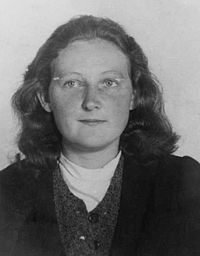 Kato Bonthees van Beck | |
| Date of Birth | November 14, 1920 |
| Place of Birth | Bremen , Weimar Republic |
| Date of death | August 5, 1943 (22 years) |
| Place of death | Prison Plötzensee , Berlin , Third Reich |
| Citizenship | Germany |
| Occupation | member of the resistance movement during World War II |
| Father | Jan Bonthees van Beck |
| Mother | Olga Brehling |
| miscellanea | anti-fascist, a member of the "Red Chapel" |
Content
Biography
Kato Bonthees van Beck was born on November 14, 1920 in Bremen , in Germany. She was the eldest child of three children in the family of the ceramics artist Jan Bonthees van Beck and the dancer and painter Olgi Brehling. Kato spent her childhood and youth in Worpswede - Fisherhud in the colony of artists near Bremen. The political views of the parents were unequivocally anti - fascist . Similar views were held by those who were frequent guests in their house, Uncle Kato Otto Modersohn, and relatives Ulrich and Christian Moderzon.
From 1929 to 1933, Kato studied at a German school in Amsterdam in the Netherlands . She learned Dutch and English, and later spent eight months at Winchcube in Gloucestershire , England . Kato was a passionate aviator. She refused to join the Union of German girls - the Hitler Youth for girls [1] .
Brother Kato Tim in the Bremen district of Fegezak made friends with a soldier who served here in 1939 in anti-aircraft forces. He was the future German Chancellor Helmut Schmidt . Tim introduced a friend to his sister. When Schmidt arrived in Berlin and enrolled in a military school, he broke off his friendship with the family of Bonthias van Beck.
In 1940, Kato and her sister Mithieh settled with their father in Berlin, who moved here in 1933. In his house, they found friends - opponents of the Nazi regime. Kato also began to master pottery and painting on ceramics. Both sisters did not conceal their attitude to the regime, which almost made it to the Gestapo . Then the father, who was never a member of the party, told them: “Children, no one can swim against the stream,” to which Kato replied: “But we can!”
The sisters began by helping French prisoners of war. At great risk, they came to Lertsky railway station in Berlin, where they handed out POWs to cigarettes, matches, soap, and even letters.
In the resistance movement, Kato and Mithieh joined Bremen. Prior to this, in the fall of 1941, in the house of their father, they met Libertas Schulze-Boysen, a member of the Berlin branch of the Red Chapel organization [2] . After the collapse of this organization, the sisters took part in actions organized by Kato's friend, the poet Heinz Strehloff . Together they printed and distributed illegal publications and leaflets calling for struggle and resistance to the Nazis.
Arrest and Execution
Kato and her father were arrested by the Gestapo on September 20, 1942 in Berlin, in their ceramics shop. Later, the father was released due to lack of evidence. On January 18, 1943, the Imperial Military Tribunal in Berlin sentenced her to capital punishment for "inciting high treason." After refusing to ask for pardon [3], Kato Bonthees van Beck, along with 15 other convicts, was executed on August 5, 1943, in Prutseensee prison in Berlin, after a head cut off. After the death sentence was brought, Kato's body was provided by the prison administration to the Director of the Anatomical Institute Hermann Shtiva in order to remove organs from it [4] [5] .
Memory
Mother Kato Olga Brehling over the next twelve years, sought from the government of the state of Lower Saxony, the rehabilitation of her daughter and Kato was recognized as a victim of the Nazi regime. Her sister Mithieu managed to avoid arrest, despite her participation in the Resistance movement. Since 2008 she has been living in Fisherhud.
The gymnasium in Achim , a town near Bremen , has been named after Kato Bonthees van Beck since 1991 [6] . In Fisherhud, the square named after her is Kato Bonthees van Beck Platz [7] . In Leipzig and Meldorf , streets are named after her. In 2004, the Kato Bonthees van Beck Cultural Center was built in Berlin, at the opening of which Hermann Wienke read excerpts from her biography. In front of the house on Kaisersdam, 22 in Charlottenburg , which was the last address where Kato lived before her arrest, a memorial stone was installed.
Documentary films
- “Kato. A Short Life in the Resistance ”( Cato - Ein kurzes Leben im Widerstand ), director Dagmar Brendack, 2008
- “Kato, as before, is here” ( Cato ist immer noch hier ), screenwriter and director Dagmar Breenke, 2009
- Cato ( CATO ), directed by Dagmar Bredecke and Walter Brun, 2010
Literature
- Hermann Vinke: Cato Bontjes van Beek. 'Ich habe nicht um mein Leben gebettelt'. Ein Porträt ("I do not pray for my life"; Image). Zürich, Hamburg 2003: Arche. ISBN 3-7160-2313-2
- Heidelore Kluge: Cato Bontjes van beek. 'Ich will nur eins sein und das ist ein Mensch'. (I just want one thing - and this is Humanity.) Stuttgart 1995: Urachhaus. ISBN 3-8251-7003-9
- Manfred Flügge: "Meine Sehnsucht ist das Leben". Eine Geschichte aus dem deutschen Widerstand. Dokumentar-Roman . 1. Aufl., Aufbau-Taschenbuch-Verlag, Berlin 1998, ISBN 3-7466-1334-5 .
- Gert Rosiejka: Die Rote Kapelle. "Landesverrat" als antifaschistischer Widerstand . 1. Aufl., Ergebnisse-Verlag, Hamburg 1986, ISBN 3-925622-16-0 . (Mit einer Einführung von Heinrich Scheel)
Links
- Kato Bontyes van Beek in the catalog of the German National Library
- Biographical sketch
- Site about the colony of artists, in which Kato Bontyes van Beek grew up
- Helmut Schmidt: The Book of Hermann Wiencke about the life and death of resistance fighter Kato Bontes van Beek . In: Die Zeit , no. 23/2003, p. 47, review
- House Kato Bontyes van Beek in Berlin-Lichtenrade
- Biography of Kato Bontes van Beek on the website of the Achim gymnasium
Notes
- Ce ceiberweiber homepage: Cato Bontjes von Beek (inaccessible link) , abgerufen am 10. Juni 2010
- ↑ Rezension zu Eine Blume am Gitterfenster ... Archive dated November 25, 2003 on the Wayback Machine
- ↑ Ablehnung von Gnadengesuchen 21. Juli 1943 . Gedenkstätte Plötzensee
- ↑ Wilhelm Bartsch: Ein Meister aus Deutschland der Anatom und Gynäkologe Hermann Stieve . (PDF) In: Ärzteblatt Sachsen-Anhalt , Heft 04/2007
- ↑ Rosemarie Stein: Erinnern und Vorbeugen - Ärzte im Nationalsozialismus . Archive dated July 15, 2015 on the Wayback Machine (PDF) In: Berliner Ärzteblatt , Heft 04/2007
- ↑ Vortrag zur Einweihung des Cato-Bontjes-van-Beek-Gymnasiums in Achim
- ↑ Innensenator Dr. Bernt Schulte weihte den neu gestalteten Cato-Bontjes-van-Beek-Platz in Kattenturm ein, 7. Juli 2000