Giant component - the effect that occurs in schemes for randomly placing particles in cells with an unlimited increase in the number of particles. The effect is that almost all particles (as a percentage) are collected in one cell.
Consider a generalized layout of n particles in N cells:

Denote by variational series of random variables . In this way, - the maximum component of the circuit (or the maximum number of particles in one cell), and - the next largest component.



If at random value has a limit distribution that does not have accumulation at zero, and If it degenerates into zero, then they say that in the layout (1) a giant component arises. [one]


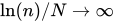
It is known, for example, that there is no giant component in the classical layout , and in the logarithmic scheme describing the lengths of the cycles in a random substitution , the giant component occurs when so that , i.e. provided that the parameter growing slower than . [2]


Literature
- ↑ Kolchin V.F. On the existence of a giant component in particle allocation schemes // Review of Applied and Industrial Mathematics. - 2000. - T. 7 , No. 1 . - S. 112-113 .
- ↑ Kazimirov N.I. Galton-Watson forests and random permutations . - Dis. for the competition step. Cand. Ph.D. - Petrozavodsk, 2003 .-- 127 p.