The concept of a monomif or a single myth was first used by Joseph Campbell , who borrowed a term from Joyce 's Finnegan Wake . Under the mono myth, he understood the structure common to any mythology for constructing wanderings and the life of a hero. In his opinion, in any of the myths we know, the hero passes the same tests, the same way of life. The same mythology is characteristic both for Ancient Greece or Scandinavia , and for Indian mythology .
Mono-myth structure
According to J. Campbell, the hero goes through several stages of the journey before the myth reaches its climax , before the hero becomes a hero.
Separative stage
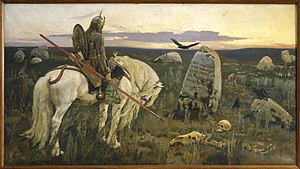
Separative stage or stage of separation - this is a way out of the former social or other status, a departure from cultural functions, the destruction of the social role . In the myth, it is symbolized by the escape, flight, wanderings and wanderings of the hero. Before that, he hears the call for these wanderings; and whether he hears him or not, but this is always the beginning of a myth. A typical form of such a call is a well-known fairy-tale admonition at a crossroads, offering a choice : “If you go to the right, you will find your wife, to the left, you will lose a horse, and you will perish straight” (having various options).
Liminal stage
The second, the liminal stage, is represented by the crossing of boundaries, being in an unusual intermediate state. A similar condition is marked by blindness, silence, nudity or ridiculous clothing, and so on. Limiting is always combined with detachment from the world of people, a person at this time is perceived as a living dead person who is to be reborn or reborn as a king, ruler or god.
End Stage
The end of any myth or mythological story is the return of the hero to Axis Mundi, the Earth's Pupu. The end of the myth is the death of the hero, when a new world is created from his body, or at least a re-creation of the world takes place, that is, the destruction of the whole chthonic one and the elevation of the hero into a host of gods .
Monomyth as a universal myth
A similar definition of a monomyph in relation to modern culture is not complete. Monomif is not only a single archetype for all nations, but also a single, universal myth. In this sense, the monomith appears in the times of ancient Greece, when the cult of Isis began to spread throughout the Mediterranean . At the same time, the myth not only changes under the influence of those cultures in which it has fallen, but over time begins to acquire common features for all cultures, thereby erasing the boundaries between them.
Today's Myths
Being a part of culture, society and science, the myth does not disappear. Although at different times the attitude towards him was not the same. M. Weber said: “In the development of mankind, the world is disenchanted” (see the withdrawal from Hegel). Thus, he wanted to show that magical ideas are losing their aura , therefore, the attitude of man to the world is becoming more and more rational. Later Derfer and Nestlé derived the theory " from myth to logos ." They believed that myth was fiction, which was replaced by reason, and considered that philosophy was a critical continuation of myth.
Also, a person does not “spell magic” the world, as M. Weber believed, but “recites” him, creating more and more new myths (in fact, being endless variations of old ones, all myths are reduced to a limited number of archetypes). In the words of A. M. Pyatigorsky , "a man, punching the roof of one myth, finds himself in the basement of another."
Modern myths are advertising , cinema and politics .
See also
- The theory of the main myth
- Propp, Vladimir Yakovlevich
Notes
Literature
- Vogler K. Journey of the writer: Mythological structures in literature and cinema = The Writer's Journey: Mythic Structure for Writers . - M .: Alpina Non-fiction, 2015. - 476 p. - 3,000 copies - ISBN 978-5-91671-353-4 .
- Campbell D. Thousands Hero = The Hero with thousand faces / Ger. from English A.P. Homik. - K. , M .: Vakler; Refl-beech; AST, 1997. - 384 p. - (Constellation of Wisdom (Astrum Sapientiae)). - 11,000 copies - ISBN 5-87983-054-3 .
- MacKey-Kallis, Susan. The Hero of the Perennial Journey in American Film. - University of Pennsylvania Press, 2001. - ISBN 0-8122-1768-3 .
- Northup, Lesley. Myth-Placed Priorities: Religion and the Study of Myth (Eng.) // Religious Studies Review : journal. - 2006. - Vol. 32 , no. 1 . - P. 5-10 .
- Radin P. Winnebago hero cycles: A study in aboriginal literature. - Baltimore: Waverly, 1948. - 168 p.
- Voytilla, Stuart. Myth & the Movies: Discovering the Myth Structure of 50 Unforgettable Films / Stuart Voytilla, Christopher Vogler. - Studio City, CA: Michael Wiese Productions, 1999. - ISBN 0-941188-66-3 .
- Laureline, Amanieux. Ce héros qui est en chacun de nous: [] . - Albin Michel ,, 2011.
- books based on interviews with campbell
- Phil Cousineau , ed. (1990), The Hero's Journey: Joseph Campbell on his Life and Work , New York: Harper and Row
- Bill Moyers , Betty Sue Flowers , ed. (1988), The Power of Myth