The yellow-eared parrot [1] ( lat. Ognorhynchus icterotis, synonym Aratinga icterotis ) is an endangered species of birds of the parrot family. Previously, the species was attributed to the genus Aratinga ( Aratinga ).
| Yellow parrot |
|---|
|
|
| No rank : | Bilateral symmetrical |
| Gender: | Yellow-eared Parrots ( Ognorhynchus Bonaparte , 1857 ) |
|
|
Ognorhynchus icterotis Massena & Souance , 1854 |
|
Endangered speciesIUCN 3.1 Endangered : 22685760 |
|
Body length 40-42 cm. Coloring green with a yellowish tinge in the lower body. Bridle, forehead, cheeks and parotid region yellowish-green. The inside of the tail feathers is pale red-brown, the outside is green. The upper side of the feathers at the ends is blackish. The upper part of the beak is blackish, the mandible and the tip are light.
Inhabited from Colombia to Ecuador , now from the territory of Ecuador, probably disappeared.
Subtropical and temperate forests inhabit the slopes of the Andes at an altitude of 2000-3000 m above sea level. Colonies of these parrots were found in plantations of wax palm trees ( Ceroxylon quindiuense ).
Nests in hollow trunks of palm trees, usually at an altitude of 25-30 meters above sea level. The nest is used by a parrot throughout its life. Often he returns to his nest after an attack by humans, thus facilitating trapping. In captivity, the parrot does not live long.
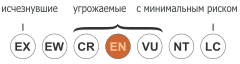
In recent years, only certain pairs have been known. In the updated Red Book in 2010, the International Union for Conservation of Nature listed yellow-eared aratinga in the list of endangered species (this is the average of seven levels of threat to the species according to the classification of the International Conservation Union).