Probiotics Probiotics are living microorganisms that benefit the host when administered in adequate amounts [1] .
By another definition, these are microorganisms used for therapeutic purposes, as well as food products and biologically active additives containing live microcultures [2] .
According to GOST R 52349-2005 “Food products. Functional food products. Terms and definitions ”, a probiotic is a functional food ingredient in the form of non- pathogenic and non- toxicogenic microorganisms that are useful for humans, which, when systematically consumed in the form of drugs or as part of food products, has a beneficial effect on the human body as a result of normalizing the composition and (or ) increase the biological activity of normal intestinal microflora .
Classification
According to GOST R 56139-2014, the main probiotic microorganisms include lactobacillus ( Lactobacillus ), bifidobacterium ( Bifidobacterium ), propionic acid bacteria ( Propionibacterium ), streptococcus Streptococcus thermophilus species, bacteria of the genus Lactococcus [3] .
According to the WHO definition, the term probiotics ( English Probiotics ) means:
Bacterial pathogens for humans that have antagonistic activity against pathogenic and conditionally pathogenic bacteria and provide restoration of normal microflora .
- WHO Vaccine and Immunization Glossary, 2009
Many, but not all, probiotics are included in the group of lactic acid bacteria [4] .
As probiotics, the species of the genera Lactobacillus and Bifidobacterium are most often used, but some spore-forming bacteria, in particular from the genus Bacillus [5] [1] , some species of E. coli and the yeast Saccharomyces boulardii, as well as Clostridium butyricum (registered in European Union as a food product) [1] .
As of 2011, there is no scientific evidence to prevent disease or improve health from taking probiotics [6] . The scope of probiotics is not well regulated, which can be used by pharmaceutical companies [7] [8] .
Despite conflicting information about the therapeutic effect of probiotics, the strongest evidence of their effectiveness is associated with the use of probiotics to improve bowel function and stimulate the immune system [9] [10] . There are other areas of health effects on the body. For example, probiotics are considered as an alternative therapy and management of patients with hepatic encephalopathy [11] [12] , there is evidence of the effect of probiotics on lowering cholesterol [13] [14] .
Lactic acid bacteria, including Lactobacillus, whose fermentation has been used for thousands of years to preserve food, can also act as a fermentation agent and, in addition, have the potential to have a beneficial effect on health. But the term "probiotic" should be used only for live microbes that have shown beneficial effects on health in controlled clinical trials in humans. Whereas the concept of “fermentation” refers to the conservation of raw agricultural products [1] .
Probiotics are available on the market in a wide range - from food to prescription drugs [15] :
- food;
- food substitution;
- nutritional supplements (tablets, capsules or sachets, usually with freeze-dried bacteria);
- “Natural healthy foods” (this category of probiotic foods is specific to Canada);
- OTC drugs
- prescription drugs.
Discovery History
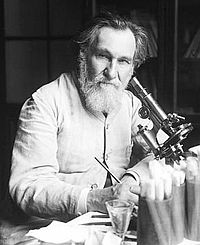
At the beginning of the 20th century, Nobel laureate Ilya Mechnikov postulated that a lactic acid bacterium (ICD) has a beneficial effect on health and promotes longevity. He suggested that “intestinal auto-toxicity”, which causes aging, can be reduced by modifying the intestinal microbiota and replacing the proteolytic microbes with beneficial ones. He developed a diet with fermented milk products. In 1917, the German scientist Alfred Nissle isolated a non-pathogenic strain of Escherichia coli . This strain, called Escherichia coli Nissle 1917, is one example of a non-lactic acid probiotic bacterium. Henri Tissier of the Pasteur Institute for the first time isolated Bifidobacterium and put forward a hypothesis about the possibility of substituting this bacterium for proteolytic bacteria that cause diarrhea. The Japanese doctor, Minoru Shirota, isolated the Shirota Lactobacillus casei strain to combat diarrhea; a probiotic product with this strain has been available since 1935 [1] .
Mechanism of Action
Probiotics act on the gastrointestinal tract ecosystem, affecting the immune mechanisms in the mucous membrane, interacting with symbiotic or potentially pathogenic microbes, generating metabolic metabolic products and communicating with the host cells through chemical signals. These mechanisms can lead to antagonism with potential pathogens, improvement of the gastrointestinal tract, strengthening the gastrointestinal barrier, negative feedback from inflammation, and feedback from the immune response to antigenic challenges. Presumably, these phenomena give positive effects, including a decrease in the frequency and severity of diarrhea, in which probiotics are most often used [16] .
Immunological effects of probiotics [17] :
- activate local macrophages, increasing the presentation of antigen B to lymphocytes and increasing the production of secretory immunoglobulin A as
locally and systemically;
- modulate the cytokine profile;
- cause tolerance to food antigens.
Non-immunological effects of probiotics [17] :
- promote digestion and compete for nutrients with pathogens;
- change the local pH to create an unfavorable local environment for pathogens;
- producing bacteriocins to inhibit pathogens;
- destroy superoxide radicals;
- stimulate mucin epithelial production;
- strengthen intestinal barrier function;
- compete with pathogens for adhesion;
- modify toxins emanating from pathogens.
Medical Use
Diseases and clinical syndromes in which, according to individual publications, the effect of probiotics may occur:
- in a Cochrane meta-review, analyzing the work on the use of probiotics for the prevention of acute diseases of the upper respiratory tract, the researchers revealed a small protective effect of probiotics compared to placebo, but the authors of the review noted a low and very low quality of the initial studies, and emphasized that side (side) effects probiotics were extremely weak, and the most common were symptoms in the digestive tract [18] ;
- in the prevention and treatment of antibiotic-associated diarrhea [19] .
According to the American Gastroenterological Association (AGA), at the present time there is not enough scientific data as to which specific probiotic should be used to improve certain conditions or in the treatment of specific diseases [20] .
According to the position of the AGA, currently probiotics are most often used in the treatment of the following diseases and conditions [20] :
- irritable bowel syndrome - probiotic strains of lactic acid bacteria Bifidobacterium infantis and Lactobacillus plantarum and fungi Sacchromyces boulardii , as well as a combination of probiotics can help with defecation;
- infectious diarrhea caused by rotavirus infection , including in infants and young children - strains of lactobacilli species Lactobacillus rhamnosus and Lactobacillus casei ;
- antibiotic-associated diarrhea - Saccharomyces boulardii can prevent the recurrence of the most dangerous and most common antibiotic-associated diarrhea caused by Clostridium difficile .
At the same time, the AGA believes that there is currently no evidence of the effectiveness of probiotics in travelers with diarrhea, and despite the possible usefulness of probiotics to maintain oral health, the prevention and treatment of eczema and other skin diseases, urological diseases and the vagina , as well as allergy prevention in children and adults, there is no comprehensive evidence of the usefulness of probiotics, and the available research results are contradictory [20] .
Dry and Liquid Probiotics
Probiotics are divided into two groups - liquid and dry. Probiotics can be medicines, food additives, food products. For food additives and probiotic foods, there are no strict rules and regulations for the manufacturer to comply with. In the United States, probiotics are outside the purview of the Food and Drug Administration (FDA) . When taking probiotics for therapeutic purposes, it is advisable to consult a doctor [20] .
See also
- Prebiotics
Notes
- ↑ 1 2 3 4 5 VOG, 2017 , p. four.
- ↑ Andreev, Igor Leonidovich. Man and the bacterial world: problems of interaction // Bulletin of the Russian Academy of Sciences. - 2009. - No. 1. - P. 41—49.
- ↑ GOST R 56139-2014, 2015 .
- ↑ VOG, 2017 , p. five.
- ↑ Pohilenko, V.D. Probiotics based on spore-forming bacteria and their safety / V.D. Pokhilenko, V.V. Perelygin // Chemical and Biological Safety: Journal .. - VINITI RAS: FSUE TsNIIHM, 2007. - No. 2–3 (32–33).
- ↑ Rijkers, GT Health benefits and health claims of probiotics: Bridging science and marketing / GT Rijkers, WM de Vos, RJ Brummer ... [et al. ] // British Journal of Nutrition. - 2011. - Vol. 106, no. 9 (November). - P. 1291–1296. - DOI : 10.1017 / S000711451100287X . - PMID 21861940 .
- ↑ Slashinski MJ, McCurdy SA, Achenbaum LS, Whitney SN, McGuire AL; McCurdy; Achenbaum; Whitney; McGuire "Snake-oil," "quack medicine," and "industrially cultured organisms:" biovalue and the commercialization of human microbiome research (English) // BMC Medical Ethics: journal. - 2012. - Vol. 13 . - P. 28 . - DOI : 10.1186 / 1472-6939-13-28 . - PMID 23110633 .
- ↑ Shane Starling. EFSA calls for characterization work as probiotic resubmissions loom unspecified . NutraIngredients William Reed Business Media Ltd (November 10, 2011). Date of treatment June 12, 2019.
- ↑ Bulatova E.M., Bogdanova N.M., Lobanova E.A., Gabrusskaya T.V. Probiotics: clinical and nutritional aspects of the application / Pediatrics. - 2010. - Volume 89. - No. 3 - S. 84−90
- ↑ E.A. Kornienko et al. The role of intestinal microflora and probiotics in the development of immunity in infants / Pediatrics. - 2009. - Volume 87, No. 1, pp. 77−83
- ↑ Viramontes Hörner, Daniela. The Effects of Probiotics and Symbiotics on Risk Factors for Hepatic Encephalopathy : A Systematic Review: [ eng. ] / Daniela Viramontes Hörner, Amanda Avery, Ruth Stow // Journal of Clinical Gastroenterology. - 2017 .-- April. - P. 312–323. - ISSN 1539-2031 . - DOI : 10.1097 / MCG.0000000000000789 . - PMID 28059938 .
- ↑ Radchenko V.G. Hepatic encephalopathy and colon dysbiosis: possible approaches to correction : improvement. honey. Technology / Clinical Hepatology. - St. Petersburg, 2011 .-- 52 p.
- ↑ Khamagaeva I.S., Tsybikova A.Kh., Zambalova N.A. Cholesterol- metabolizing activity of probiotic microorganisms / Dairy industry.- 2011. - No. 10. - p. 56
- ↑ Khamagaeva I.S., Tsybikova A.Kh., Zambalova N.A., Tiansong San. The influence of cultivation conditions on the quality of a bacterial concentrate with cholesterol -metabolizing properties - Ulan-Ude: Publishing House of VSGTU, 2011. - No. 3 - P.85−88
- ↑ VOG, 2017 , p. ten.
- ↑ VOG, 2017 , p. 9.
- ↑ 1 2 FOG, 2017 , Tab. four.
- ↑ Hao, Qiukui. Probiotics for preventing acute upper respiratory tract infections: [ eng. ] / Qiukui Hao, Bi Rong Dong, Taixiang Wu // Cochrane Database of Systematic Reviews. - 2015. - No. 2 (February 3). - DOI : 10.1002 / 14651858.CD006895.pub3 . - PMID 21901706 .
- ↑ Hempel, S. Probiotics for the Prevention and Treatment of Antibiotic-Associated Diarrhea: A Systematic Review and Meta-analysis: [ eng. ] / S. Hempel, SJ Newberry, AR Maher ... [ et al. ] // JAMA. - 2012. - Vol. 307, no. 18 (9 May). - P. 1959-1969. - DOI : 10.1001 / jama.2012.3507 . - PMID 22570464 .
- ↑ 1 2 3 4 D'Arrigo, Terri. Probiotics : What They Are and What They Can Do for You: [ eng. ] : [ arch. June 5, 2010 ] / Reviewed by Richard Fedorak, John I. Allen, Linda A. Lee. - American Gastroenterological Association, 2008. - April.
Translation: Probiotics . What are they and how can they be useful to you? . GastroScan . - The brochure was written by professional medical writer Terri D'Arrigo and verified by gastroenterologists Richard Fedorak, John I. Allen and Linda A. Lee. Illustrations added during translation. Date of treatment June 12, 2019. Archived October 26, 2012.
Literature
- Zaikov, S. V. Disorders of the intestinal microbiocenosis: are probiotics always necessary? : [ arch. July 5, 2008 ] // Rational pharmacotherapy: journal .. - 2008. - No. 2. - P. 1−6.
- Shenderov, B. A. Medical microbial ecology and functional nutrition: in 3 vol . - M .: GRANT, 2001. - T. 3: Probiotics and functional nutrition: Biofilm. Skin and mucous membranes. Immune mechanisms .. - 287 p. - LBC R123.0.0 . - ISBN 5-89135-177-3 (t. 3).
- Prospects for the practical implementation of the biotechnological potential of probiotic microorganisms / I. Khamagaeva; Kryuchkova I. // Regional market of goods and services: innovative technologies and business organization: International scientific and practical conference, October 30-31, 2008: conference proceedings: Sat. / M-in food industry and consumer market of the Khabarovsk Territory, M-in education and science of the Russian Federation, Federal Agency for Education, State. higher education institution prof. education "Khabarovsk state. Acad. Economics and Law ”, Commercial Fact., Khabarovsk Int. fair; [editor: S.I. Lopatin et al.]. - Khabarovsk: KhGAEP, 2008. - Part 2. - S. 323—327. - ISBN 978-5-7823-0400-3 .
- Belousova, E. A. World Congress on Gastroenterology (Montreal, 2005) : [ arch. March 1, 2014 ] // Farmateka: Journal .. - 2006. - No. 1. - P. 3.
- Jeremy Taylor Darwin Health: Why We Get Ill and How It Tells Evolution = Jeremy Taylor “Body by Darwin: How Evolution Shapes Our Health and Transforms Medicine”. - M .: Alpina Publisher, 2016 .-- 333 p. - ISBN 978-5-9614-5881-7 .
- GOST R 52349-2005 : Food products. Functional food products. Terms and Definitions. - With the change of N1. - M .: Codex JSC, 2010.
- GOST R 56139-2014 : Functional food products. Methods for determining and counting probiotic microorganisms. - M .: Standartinform, 2015.
- English-Russian Glossary of Key Terms on Vaccinology and Immunization - English-Russian Glossary of Key Terms for Vaccinology and Immunization : [ arch. June 16, 2010 ] / WHO Regional Office for Europe. - Geneva: WHO, 2009. - 110 p.
- Probiotics and Prebiotics : Global Practical Recommendations of the World Gastroenterological Organization: [ arch. October 31, 2017 ] = WGO Global Guideline Probiotics and prebiotics. World Gastroenterology Organization, 2017: [trans. from English ]: review / Authors of the review of the IGO Francisco Guarner (Chair, Spain), Mary Ellen Sanders (Co-Chair, USA), Rami Eliakim (Israel), Richard Fedorak (Canada), Alfred Gangl (Austria), James Garisch (South Africa), Pedro Kaufmann (Uruguay), Tarkan Karakan (Turkey), Aamir G. Khan (Pakistan), Nayoung Kim (South Korea), Juan Andrés De Paula (Argentina), Balakrishnan Ramakrishna (India), Fergus Shanahan (Ireland), Hania Szajewska (Poland) ), Alan Thomson (Canada), Anton Le Mair (Netherlands). Invited experts Dan Merenstein (USA), Seppo Salminen (Finland). - World Organization of Gastroenterologists , 2017. - February. - 37 p.
Links
- Probiotic Lactobacillus GG: A New Clinical Breakthrough. - Unimilk, 2009