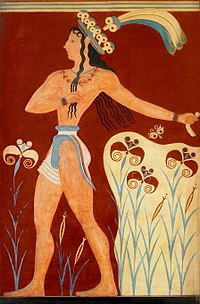
The “ Priest King” [1] (“The Young Man Among the Lilies” [2] , “The Prince with Lilies” [3] ) is a painted relief [4] of the Knossos Palace of the Minoan civilization era, dated about 1550 BC. e. The restored original fresco is exhibited in the Archaeological Museum of Heraklion , and a copy of it is decorated with the wall of the southern corridor of the central courtyard of the Knossos Palace , where it was found [5] .
The fresco was restored in three separate fragments: the head, trunk and left leg. When Arthur Evans discovered them in 1901 , he noted that presumably these fragments belong to different figures. He suggested that the body may belong to a fighter with bulls , [6] . The head obviously belonged to a woman, because according to the Minoan tradition, men were not portrayed with pale skin; that it could be the figure of a priestess is indicated by an elegant headdress, in which the priestesses depicted on the sarcophagus from Agia Triad were wearing.
Notes
- ↑ Nina Aleksandrovna Dmitrieva. A Brief History of Art: Essays . - "Art," 1969. - 356 p.
- ↑ Lyubov Butkevich. The history of ornament: a training manual . - Litres, 2017-09-05. - 553 s. - ISBN 9785457008403 .
- ↑ Zinchenko S. A. Introduction to the foundations of the art of the Aegean world. - M .: Direct Media, 2015 .-- 329 p. - ISBN 978-5-4475-0538-7 .
- ↑ Yu.D. Kolpinsky. The art of the Aegean world and ancient Greece. M., 1970.S. 28
- ↑ Minoan monuments of Crete
- ↑ Alternative restoration of the fresco Archived on March 25, 2010.