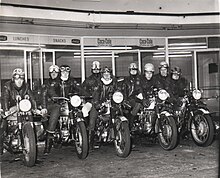

Café Racer ("cafe racer": English café - cafe + racer - racer) - type of motorcycle . Designed for high-speed trips (walks) over short distances. The design is optimized for speed and handling to the detriment of ride comfort [1] [2] .
According to the magazine Popular Mechanics , the term café racer appeared in England in the 1960s as the ironic name for motorcyclists posing as “cool” professional racers , parking their cars next to their table in a cafe [3] .
Content
History
In the late 1950s and early 1960s, the rapid development of motor propulsion began in London; motorcyclists often gathered in pubs and cafes, and then the original entertainment was invented - racing to the music . The race track from Ace Cafe to the nearest roundabout was approximately 2 km one way, and street racers needed to have time to drive that distance from the cafe and back while playing a song in a jukebox . The races were called Caff, quickly becoming popular, they began to attract more people in the "Ace Cafe" .
Design Features
Serial motorcycles were unsuitable for such competitions, and riders began to improve them, dismantling all the excess to reduce weight and installing fairings for less air resistance. The steering wheel was replaced by clips , an elongated narrow fuel tank and a single seat became a distinctive feature of cafe-racers.
Visually similar to cafe racers are bobber-type motorcycles . On the bobber, unlike the cafe-racer, the steering wheel is left, it just is understated. In addition, cafe racers, as a rule, are made from small-capacity motorcycles, babery - large motorcycles (up to 1 liter).
The first cafe racers were built on the basis of British motorcycles, such as Triumph Bonneville, Norton 500 Manx, Norton 30M, etc. In the 1970s, these manufacturers were seriously pushed aside by Yamaha , Suzuki , Honda and Kawasaki . Some manufacturers began to produce serial cafe-racers, among them were the 1977 Harley Davidson XLCR and the 1980 Suzuki GS1000S.
The culture icon is the classic British motorcycle Triumph Bonneville, on the basis of which a huge number of "cafes" are built by various customizers and workshops. This model is still available in a modern design, but with an original design. .
Current status
Notes
- ↑ none (unopened) // The Listener. - British Broadcasting Corporation, 1971. - T. 85 . - S. 373 .
- ↑ James Adam Bolton. Moto Guzzi T3 Special . Motorcycle Classics (November – December 2010). Date of treatment October 11, 2009.
- ↑ Wyss, Wally (September 1973).