Elden Abbey is one of the oldest monasteries in Pomerania , founded in 1199 in the vicinity of Greifswald. In 1535, during the Reformation and the spread of Lutheranism in Pomerania, the abbey was abolished. So far, the ruins of monastic buildings have been preserved.
| Monastery | |
| Abbey of Elden | |
|---|---|
| Kloster eldena | |
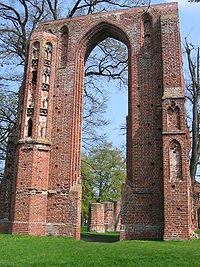 Ruins of Elden Abbey | |
| A country |  Germany Germany |
| City (neighborhood) | Greifswald |
| Denomination | Catholicism |
| Type of | male |
| Architectural style | Gothic |
| Founder | Cistercian Order |
| Founding date | Year 1199 |
| Date of abolition | 1535 |
| Status | municipal property |
| condition | ruin |
Content
History
As early as the 12th century, in the south of the principality of Rügen , which was vassal of Denmark , Cistercian monks from the Esrom Abbey on the island of Zealand founded a monastery, destroyed in 1198 during the war between Denmark and Brandenburg . Prince Rugen Jaromar I , married to a princess from the Danish House, again invited Cistercian monks from Denmark, giving them land at the mouth of the Hilda River to found a new monastery.
On the territory granted by the prince there were salt pans and in 1199 an abbey was founded here, which in 1204 was officially recognized by Pope Innocent III . Princes Rugen bestowed vast lands, but almost all of them were disputed territories between the principality and neighboring states. [one]
The name "Hilda" was given to the monastery by the name of the river, the first mention of which in the documents refers to 1241 ("Hildam Fluvium"). However, it is believed that the monastery was named after the river, and not vice versa [2] . The name of the monastery changed several times from 1204 from “Hilda or Ilda” to “Hilda” in 1220, then “Elden” in 1347 [3] and Elden in 1621. Finally, the penultimate name was assigned to the abbey. In 1939, the Greifswald district, adjacent to the ruins of a former monastery, received the same name - Elden [4] .
Near the Abbey of Elden, at the intersection of the ancient trade routes in the first half of the 13th century, a settlement of workers who worked in salt mining arose, which soon became the city of Greifswald. In 1241, Prince Rugen Witzlav I and Duke of Pomerania Wartislav III granted the abbey the right to hold a fair [5] [6] . After Vratislav III was buried in the abbey, a tomb for representatives of the House of Pomerania was founded there. In 1249, the monastery recognized the ownership of the church of St. Nicholas and the Church of St. Mary in Greifswald [7] . One of the items of income of the monastery was the production and sale of beer.
The construction of the monastery complex lasted for four centuries. Construction began in the eastern part of the monastery church in 1200 and ended in the beginning of the 15th century with a substantial refinement of the western facade of the church and the nave of the abbey building. The monastery played an important role in the Christianization of Western Pomerania .
In 1534, the dukes Barnim XI and Philip I recognized Lutheranism as an official confession in the duchy of Pomerania on the Landtag in Treptow-on-Rega. Monasteries and abbeys were subjected to secularization [8] . In 1535, the Abbey of Elden was abolished and in its place was founded the principality of Elden [9] . Duke Philip I seized the property of the monastery and founded a farm on the site of the abbey. The last abbot of the monastery Envald Schinkel and prior Michael Knabe lived in the abbey until his death [10] .
The former monastery was badly damaged during the Thirty Years War (1618-1648). In 1634, the last duke of the House of Pomerania, Bohuslav XIV, presented the abbey with the large part of the former monastic sites to the University of Greifswald [11] . During the occupation of Pomerania by Sweden (1648-1815), the buildings of the monastery were dismantled for the construction and repair of fortifications and the historic center of Greifswald.
Interest in the monastery arose at the beginning of the XIX century with the era of romanticism and the emergence of paintings by Caspar David Friedrich, depicting the ruins of the abbey.
In 1828, under the patronage of the University, archaeological excavations were initiated in a former monastery, and a park was created on the territory of the abbey by Peter Joseph Lenne . In the years 1926-1927, during the excavations, Hans Kloer restored the original condition of the monastic buildings. The ruins of the abbey include parts of the church nave and a monastery building, a brewery with cellars, a barn and parts of the monastery walls of the 14th century [12] . In the 1960s, after regular measures to preserve the historical heritage of the former monastery, an open-air theater was built here, and then various cultural events were held on the territory of the monastery. In 1995 and 1996–1997, the State Administration for the Protection of Historical Monuments (Landesamt für Denkmalpflege) and the city of Greifswald jointly led another excavation [13] and restoration work, which ultimately led to the creation of the cultural center “Euroregion Pomerania” .
Gallery
Ruins of Eldena
Ruins of Eldena
Monastery barn of the XIV century
Tombstone of Vratislav III, Duke of Pomerania in the XIII century in the tomb of members of the House of Pomerania
Tombstone of John VII. Abbot of the monastery in the XV century
Literature
- Julius Heinrich Biesner: Geschichte von Pommern und Rügen nebst angehängter Specialgeschichte des Klosters Eldena . Koch, Greifswald 1839, 552 Seiten, online .
- Theodor Pyl: Geschichte des Cistertienserklosters Eldena im Zusammenhange mit der Stadt und Universität Greifswald. 1. und 2. Teil und Nachtrag in 2 Bd. Greifswald, Bindewald: 1880–1883.
- Horst Wernicke (Hrsg.): Greifswald. Geschichte der Stadt , Schwerin 2000. ISBN 3-931185-56-7
- Darin:
- Günter Mangelsdorf: Zur Ur- und Frühgeschichte des Greifswalder Gebietes, zu den Anfängen des Klosters Eldena der der Gredswald im 12./13. Jahrhundert , S. 24-26.
- Norbert Buske: Hinweise auf die Kirchengeschichte Greifswalds von der Gründung der Stadt bis in die Zeit der beiden Weltkriege , S. 161—163.
- Günter Mangelsdorf: Kloster Eldena bei Greifswald and der Beginn des deutsch-slawischen Landesausbaues in Vorpommern . In: Christian Lübke (Hrsg): Struktur und Wandel im Früh- und Hochmittelalter. Eine Bestandsaufnahme aktueller Forschungen zur Germania Slavica (= Forschungen zur Geschichte und Kultur des östlichen Mitteleuropa, Bd. 5), Stuttgart 1998, S. 301-311.
- Nicole Kiesewetter; Tobias Kunz & Felix Schönrock: Ein interdisziplinäres Forschungsprojekt zum Kloster Eldena. In: Oliver H. Schmidt; Heike Frenzel & Dieter Pötschke (Hrsg.): Spiritualität und Herrschaft (= Studien zur Geschichte, Kunst und Kultur der Zisterzienser, Bd. 5), Berlin, S. 206—222.
- Lutz Mohr: Ein Streifzug und Wegweiser durch die Greifswalder Ortsteile Eldena und Friedrichshagen in Vergangenheit und Gegenwart . 2. Auflage, Greifswald 1979, S. 10-34.
- Gerd Baier; Horst Ende & Renate Krüger: Die Denkmale des Kreises Greifswald , Leipzig 1973, S. 135–146.
Links
- The ruins of the Abbey of Elden in the paintings of Caspar David Friedrich (him)
- Elden Abbey on Cistercensi.info (inaccessible link) (it.)
Notes
- ↑ Gerhard Hess: Die kulturgeographische Entwicklung der akademischen Dörfer Koitenhagen, Groß-Schönwalde, Klein-Schönwalde und Weitenhagen-Potthagen auf historisch-geographischer Grundlage , zugleich Phil, Univ. Greifswald, 1957, S. 21 f.
- ↑ Teodolius Witkowski: Die Ortsnamen des Kreises Greifswald , Weimar 1978, S. 53 f.
- ↑ Lutz Mohr: Ein Streifzug und Wegweiser durch die Greifswalder Ortsteile Eldena Friedrichshagen in Vergangenheit und Gegenwart , 2. Aufl., Greifswald 1979, S. 13; Teodolius Witkowski: Die Ortsnamen des Kreises Greifswald , Weimar 1978, S. 52.
- ↑ Teodolius Witkowski: Die Ortsnamen des Kreises Greifswald , Weimar 1978, S. 52.
- ↑ Günter Mangelsdorf: Zur Ur- und Frühgeschichte des Greifswalder Gebietes, zu den Anfängen des Klosters Eldena der der Stadt Greifswald im 12./13. Jahrhundert , in: Horst Wernicke (Hrsg.): Greifswald. Geschichte der Stadt , Schwerin 2000, S. 26; Horst Wernicke: Greifswald - so wie es war , Droste 1995, S. 5.
- ↑ Norbert Buske: Hinweise auf die Kirchengeschichte Greifswalds von der Gründung der Stadt bis in die Zeit der beiden Weltkriege , in: Horst Wernicke (Hrsg.): Greifswald. Geschichte der Stadt , Schwerin 2000, S. 164.
- ↑ Norbert Buske: Hinweise auf die Kirchengeschichte Greifswalds von der Gründung der Stadt bis in die Zeit der beiden Weltkriege , in: Horst Wernicke (Hrsg.): Greifswald. Geschichte der Stadt , Schwerin 2000, S. 163; Günter Mangelsdorf: Zur Ur- und Frühgeschichte des Greifswalder Gebietes, zu den Anfängen des Klosters Eldena der der Gredswald im 12./13. Jahrhundert , in: Horst Wernicke (Hrsg.): Greifswald. Geschichte der Stadt , Schwerin 2000, S. 27.
- ↑ Gerhard Hess: Die kulturgeographische Entwicklung der akademischen Dörfer Koitenhagen, Groß-Schönwalde, Klein-Schönwalde und Weitenhagen-Potthagen auf historisch-geographischer Grundlage , zugleich Phil, Univ. Greifswald, 1957, S. 37 f.
- ↑ Norbert Buske: Hinweise auf die Kirchengeschichte Greifswalds von der Gründung der Stadt bis in die Zeit der beiden Weltkriege , in: Horst Wernicke (Hrsg.): Greifswald. Geschichte der Stadt , Schwerin 2000, S. 176; Horst Wernicke: Greifswald - so wie es war , Droste 1995, S. 10; Lutz Mohr: Ein Streifzug und Wegweiser durch die Greifswalder Ortsteile Elden Friedrichshagen in Vergangenheit und Gegenwart , 2. Aufl., Greifswald 1979, S. 25 f .; Gerhard Hess: Die kulturgeographische Entwicklung der akademischen Dörfer Koitenhagen, Groß-Schönwalde, Klein-Schönwalde und Weitenhagen-Potthagen auf historisch-geographischer Grundlage , zugleich Test, Univ. Greifswald, 1957, S. 38
- ↑ Lutz Mohr: Ein Streifzug und Wegweiser durch die Greifswalder Ortsteile Eldena Friedrichshagen in Vergangenheit und Gegenwart , 2. Aufl., Greifswald 1979, S. 26
- ↑ Lutz Mohr: Ein Streifzug und Wegweiser durch die Greifswalder Ortsteile Eldena Friedrichshagen in Vergangenheit und Gegenwart , 2. Aufl., Greifswald 1979, S. 26; Barbara Rimpel: Stadtgestalt und Stadtbild Greifswalds vom Mittelalter bis 1780 , in: Horst Wernicke (Hrsg.): Greifswald. Geschichte der Stadt , Schwerin 2000, S. 466 f.
- ↑ Gerd Baier; Horst Ende & Renate Krüger: Die Denkmale des Kreises Greifswald , Leipzig 1973, S. 145.
- ↑ Günter Mangelsdorf: Zur Ur- und Frühgeschichte des Greifswalder Gebietes, zu den Anfängen des Klosters Eldena der der Stadt Greifswald im 12./13. Jahrhundert , in: Horst Wernicke (Hrsg.): Greifswald. Geschichte der Stadt , Schwerin 2000, S. 24.