Keynesian investment function - the most popular function for determining the investment climate, which was developed by John Maynard Keynes [1] .
Background
The first - the motivating factor in the demand for investment is net profit. At the same time, Keynes understood net profit as the net revenue that remains after reimbursement of current expenses and depreciation deductions .
The second - since investments bring results not when they are made, but in the future, Keynes proceeded from the need to take into account the profit that is expected over the entire life of the fixed capital. This makes it necessary to discount future income.
Third , the expected return on investment is compared with the renewal of the value of capital property, which is determined by the costs associated with its replacement.
Keynes uses marginal capital efficiency to compare expected returns with the value of capital assets. By marginal efficiency of capital, he understood such a rate of interest that balances the present value of expected income with the value of capital property. The indicated role of marginal capital efficiency can be demonstrated in the following formula:
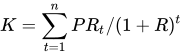
where K is the value of capital property (investment project); PR t - expected profit (net) R - marginal capital efficiency; t - years during which capital property should be used. The marginal efficiency of individual capital depends on the rate of return on capital assets, that is, on the ratio P = PR / K
The higher the rate of return on capital assets, the higher the interest rate, which is able to balance the value of capital assets with the discounted value of expected profits. Each type of capital property has an unequal rate of return and therefore unequal marginal efficiency of capital. Keynes distinguished between the marginal efficiency of individual capital and the marginal efficiency of total capital. In this case, the role of the marginal efficiency of total capital is played by the high marginal efficiency of individual capital. In a broad context, the role of marginal efficiency of total capital is played by such a level of income that is maximum among all possible investment options (real and financial).
For investments in an investment project to be economically viable, the interest rate at which investment funds are purchased should be lower than the interest rate, which plays the role of marginal capital efficiency, that is, i <R * . Only under this condition, the really discounted value of the expected income will exceed the cost of capital property, as a result of which the investor, in addition to the payback of his funds, will receive additional income. This means that the marginal efficiency of capital serves as the upper limit for the interest rate, which is the price of investment.
For example, four investment projects are placed on the horizontal axis of the graph, the marginal capital efficiency of which is 20%, 18%, 12%, 8%, respectively. On the vertical axis of the graph is the interest rate in the range of 0% to 20%. The marginal efficiency of total capital is 20%, which corresponds to the marginal efficiency of capital of the first investment project, which is the highest among all investment options. If the interest rate is 20%, then the investment demand is zero, since there are no investment projects whose marginal capital efficiency exceeds 20%. If the interest rate is reduced to 15%, investments in the first and second projects will be economically feasible, the marginal capital efficiency of which (20%, 18%) exceeds 15%. This means that investment demand is leveling out. A decrease in the interest rate to 10% increases the investment demand to a value, and a decrease in the interest rate to 5% increases the investment demand to the amount of investment projects.
So, when the interest rate decreases, investment demand rises. This indicates that investments are inversely related to the interest rate, the level of which cannot exceed the marginal efficiency of capital. Based on this, the Keynesian investment function can be expressed by the following equation:
Notes
- ↑ A. G. Savchenko, O. V. Pasechnik. Teaching aid for self-study of discipline. Macroeconomics / / 2007.P. 94-103