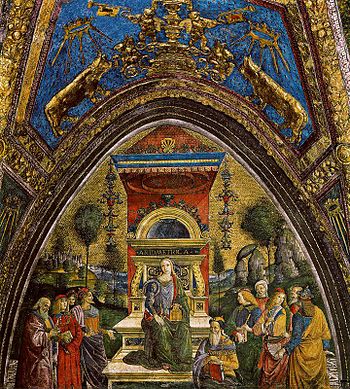
The history of arithmetic covers the period from the occurrence of an account to the formal determination of numbers and arithmetic operations on them using a system of axioms . Arithmetic - the science of numbers , their properties and relationships - is one of the basic mathematical sciences. It is closely related to algebra and number theory .
The reason for the arithmetic was the practical need for counting, simple measurements and calculations . The first reliable information about arithmetic knowledge was found in the historical monuments of Babylon and Ancient Egypt , dating back to the III – II millennia BC. e. A great contribution to the development of arithmetic was made by Greek mathematicians , in particular the Pythagoreans , who tried using numbers to determine all the laws of the world. In the Middle Ages, the main areas of application of arithmetic were trade and approximate calculations . Arithmetic developed primarily in India and Islamic countries and only then came to Western Europe. In the 17th century, naval astronomy , mechanics , and more complex commercial calculations presented arithmetic with new demands on the computing technique and gave impetus to further development.
The theoretical basis for the concept of number is primarily associated with the definition of a natural number and Peano's axioms formulated in 1889 . They were followed by rigorous definitions of rational , real , negative, and complex numbers. Further expansion of the concept of number is possible only if one of the arithmetic laws is abandoned.
Content
- 1 The emergence of arithmetic
- 2 Ancient mathematical texts and number systems
- 2.1 Ancient Egypt
- 2.2 Babylon
- 2.3 Ancient Greece
- 2.4 Ancient Rome
- 2.5 China
- 3 Arithmetic in the Middle Ages
- 3.1 India
- 3.2 Countries of Islam
- 3.3 Byzantium
- 3.4 America
- 3.5 Western Europe
- 4 New Age Arithmetic
- 4.1 Decimal arithmetic and extension of the concept of number
- 4.2 Creation and development of number theory
- 4.3 Problems of substantiation of arithmetic
- 5 History of arithmetic in Russia
- 6 Comments
- 7 notes
- 8 Literature
The Origin of Arithmetic

If in two sets (sets of objects) each element of one set has a single pair in another set, then these sets are equally powerful [2] . Such an actual comparison, when objects were laid out in two rows, was used by primitive tribes in exchange [3] , it makes it possible to establish quantitative relations between groups of objects and does not require the concept of number [4] .
In the future, natural standards of counting appeared, for example, fingers, and then sets of standards, such as hands. With the advent of standards symbolizing specific numbers, and the emergence of the concept of number is associated. The number of objects was compared with the moon in the sky, the number of eyes, the number of fingers on the hand. Later, numerous standards were replaced by one of the most convenient, usually they became the fingers and / or toes [3] .
The next step was the emergence of a general concept of a natural number , separated from specific objects. A natural number arose as an idealization of a finite set of homogeneous, stable and indivisible objects (people, sheep, days, etc.) [5] ; accordingly, actions with numbers initially reflected real actions with such sets (unification, division, etc.). For the pre-Indo-European language that used the decimal number system, the names of numerals up to one hundred inclusive have already been reconstructed [6] . On this occasion, Lebesgue remarked: “ It is possible that if people had eleven fingers, a decimal number system would be adopted ” [3] .
To record the results of counting, nicks were used on a tree or bones, knots on ropes were artificial standards of counting [3] [7] [8] . The radial bone of a young wolf with 55 nicks on it was found in 1937 near the village of Dolni Vestonice ( Czech Republic ). The find is about 5 thousand years old (according to other sources, about 30 thousand years [1] ), for a long time it was the oldest known record of the number [7] . B. A. Frolov , a Paleolithic specialist from Novosibirsk , sees in the graphic of the Upper Paleolithic ornaments, starting with the monuments from Dolny-Vestonice, many evidence that people of this era clearly distinguished certain amounts of identical elements and especially often emphasized some of them: 5 or 7 objects, as well as multiples of them (especially 10 and 14) [9] .
When naming the numbers, either indecomposable names were used (such numbers were called nodal ones ), or algorithmic ones made up of nodal names [10] . Moreover, the combination of algorithmic numbers is based on arithmetic operations performed on nodal numbers [11] .
Numbering, as well as the names of numbers, is based on one of three principles [7] :
- additive ( additio - addition ) - signs for and repetition of these signs ( );
- subtractive ( subtractio - subtraction ) - a combination of numbers where is equivalent to the difference ;
- multiplicative ( multiplicatio - multiplication ) - a combination of numbers equivalent to a work, used to name tens and hundreds in Indo-European languages , in particular in Russian.
In addition to the above, a number of sources also mention the principle based on division [12] [13] .
Ancient mathematical texts and number systems
Ancient Egypt
The basic information on Egyptian mathematics is based on the papyrus of Akhmes , which is a compendium of the Egyptian scribe Akhmes (XVIII-XVII centuries BC), as well as the Moscow papyrus . Both papyrus belong to the era of the Middle Kingdom . Information about the mathematical texts of the New Kingdom , as well as the Early and Ancient Kingdoms , has not been preserved [14] . Mathematical papyruses of Ancient Egypt were compiled for educational purposes [14] , they contain problems with solutions, auxiliary tables and rules for operations on integers and fractions , arithmetic and geometric progressions , as well as equations [8] [15] are encountered.
The Egyptians used the decimal number system [16] . The hieroglyphic numbering was additive with special characters for and so on up to ten million, while in the hieratic letter there were signs for numbers from one to nine, for tens, hundreds and thousands, as well as special signs for fractions of the form , or aliquots of fractions [17] .
Egyptian mathematical texts paid special attention to computations and the difficulties that arise, on which the methods for solving problems depend in many respects. The Egyptians used arithmetic operations such as adding, doubling, and adding fractions to one. Any multiplication by an integer and any division without a remainder was carried out by repeatedly repeating the doubling operation, which led to cumbersome calculations in which certain members of the sequence participated [18] . In Egypt, only aliquot fractions were used, and all other fractions were decomposed into the sum of aliquots. The papyrus of Ahmes presents tables of such expansions for fractions of the form , other calculations with fractions were done using the doubling operation [19] . When determining the area of a square , the volume of a cube, or finding the side of a square by its area, the Egyptians faced raising and extracting a root , although the name of these operations was not yet [18] .
Babylon
= 1.41421296 ...
The Babylonian cuneiform mathematical texts used the six-decimal number system , which was characteristic of the Sumerians [20] , and were textbooks that included multiplication tables for numbers from before as well as tables of inverse numbers , tables of squares and cubes of numbers of the natural series , tables for calculating percent , fractions with the base [8] [16] . More than three hundred tablets with texts of mathematical problems and numerical tables are known [21] . Babylon is characterized by widespread use of tables [22] [23] .
In Babylon, sequential positional numbering first appears. The first fifty-nine numbers were recorded with the repetition of the signs of units and tens of the required number of times. Multiples of sixty were written in the same way to the left of the first set. Later, this arrangement spread to any numbers of the form and . In addition, the Babylonians introduced a sign denoting zero when writing the number [24] [23] .
Addition and subtraction in Babylon were similar to these actions in the decimal positional system with the difference that the transition to the next category was necessary both for the foundation of the system, and for units and tens. Due to the large base, the Babylonians did not use a single multiplication table until , which would contain a large number of elements, and a set of tables of products of numbers from before on numbers , also called "capitalized." The Babylonians did not have a division operation, so much attention was paid to compiling a table of reciprocal quantities, that is, numbers formed during division on . In the case of division, giving an infinite fraction, it was first written that there is no inverse number, and later an approximate value was given [22] .
In solving arithmetic problems, the Babylonians relied on proportions and progressions. They knew the sum formula members of arithmetic progression, the rules for summing geometric progression solved percent problems [25] . In Babylon, there were many Pythagorean triples , for the search of which they probably used an unknown common technique. In general, the problem of finding whole and rational solutions of the equation relates to number theory [26] . Geometric tasks led to the need for an approximate extraction of square roots , which they performed using the rule and iterative methods for further approximating the result [com. 1] [27] .
Ancient Greece
The Greeks originally used the Attic numbering , which used signs for numbers [28] . This system was described by the grammarians and historian Herodian in the 2nd century AD. e. Using attic numbering, the results of calculations on the abacus counting board were recorded . Over time, the attic numbering was replaced by a compact alphabetic, or ionic [29] . The Ionian numbering used 24 letters of the Greek alphabet and three obsolete letters to indicate units of before dozens of before and hundreds from before (obsolete letters were used to indicate numbers [28] ). To distinguish numbers from letters above them put a line. To record a number used the same character as for the unit, but with a stroke at the bottom left. This resembles a positional system, but the final transition did not occur [30] . It is believed that such a system made complicated calculations difficult [8] , however, in 1882, the French mathematics historian Paul Tannery came to the conclusion that, with the right approach, the Greek numbering system is not much different from decimal in speed of calculations [31] .
The development of ancient Greek arithmetic is associated with the Pythagorean school . The Pythagoreans at first believed that the ratio of any two segments can be expressed in terms of the ratio of integers, that is, geometry was the arithmetic of rational numbers. The use of similar relations in harmony and music led the Pythagoreans to conclude that all the laws of the world can be expressed using numbers, and arithmetic is needed in order to formulate relationships and build a model of the world [32] . In particular, the Pythagorean Arch wrote [33] : “Arithmetic, in my opinion, is quite distinguished among other sciences by the perfection of knowledge; and geometry [it is more perfect, because] it is clearer than geometry, it considers any [subject] . ”
The Pythagoreans considered only positive integers and considered the number as a collection of units. The units were indivisible and arranged in the form of regular geometric bodies. The Pythagoreans are characterized by the definition of " curly numbers " ("triangular", "square" and others). Studying the properties of numbers, they divided them into even and odd (as a sign of divisibility into two), simple and compound . Probably, it was the Pythagoreans who, using only the sign of divisibility into two, were able to prove that if Is a prime then Is a perfect number . The proof is presented in the " Beginnings " of Euclid (IX, 36), only in the XVIII century Euler proved that there are no other even perfect numbers, and the question of the infinity of the number of perfect numbers has not yet been resolved. The Pythagoreans also derived a formula and found an infinite number of integer solutions of the equation , the so-called Pythagorean triples [34] (the derivation of the first formula for determining the Pythagorean triples is attributed to Plato , who paid great attention to arithmetic, or the science of numbers [35] ).
It is known that among the Pythagoreans there was a doctrine of rational numbers , or the relations of segments, but it itself was not preserved [36] . At the same time, they own the proof of the incommensurability of the diagonal and the sides of the unit square. This discovery meant that the relationship of integers is not enough to express the relations of any segments and that on this basis it is impossible to build metric geometry [37] . The first doctrine of irrationality belongs to Teetet , a student of Socrates . He determined that for a square whose area is expressed as a non-square integer, the side is incommensurable to the side of the unit square, in other words, he determined the irrationality of the form , in a similar way he defined the irrationality of the form for a unit cube [38] .
The general theory of divisibility appeared in 399 BC. e. and apparently also belongs to Teetet. Euclid dedicated book VII to her and part IX of the book "The Beginning." The theory is based on the Euclidean algorithm for finding the common greatest divisor of two numbers. A consequence of the algorithm is the possibility of decomposing any number into prime factors, as well as the uniqueness of such a decomposition. The law of uniqueness of factorization is the basis of the arithmetic of integers. The Euclidean algorithm allows one to determine partial partial decompositions of a rational number into a continued fraction . However, the concept of a continued fraction in ancient Greece did not arise [38] .
Following Euclid, for rational numbers, unlike integers, division is always possible. In Greece, they knew how to handle fractions of the form , add and subtract them, leading to a common denominator, multiply and divide, and also reduce. In theoretical constructions, the Greeks proceeded from the indivisibility of a unit and spoke not about the units of a unit, but about the ratio of integers. For these relations, the concept of proportionality was defined, which divided all relations into disjoint classes.In ancient Greece, the smallest pair of all that have the same ratio, or a pair in which the numbers are coprime, which corresponds to the notion of an irreducible fraction, was determined for this [36] .
Проблемы построения конечной меры и определения действительного числа обнажили научный кризис в V веке до н. э., выходом из которого занимались все философские школы Древней Греции . Показать все трудности, возникающие при решении этих проблем, удалось Зенону Элейскому в его парадоксах, или апориях [39] . Новые основы математики предложил Евдокс Книдский . Он сформулировал более общее, чем число, понятие геометрической величины — например, отрезка, площади, объёма. Для однородных величин Евдокс определил с помощью аксиом отношение порядка , а также ввёл аксиому, известную как аксиома Архимеда . Такой подход позволил определять произвольные отношения величин, что решало известные тогда проблемы несоизмеримости. Вместе с тем Евдокс не сформулировал аналога аксиомы непрерывности, из-за чего вопрос соизмеримости остался не до конца решённым. Евдокс также не определял для величин арифметические операции [40] . Окончательно объединил понятия числа и величины (точнее, отношения величины к единичному эталону) Ньютон, Исаак в « Универсальной арифметике » (1707) [41] . Вместе с тем построения Евдокса настолько близки более позднему определению действительного числа, данному Дедекиндом , что Липшиц спрашивал последнего в одном из писем о том, что он сделал нового [40] .
After the conquests of Alexander the Great, the center of Greek science shifted to Alexandria [42] . The fundamental work of that time is the " Beginnings " of Euclid , consisting of thirteen books. Book V is devoted to the theory of relations of Eudoxus, book VI is the relationship of relations with the operation of multiplying segments, or the construction of parallelograms , books VII — IX are theories of integer and rational numbers, also considered as segments, book X is the classification of irrationalities according to Teetet [43] .
In the work of Archimedes Psammit , a method was developed for expressing arbitrarily large numbers. Its construction allows the construction of first-order numbers (up to ), then second order (from before ) and further, while it can be continued further. Archimedes also shows that the number of grains of sand in a sphere whose diameter is less than times the diameter of the earth, does not exceed , in other words, is finite [44] [45] .
In the future, ancient Greek arithmetic, like mathematics in general, fell into decay [46] . New knowledge appears only in the I-II centuries BC. e. [47] In the III century, Diophantus began the construction of algebra based not on geometry, but on arithmetic. Diophantus also expanded the numerical region by negative numbers [48] . Diophantus's work on solving indefinite equations in rational numbers is at the junction of number theory and algebraic geometry [49] .
Ancient Rome
The Roman numbering system was little adapted for calculations. Roman numeric characters originated before the alphabet and do not come from its letters. It is believed that initially numbers from 1 to 9 were denoted by the corresponding number of vertical bars, and their strikethrough meant a tenfold number (hence the number X). Accordingly, to get the number 100, the stick was crossed out twice. Subsequently, there was a simplification of the system [50] . Currently, it is used in special cases - the XIX century, Catherine II, VI congress, etc.
China
In the II century AD e. the Treatise on the Measuring Pole (on astronomy) and the Mathematics in Nine Books (a book for land surveyors, engineers, officials, and traders) —the most ancient of the mathematical works of China that have come down to us — were created. Together with a number of books written in the 3rd – 4th centuries, they formed The Ten Classical Treatises, which were reprinted for a long time without changes [51] . Until the XIV century, Chinese mathematics was a set of computational algorithms for solving on the counting board [52] .
The basis of the Chinese numbering is the multiplicative principle: the digits are written from top to bottom or from left to right, while the number of thousands is followed by the sign of thousands, then by the number of hundreds - by the sign of hundreds, by the number of tens - the sign of ten - and in the end the number of units. To perform arithmetic operations, a counting board, a harbinger of Xuanpan , and counting sticks were used . A positional record was used on the counting board. Moreover, according to the words of a third-century Chinese mathematician Sun Tzu , “in the methods that are used in the ordinary calculation, first of all [one should] get acquainted with the digits: units are vertical, tens are horizontal; hundreds stand, thousands lie; thousands and tens look the same, tens of thousands and hundreds too ” [53] .
The arithmetic operations of addition and subtraction performed on the counting board did not require additional tables; for multiplication, there was a table from before . The actions of multiplication and division were performed starting from the highest digits, while the intermediate results were removed from the board, which made verification impossible. At first, multiplication and division were independent operations, but then Sun Tzu noted their mutual inverse [54] . Fractions appeared almost simultaneously with integers, moreover, by the 2nd century BC. e. fraction operations were well designed. For addition and subtraction, the product of the denominators was used, the multiplication was determined geometrically as the area of the rectangle, the division was connected with the division problem, while the number of participants in the division could be fractional. In the 5th century AD e. Zhang Qiu-jian replaced division by a fraction by multiplying by inverted, while the fraction was perceived as a pair of numbers, which was facilitated by the use of a counting board. Already in the III century BC e. decimal fractions appear in China, with the help of which an approximate value of irrational values was given [55] .
In China, they knew how to solve problems using the rule of two false provisions, which the Europeans attributed to Indian science. By substituting two different quantities on the left side of the equation on the right, two different values are obtained, from which with the help of proportion it was possible to find a solution for . The Chinese used the option when there is an excess and a deficiency on the right side [56] . To solve systems of linear equations, it was necessary to introduce negative numbers. On the blackboard they stood out with chopsticks of a different color, and on the letter with other ink or a slash. In addition, negative numbers had a special name. The rules for performing subtraction and addition operations were formulated for them, and the subtraction was determined primarily. At first, negative numbers were used only in the process of counting, and by the end of calculations they were removed from the board, then Chinese scientists began to interpret them as debt or shortage [57] .
Arithmetic in the Middle Ages
In the Middle Ages, mathematics developed primarily in Islamic countries, Byzantium and India, and only then came to Western Europe. One of the main areas of mathematics at this time was commercial arithmetic, approximate calculations, and number theory [58] .
India
A positional number system (ten digits , including zero ) was introduced in India . It allowed the development of relatively simple rules for performing arithmetic operations [8] . Scientists believe that in India, the positional system first appeared no later than the beginning of our era. However, due to the fact that the Indians used fragile materials for writing, documentary monuments of this period were not preserved. The original document using positional numbering is considered the , which refers to the XII century [59] .
For integers in India, the decimal system was used. First, these were the numbers in the Kharoshthi letter, which were written from right to left, and then in the Brahmi letter, which were written from left to right. Both options used the additive principle for numbers up to 100 and the multiplicative one - further. However, in brahmi, special signs were used for numbers from 1 to 9. Based on this system, modern digits of Devanagari letters (or “divine letters”) were developed, which began to be used in the decimal positional system. The year 595 refers to the first record of a number in which nine digits are applied; there was no zero yet. For the convenience of calculations, Ariabhata proposed to write down the numbers with signs of Sanskrit writing. In 662, the Christian bishop of Syria, North Seboht, wrote: “I will not touch upon the science of the Indians ... their number system that exceeds all descriptions. I just want to say that the count is made using nine characters ” [60] .
The main arithmetic operations in India were the addition, subtraction, multiplication, division, squaring and cube extraction of square and cubic roots, for which the rules were developed. Calculations were carried out on a calculating board with sand or dust, or simply on the ground and recorded with a stick. Intermediate calculations were erased, which made it impossible to verify using the inverse operation, instead using verification with the help of nine [61] . The Indians knew fractions and were able to perform operations on them, proportions, progressions [62] . Already from the 7th century AD e. they used negative numbers, interpreting them as duty, as well as irrational numbers [63] . They were engaged in the summation of numerical series, in particular, examples of arithmetic and geometric progressions are available in the Vedas , and in the 16th century made more general summations [64] .
Indian mathematicians Ariabhat, Brahmagupta and Bhaskara solved Diophantine equations of the form in integers. In addition, they solved in integers equations of the form , which was the highest achievement of Indian mathematicians in the field of number theory. Subsequently, this equation and its special case for attracted the attention of Fermat , Euler , Lagrange . The method proposed by Lagrange to find a solution was close to Indian [65] .
Islamic Countries
In the 9th-10th centuries, the scientific Islamic center was Baghdad , in which al-Khorezmi , Khabbash al-Hasib , al-Fargani , Sabit Ibn Kurra , Ibrahim ibn Sinan , al-Battani worked. Later, new scientific centers arose in Bukhara , Khorezm and Cairo , where Ibn Sina , al-Biruni and Abu Kamil al-Misri worked, and then in Isfahan and Merag , where Omar Khayyam and Nasir ad-Din al-Tusi worked. In the XV century, a new scientific center was established in Samarkand , where Giyas ad-Din al-Kashi worked. The mathematical centers of the northwestern coast of Africa and the Iberian Peninsula played a large role in the dissemination of knowledge in Europe [66] .
Arabs had two types of numbering: alphabetic and decimal positional. The letter numbering, although similar to the ancient Greek, dates back to the ancient Semitic alphabet [67] . At the beginning of the 9th century, Muhammad ibn-Musa al-Khwarizmi wrote a book “On the Indian Account”. The textbook contained solutions to practical problems of "various kinds and varieties" and was the first book written using a positional number system; before that, numbers were used only for calculations on the counting board [68] [67] . In the XII century, Adelard (England) and John Sevelsky (Spain) made two translations of the book into Latin [69] . Its original has not been preserved, but in 1857, the found Latin translation was published under the name "Alhorezmi about the Indian number" [68] . The treatise describes the implementation using Indian numbers on the counting board of arithmetic operations such as addition, subtraction, doubling, multiplication, bifurcation, division and extraction of the square root [70] . Fraction multiplication, like division, was considered using proportions: multiply by was tantamount to finding such , what . This theory was the basis of Arabic arithmetic. However, there was another calculus of fractions, representing any fraction as the sum of aliquots of fractions [71] .
In the years 952–953, Abu l-Hassan Ahmad al-Uklidisi used decimal fractions in his book of sections on Indian arithmetic when dividing odd numbers in half and some other calculations, but this book did not affect further development. At the beginning of the 15th century, al-Kashi intended to build a system of fractions in which all operations are carried out as with integers and which is available to those who do not know the "calculus of astronomers" [71] . In 1427, al-Kashi described the decimal fraction system, which became widespread in Europe after the writings of Stevin in 1585 [8] . Thus, al-Kashi formulated the basic rules for decimal fractions, the formulas for converting them to six decimal and vice versa [71] .
In the works of al-Khorezmi, a method of extracting a square root was encountered, Kushyar ibn Labbana was engaged in the extraction of cubic roots, Omar Khayyam was engaged in the general development of methods for calculating the roots. The first description of extracting roots of any degree from an integer is found in at-Tusi's book "A collection of arithmetic using blackboards and dust" (1265). The scheme essentially coincides with the Horner scheme proposed in the 19th century, when the fractional part of the root is approximately in the form . In addition, at-Tusi gives a table of binomial coefficients in a form similar to the Pascal triangle [72] . Much attention in the Arab countries was given to irrational numbers and approximate calculations. Al-Khwarizmi performed the simplest operations with radicals , which seemed simpler than the disparate segments used in ancient Greece. The theory of proportions has undergone critical analysis. In particular, Omar Khayyam in 1077 in the treatise "Comments on the difficulties in introducing the book of Euclid" said that the ancient Greek definition does not reflect the true essence of proportions. Khayyam gave a new definition of proportion, introduced the relationship "more" and "less", generalized the concept of a positive real number. Negative numbers were not popular with Arab mathematicians [73] .
To solve the problems, the Arabs used the triple rule that came from India and was described along with a number of other tricks in the Book of Indian Rashiki by al-Biruni, the rule of two false provisions that came from China and received theoretical justification in the Book of the Double False Position Rule Bush Ibn Lucca [74] .
The successes of Islamic science in number theory are less significant. They knew how to solve equations of the first and second degree in integers, knew the rules for constructing Pythagorean triples, and also for the first time stated the statement that the equation in general, it is unsolvable in rational numbers, which is a special case of Fermat's great theorem . The above evidence of this statement has not been preserved [75] .
Byzantium
The first Byzantine Christian mathematician was Anthimius , who lived in the VI century. Byzantine arithmetic was influenced by the works of Arab and ancient Greek mathematicians. Mikhail Psell , who lived in the XI century, owns an essay on arithmetic, in which he deals with the classification of numbers and relations, and also gives the names of degrees, while naming “First unspeakable”, and - “the second inexpressible”, which means that Psell knew and used a multiplicative system in which the exponents are expressed by the product, and not by addition, as it was before. Maxim Planud , who lived in the XIII century, belongs to the commentary on the "Arithmetic" of Diophantus, as well as "Arithmetic on the model of the Indians." In the XIV century, John Pediasim wrote several essays on arithmetic, highlighting her difficult questions, Nikolai Ravda gave a method of calculating on fingers and an approximate method of extracting square roots, and Isaac Argir gave comments on the first six books of the “Beginnings” of Euclid and built a table for extracting square roots for numbers up to 102 using hexadecimal fractions [76] .
America
In Central America , the decimal number system was mainly used. The Mayan priests from Yucatan created it artificially and used it for calendar calculations . In it, the second category was incomplete and reached only [77] . As an additional reason, the number was used [78] . The Mayan calendar was a positional system, where at each position there was a deity with a certain number of signs. When writing, deities were not depicted, and to designate an empty discharge, a symbol was used in the form of an open shell [79] or an eye [80] [81] . In South America , nodal numbering, or kipu , was used to record numbers [82] .
Арифметические расчёты проводились с помощью юпаны , которая представляет собой аналог абака [83] , однако в связи с особенностями системы счисления арифметика, не связанная с астрономическими расчётами, получила слабое развитие [84] .
Западная Европа
В эпоху раннего феодализма в Западной Европе потребности в науке не выходили за пределы вопросов практической арифметики и геометрии. Книги содержали начальные сведения о семи свободных искусствах , включая арифметику. Наиболее популярными были сочинения Боэция , датируемые VI веком, который в числе прочего перевёл на латинский язык «Арифметику» Никомаха с собственными числовыми примерами и часть «Начал» Евклида без строгих доказательств [85] .
Через Испанию и Сицилию в X веке начали завязываться научные связи с арабским миром. В это время Каталонию посетил учёных монах Герберт, ставший позднее папой Сильвестром II . Ему приписываются такие сочинения, как «Книжка о делении чисел» и «Правила счёта на абаке». В обеих книгах числа пишутся словами или римскими цифрами [85] . Герберт называл вычислителей на абаке «абацистами» [86] .
В XII—XIII веках в Европе появились латинские переводы арабских книг по арифметике. Основные переводы были сделаны с арабского на территории Пиренейского полуострова в Толедо под покровительством архиепископа Раймонда I , а также в Барселоне и Сеговии . Приверженцы представленной в книгах десятичной позиционной нумерации стали называться «алгористами» по имени математика ал-Хорезми в латинской форме [86] . Постепенно новая система взяла верх [69] [87] . Основным её преимуществом явилось упрощение арифметических операций. Вместе с тем в Германии, Франции и Англии новые цифры не употреблялись до конца XV века [87] .
Далее переводов пошёл итальянец Леонардо Пизанский (Фибоначчи), живший в XIII веке. В своём основном труде « Книга абака », написанном в 1202 году, он выступил сторонником индийской системы нумерации и считал приёмы абацистов отклонением от верного пути. Пять глав книги посвящены арифметике целых чисел. Фибоначчи использовал нуль как настоящее число, проводил проверку с помощью девятки, знал признаки делимости на 2, 3, 5, 9, приводил дроби к общему знаменателю с помощью наименьшего общего кратного знаменателей, излагал тройное правило, правила пяти, семи, девяти величин и другие правила пропорций, решал задачи на смешение, оперировал суммированием рядов, включая один из возвратных рядов, или ряд Фибоначчи , разъяснял способы приближённого вычисления квадратных и кубических корней. В «Книге абака» приводятся вместе с доказательствами разнообразные методы и задачи, которые широко использовались в сочинениях поздних математиков [88] .
Преподавателю Оксфордского университета магистру Томасу Брадвардину (начало XIV века), ставшему впоследствии архиепископом Кентерберийским , принадлежит книга «Теоретическая арифметика», которая является сокращённым вариантом «Арифметики» Боэция. Кроме того, этот мыслитель в своих работах по механике использовал «половинное» отношение, на основе которого французский математик Николай Орем развил учение о дробных показателях степеней в своём трактате «Алгоризм отношений», а также подошёл к понятию иррационального показателя [89] [90] , которое можно заключать между достаточно близкими целыми и дробными, и осуществил обобщение возведения в степень на положительные дробные показатели. Работы Орема были напечатаны только в XIX веке [90] .
В 1484 году увидела свет рукопись французского бакалавра медицины Никола Шюке «Наука о числах в трёх частях», в которой он, в частности, сопоставляет произведение членов арифметической прогрессии и сумму членов геометрической прогрессии, предвосхищая логарифмы , предлагает число считать корнем первой степени из себя самого, а также использует отрицательные и нулевой показатели степени [91] . В 1487 году Пачоли написал свою «Сумму [знаний] по арифметике, геометрии, отношениям и пропорциональности». В книге, изданной в Венеции в 1494 году, Пачоли изложил различные приёмы арифметических действий, пользуясь при этом алгебраическими символами. Сложение Пачоли обозначал знаком , а вычитание — . Кроме того, он использовал для отрицательного числа выражение «меньше нуля» и сформулировал правило, по которому меняются знаки при умножении чисел [92] .
В работе Кардано «Великое искусство» в XVI веке было введено понятие мнимых величин, или софистических. Хотя сам Кардано считал их бесполезными, они были использованы Рафаэлем Бомбелли для решения кубических уравнений, который также ввёл правила умножения мнимых и действительных чисел [93] . В том же веке в Европе получают распространение десятичные дроби. Они появляются в работах Франсуа Виета , Иммануила Бонфиса , Симона Стевина . В 1585 году в книге «Десятая» последний агитировал за повсеместное использование десятичных дробей. В том же году [94] в работе «Арифметика» он дал принципиально новое определение иррациональному числу как «с помощью чего выражается количество всякой вещи». Стевин считал иррациональные и отчасти отрицательные числа такими же настоящими, как и дроби, а также полагал делимой единицу [95] .
Штифель в своей «Полной арифметике» вводит определение и алгоритм деления отношения на отношение [96] , он также даёт геометрическое толкование отрицательных чисел («ниже, чем ничего») и проводит аналогию между введением отрицательных и иррациональных чисел [97] . В 1569 году французский профессор Пётр Рамус , которому указом короля было запрещено выступать с критикой Аристотеля, написал «Курс математики в тридцать одной книге», в котором пытался дать математике новое обоснование, основанное не на геометрии, а на арифметике [98] .
Арифметика Нового времени
В XVII веке мореходная астрономия , механика , более сложные коммерческие расчёты поставили перед арифметикой новые запросы к технике вычислений и дали толчок к дальнейшему развитию.
Десятичная арифметика и расширение понятия числа
Значительному изменению подверглось понятие числа. Если ранее к области чисел в большинстве своём относили только положительные рациональные числа, то начиная с XVI века всё более признавались иррациональные и отрицательные числа. В « Геометрии » Декарта 1637 года устанавливается связь между арифметикой и геометрическими построениями, причём числовые величины, вопреки Евклиду, фактически лишаются размерности и отделяются от геометрии. Отношение любой величины к единичному эталону является в данном случае эквивалентом действительного числа, при этом рассуждения оставались верны как для соизмеримых, так и для несоизмеримых отрезков, последние сам Декарт называл «глухими числами» ( nombres sourds ). Ньютон в своих лекциях также делит числа на три вида: целые (измеряются единицей), дробные (кратные доли единицы) и иррациональные (несоизмеримые с единицей). С 1710 года такое определение числа прочно входит во все учебники [99] .
Периодические дроби появились ещё в работе «Десятичный счёт» ( Logistica decimalis ) И. Г. Бейера в 1603 году. Работу над ними продолжил Валлис в «Трактате по алгебре» в 1685 году, где он определил, что для несократимой дроби число цифр периода меньше или равно . Валлис, кроме того, показал конечность дроби со знаменателем вида , он также знал, что невозможно иррациональные числа выразить периодическими дробями [100] .
В начале XVII века Непер изобрёл логарифмы . Применение логарифмов и десятичных дробей, включение в арифметику понятия иррационального числа как последовательности рациональных приближений расширили область применения арифметики к концу XVII века и определили фундаментальное значение науки для изучения непрерывных величин [8] .
В XVIII веке продолжились работы с десятичными дробями, в частности с бесконечными и периодическими десятичными дробями. Тот факт, что любая периодическая дробь является рациональным числом, а также, что любая несократимая дробь, содержащая в знаменателе отличные от двух и пяти простые делители, разлагается в периодическую, доказал в середине XVIII века Ламберт . В работе Гаусса « Арифметические исследования » с помощью теории степенных вычетов представлены более глубокие свойства периодических дробей. Вместе с тем в учебниках того времени десятичные дроби затрагиваются мимоходом или не упоминаются вовсе. Непрерывными дробями занимался Эйлер , который впервые представил приёмы преобразования бесконечных непрерывных дробей в бесконечные ряды, а затем посвятил им целую главу в первом томе своего «Введения в анализ бесконечных» в 1748 году. Эйлеру принадлежит доказательство того, что всякое рациональное число может быть представлено в виде конечной непрерывной дроби, а также, что периодическая непрерывная дробь с единицами в числителях является корнем квадратного уравнения. Обратное было доказано Лагранжем в 1768 году [100] . В XVIII веке у Эйлера и его учеников арифметика приобретает современные формы [8] .
Жирар и Декарт геометрически интерпретировали отрицательные числа противоположно направленными отрезками. Несмотря на то, что уже Декарт считал отрицательные корни уравнений, наряду с положительными, действительными корнями (в противовес мнимым), некоторые свойства отрицательных чисел долгое время оставались неясными [101] . 1 сентября 1742 года Эйлер в письме Николаю I Бернулли впервые высказал утверждение, что корни любого алгебраического уравнения имеют вид . В 1747 году в «Размышлениях об общей причине ветров» Даламбер показал, что . В «Исследованиях о мнимых корнях» Эйлер тем не менее определяет мнимое число как такое, которое «ни больше нуля, ни меньше нуля, ни равно нулю», а «нечто невозможное». При этом он доказывает теорему, что всякое мнимое число образовано суммой действительного числа и произведения действительного числа on . Задача решалась для отдельных функций, круг операций над мнимыми числами очерчен не был. Кроме того, были проблемы с геометрическим толкованием мнимых чисел [102] . Первую попытку сделал Валлис, который полагал мнимые числа отрезками, перпендикулярными вещественным [101] , затем была работа Генриха Кюна в 1753 году, в которой он считал мнимым числом сторону квадрата с отрицательной площадью [102] . Развить определение Валлиса удалось Весселю и Аргану только на рубеже XVIII—XIX веков [101] .
Создание и развитие теории чисел
В 30-х годах XVII века Ферма выделил теорию чисел как отдельную область арифметики, по его мнению, лишь слегка затронутую Евклидом и, возможно, Диофантом. Ферма занимался решением диофантовых уравнений и делимостью целых чисел. Он сформулировал ряд утверждений без доказательства, в частности малую [103] и великую теоремы Ферма [104] . Ферма не написал никакого специального труда по теории чисел, его предложения сохранились лишь в переписке, а также в виде замечаний к «Арифметике» Диофанта [105] .
Только через 70 лет работы Ферма привлекли внимание Эйлера , который занимался теорией чисел несколько десятилетий [105] . Ей посвящено четыре с половиной тома 30-томной математической серии Эйлера [106] . Эйлер занимался обобщением малой теоремы Ферма , а также доказательством великой теоремы Ферма для случая . Эйлер первым начал применять для задач теории чисел аппарат других разделов математики, в первую очередь математического анализа . Он сформулировал метод производящих функций , тождество Эйлера , а также задачи, связанные со сложением простых чисел [107] .
Считается, что именно после работ Эйлера теория чисел стала отдельной наукой [108] .
Проблемы обоснования арифметики
С работами Лобачевского по геометрии связан процесс критического пересмотра основ математики, который случился в XIX веке. Ещё в XVIII веке начались попытки дать теоретические обоснования представлениям о числе. Поначалу это касалось только арифметики натуральных чисел, для которой применялись различные аксиомы и определения, зачастую избыточные и недостаточные одновременно, во многом заимствованные из « Начал » Евклида . Также обстояло дело с основными законами арифметики: коммутативный и ассоциативный законы для умножения и сложения упоминались довольно часто, дистрибутивный закон относительно сложения для умножения — реже, а все пять законов — крайне редко. Лейбниц первый поставил задачу дедуктивного построения арифметики и, в частности, показал необходимость доказательства равенства «два плюс два равно четыре» в своих «Новых опытах о человеческом разуме» в 1705 году. В попытках решить этот вопрос свои аксиомы представили Вольф в 1770 году, Шульц в 1790 году, Ом в 1822 году, Грассман в 1861 году и, наконец, Пеано в 1889 году [109] .
Сложность выделения основных положений арифметики связана с простотой её начальных положений. Только в середине XIX века Грассман выбрал систему основных аксиом, определяющих сложение и умножение. Система позволяла вывести остальные положения арифметики как логическое следствие из аксиом. На основе аксиом были доказаны коммутативный , ассоциативный и дистрибутивный законы сложения и умножения, введено понятие дроби как пары целых чисел с определёнными законами сравнения и действий. Работа Грассмана была продолжена Пеано [8] . Были и дальнейшие попытки приблизиться к полному теоретическому обоснованию арифметики натуральных чисел, в частности работы Гильберта , пока в 1932 году Гёдель не доказал теорему о неполноте [109] .
Аналогичным образом были попытки дать теоретическое обоснование рациональным дробям, для которых выделялись две концепции: равные доли единицы или отношение двух однородных величин [109] . Для рациональных дробей необходимо было доказать верность равенств and ( — натуральное число), которые использовались при сложении, вычитании и сокращении дробей. Равенство было тривиальным в теории отношений, но совсем не очевидным в независимой от неё концепции. Вместе с тем его просто считали верным [110] . Арифметика дробей была обоснована Ж. Таннери в 1894 году, в его модели дроби представлялись парами целых чисел [102] .
В 1758 году в «Первых основаниях арифметики, геометрии, плоской и сферической тригонометрии и перспективы» Кестнер выступил за обоснование всех арифметических понятий через целое число. Таким образом, он определил, в порядке следования в книге, натуральные числа, дроби, отрицательные числа, десятичные дроби, иррациональные числа и только затем теорию отношений. Операции над иррациональными числами стали исследовать, опираясь на их приближения рациональными дробями. При этом существование иррациональных чисел принималось заранее, а сами они трактовались как пределы последовательности рациональных чисел. Для иррациональных чисел пользовались определением Ньютона как отношения несоизмеримых величин (подобное определение дал и Эйлер). Аналогичным образом трактовал иррациональные числа П. А. Рахманов в «Новой теории содержания и пропорции геометрически соизмеримых и несоизмеримых количеств, и в последнем случае основанной на теории пределов». И только во второй половине XIX века появляются строгие теории действительного числа , сформулированные Мерэ , Кантором , Дедекиндом и Вейерштрассом [110] .
В формировании теории отрицательных чисел основную проблему составляло утверждение, что отрицательное число меньше нуля, то есть меньше, чем ничего. Строгое определение отрицательных чисел отсутствовало, при этом были попытки сформулировать правила знаков («минус на плюс даёт минус» и «минус на минус даёт плюс»). Французский математик Карно в 1813 году писал: « Метафизика правила знаков при более глубоком изучении её обнаруживает, пожалуй, бо́льшие трудности, чем метафизика бесконечно малых количеств; это правило никогда не было доказано вполне удовлетворительным образом, и, по-видимому, оно даже не может быть доказано достаточно удовлетворительно ». Первые попытки сформулировать теорию отрицательных чисел были сделаны в середине XIX века и принадлежат Гамильтону и Грассману [111] .
Полное геометрическое толкование комплексных чисел было предложено Каспаром Весселем в «Опыте об аналитическом представлении направления и его применениях, преимущественно к решению плоских и сферических многоугольников» в 1799 году. Вессель хотел работать с направленными отрезками на плоскости с помощью алгебраических операций, но для вещественных чисел они позволяли только изменить направление на противоположное, а не задать произвольное направление. Вессель использовал основные единицы , , , и, используя правила умножения, заключил, что . Работы Весселя оставались незамеченными около 100 лет. За это время своё толкование мнимых чисел представили Жан Робер Арган в 1813—1814 годах, Шайсс в 1831 году в «Теории биквадратичных вычетов», а также Гамильтон в 1832 году, который построил арифметическую теорию, рассматривая комплексные числа как пары действительных [102] .
Вессель пытался обобщить теорию на трёхмерное пространство, но это ему не удалось. Вопрос оставался открытым до тех пор, пока Гамильтон не построил теорию кватернионов , при умножении которых не выполняется коммутативный закон. При этом исследования Вейерштрасса, Фробениуса и Пирса показали, что отказаться от какого-либо из арифметических законов придётся при любом расширении понятия числа за пределы комплексных чисел [102] .
История арифметики в России
На Руси использовали аналог древнегреческой нумерации с использованием букв кириллицы или глаголицы . Вместе с тем, в отличие от многих народов, которые придали числовые значения новым буквам, на Руси за малым исключением продолжали использовать буквы греческого алфавита или похожие. Числа писались в том же порядке, что и произносились, то есть в числе 15 сначала шёл знак для пяти, а потом для десятка, в то время как в числе 25 — сначала для 2, а потом для 5. Наибольшее распространение получила кириллическая нумерация [112] . Арифметика в России называлась щётная мудрость , или «Чёрная книга» , откуда произошло чернокнижие . Книги по арифметике мало кто мог прочитать и понять, так как они содержали арифметические правила и выкладки и были составлены из малопонятных знаков [31] .
XI веком датируются математические задачи из юридического сборника « Русская Правда » — первый дошедший до нас математический документ Древней Руси, содержащий задачи о приплоде скота, количестве зерна и сена, собираемого с определённой площади. Дальнейшее развитие науки было остановлено монголо-татарским нашествием [113] . В конце XVI века появилась «Книга, рекома по гречески Арифметика, по-немецки Алгорисма, а по-русски — Цифирная счетная мудрость», которая, по мнению Карамзина , и была первой русской арифметикой [114] .
Считается, что арабские цифры были введены в России после первого заграничного путешествия Петра I [115] , когда он в 1698 году привёз из Лондона морских офицеров. Одним из офицеров был Фергарсон, который, как полагают, ввёл в России арабские цифры [114] . Но на самом деле они пришли в Россию задолго до Петра, в 1647 году в Москве по указу царя Алексея Михайловича был напечатан русский воинский устав, в котором использовались арабские цифры. Книги же, напечатанные на русском языке за пределами России, содержали арабские цифры с начала XVI века. При этом в тексте использовалась славянская нумерация, а для вычислений — арабская [116] .
В 1682 году в Москве была напечатана первая книга математического содержания «Считание удобное, которым всякий человек купующий или продающий зело удобно изыскати может, число всякие вещи», которая содержала таблицы умножения до 100 и использовала славянскую нумерацию. Второе издание этой книги, выпущенное в 1714 году в Петербурге , было напечатано гражданским шрифтом и арабскими цифрами. В 1699 году в Амстердаме вышла книга «Краткое и полезное руковедение в аритметыку, или во обучение и познание всякого счёту в сочетании всяких вещей» — первый учебник арифметики на русском языке. Книга была составлена Ильёй Фёдоровичем Копиевичем (или Копиевским) по заказу архангельских купцов. Она не удовлетворила заказчиков и распространения не получила [116] .
В России первый учебник арифметики Леонтия Магницкого был напечатан в 1703 году [115] . В «Арифметике» Магницкого, вслед за остальной Европой, используется счёт по числу пальцев на руках: числа от 1 до 9 названы «перстами», нуль — «низачто», десятки — «составами», а остальные числа — «сочинениями» [ком. 2] [117] .
Comments
- ↑ Пусть необходимо найти корень из , — первое приближение с недостатком, — приближение с избытком. Второе приближение образуется по формуле среднего арифметического , и ему соответствует , и так далее) [27] .
- ↑ У Герберта (940—1003) используются «digiti», «articuli», «compositi». У Леонардо Пизанского (начало XIII века) — «unitates», «deceni», «decades». У авторов эпохи Возрождения — «monadici», «decades» [117] .
Notes
- ↑ 1 2 Boyer & Merzbach, 2010 , Concepts and Relationships.
- ↑ MacDuffee, C. C. Arithmetic (англ.) . Encyclopædia Britannica. Дата обращения 20 марта 2012. Архивировано 27 мая 2012 года.
- ↑ 1 2 3 4 История математики, т. I, 1970 , pp. 9—12.
- ↑ Депман, 1965 , с. 18—20.
- ↑ Мах Э. Познание и заблуждение // Альберт Эйнштейн и теория гравитации. — М. : Мир, 1979. — С. 74 (подстрочное примечание). - 592 p. : «прежде чем возникнет понятие о числе, должен существовать опыт, что в известном смысле равноценные объекты существуют множественно и неизменно ».
- ↑ Mallory, JP Encyclopedia of Indo-European Culture / JP Mallory, QA Douglas. — L. : Fitzroy Dearborn Publishers, 1997. — P. 398. — ISBN 9781884964985 .
- ↑ 1 2 3 История математики, т. I, 1970 , с. 12—13.
- ↑ 1 2 3 4 5 6 7 8 9 Арнольд, 1970 .
- ↑ Фролов, Б. А. Числа в графике палеолита. — Новосибирск : Наука, 1974. — С. 93—94.
- ↑ Арифметика, 1951 , с. 12—13.
- ↑ Арифметика, 1951 , с. 24.
- ↑ Беллюстин, 1909 , Глава 4: Различные системы счисления .
- ↑ Меннингер, 2011 , с. 100.
- ↑ 1 2 История математики, т. I, 1970 , с. 19—20.
- ↑ Scott, 1958 , p. 8.
- ↑ 1 2 Депман, 1965 , p. 49—52.
- ↑ История математики, т. I, 1970 , с. 21.
- ↑ 1 2 История математики, т. I, 1970 , с. 23—24.
- ↑ История математики, т. I, 1970 , с. 25.
- ↑ История математики, т. I, 1970 , с. 34.
- ↑ История математики, т. I, 1970 , с. 35.
- ↑ 1 2 История математики, т. I, 1970 , с. 37—39.
- ↑ 1 2 Scott, 1958 , p. 10.
- ↑ История математики, т. I, 1970 , с. 36.
- ↑ История математики, т. I, 1970 , с. 40.
- ↑ История математики, т. I, 1970 , с. fifty.
- ↑ 1 2 История математики, т. I, 1970 , с. 46—47.
- ↑ 1 2 Scott, 1958 , pp. 40—41.
- ↑ История математики, т. I, 1970 , с. 62.
- ↑ История математики, т. I, 1970 , с. 64.
- ↑ 1 2 Депман, 1965 , с. 53—54.
- ↑ История математики, т. I, 1970 , с. 67.
- ↑ История математики, т. I, 1970 , с. 68.
- ↑ История математики, т. I, 1970 , с. 68-69.
- ↑ Scott, 1958 , p. 20.
- ↑ 1 2 История математики, т. I, 1970 , с. 70—72.
- ↑ История математики, т. I, 1970 , с. 73.
- ↑ 1 2 История математики, т. I, 1970 , с. 74—76.
- ↑ История математики, т. I, 1970 , с. 88—89.
- ↑ 1 2 История математики, т. I, 1970 , с. 94—98.
- ↑ История математики, т. II, 1970 , с. 33—35.
- ↑ История математики, т. I, 1970 , с. 106.
- ↑ История математики, т. I, 1970 , с. 111—114.
- ↑ История математики, т. I, 1970 , с. 128.
- ↑ Выгодский, 1967 , с. 265.
- ↑ История математики, т. I, 1970 , с. 139.
- ↑ История математики, т. I, 1970 , с. 143.
- ↑ История математики, т. I, 1970 , с. 144—146.
- ↑ История математики, т. I, 1970 , с. 146—148.
- ↑ Депман, 1965 , с. 57—58.
- ↑ История математики, т. I, 1970 , с. 156—157.
- ↑ История математики, т. I, 1970 , с. 178.
- ↑ История математики, т. I, 1970 , с. 157—160.
- ↑ История математики, т. I, 1970 , с. 160—161.
- ↑ История математики, т. I, 1970 , с. 162—163.
- ↑ История математики, т. I, 1970 , с. 163—164.
- ↑ История математики, т. I, 1970 , с. 167—169.
- ↑ История математики, т. I, 1970 , с. 154.
- ↑ Депман, 1965 , с. 62—68.
- ↑ История математики, т. I, 1970 , с. 181—183.
- ↑ История математики, т. I, 1970 , с. 183—185.
- ↑ История математики, т. I, 1970 , с. 185.
- ↑ История математики, т. I, 1970 , с. 190—191.
- ↑ История математики, т. I, 1970 , с. 201.
- ↑ История математики, т. I, 1970 , с. 194—195.
- ↑ История математики, т. I, 1970 , с. 205—209.
- ↑ 1 2 История математики, т. I, 1970 , с. 209—210.
- ↑ 1 2 Депман, 1965 , с. 72—78.
- ↑ 1 2 Депман, 1965 , p. 90—94.
- ↑ История математики, т. I, 1970 , с. 211—212.
- ↑ 1 2 3 История математики, т. I, 1970 , с. 212—214.
- ↑ История математики, т. I, 1970 , с. 214—216.
- ↑ История математики, т. I, 1970 , с. 216—218.
- ↑ История математики, т. I, 1970 , с. 218—219.
- ↑ История математики, т. I, 1970 , с. 227—229.
- ↑ История математики, т. I, 1970 , с. 249—250.
- ↑ Меннингер, 2011 , с. 80—81.
- ↑ Меннингер, 2011 , с. 83—84.
- ↑ Ifrah, 2000 , p. 310.
- ↑ Boyer & Merzbach, 2010 , Early Number Bases.
- ↑ Депман, 1965 , с. 61.
- ↑ Депман, 1965 , с. 59.
- ↑ Ifrah, 2000 , p. 308.
- ↑ Ifrah, 2000 , p. 322.
- ↑ 1 2 История математики, т. I, 1970 , p. 254—256.
- ↑ 1 2 История математики, т. I, 1970 , с. 256—257.
- ↑ 1 2 Арифметика, 1951 , с. 50—57.
- ↑ История математики, т. I, 1970 , с. 261—265.
- ↑ История математики, т. I, 1970 , с. 270-271.
- ↑ 1 2 История математики, т. I, 1970 , с. 275—277.
- ↑ История математики, т. I, 1970 , с. 289—290.
- ↑ История математики, т. I, 1970 , с. 286—287.
- ↑ История математики, т. I, 1970 , с. 296—297.
- ↑ История математики, т. I, 1970 , с. 301—303.
- ↑ История математики, т. I, 1970 , с. 304—306.
- ↑ История математики, т. I, 1970 , с. 306—307.
- ↑ История математики, т. I, 1970 , с. 316.
- ↑ История математики, т. I, 1970 , с. 307.
- ↑ История математики, т. II, 1970 , с. 34—36.
- ↑ 1 2 История математики, т. III, 1972 , с. 45—47.
- ↑ 1 2 3 История математики, т. II, 1970 , с. 36—39.
- ↑ 1 2 3 4 5 История математики, т. III, 1972 , с. 61—66.
- ↑ История математики, т. II, 1970 , с. 74.
- ↑ История математики, т. II, 1970 , с. 78.
- ↑ 1 2 История математики, т. II, 1970 , с. 73—74.
- ↑ История математики, т. III, 1972 , с. 37—38.
- ↑ Чисел теория / А. А. Карацуба // Чаган — Экс-ле-Бен. — М. : Советская энциклопедия, 1978. — ( Большая советская энциклопедия : [в 30 т.] / гл. ред. А. М. Прохоров ; 1969—1978, т. 29).
- ↑ История математики, т. II, 1970 , с. 17.
- ↑ 1 2 3 История математики, т. III, 1972 , с. 47—49.
- ↑ 1 2 История математики, т. III, 1972 , с. 49—52.
- ↑ История математики, т. III, 1972 , с. 52—56.
- ↑ История математики, т. I, 1970 , с. 252.
- ↑ История математики, т. I, 1970 , с. 252—253.
- ↑ 1 2 Арифметика, наука // Энциклопедический словарь Брокгауза и Ефрона : в 86 т. (82 т. и 4 доп.). - SPb. , 1890-1907.
- ↑ 1 2 Успенский, Г. П. Опыт повествования о древностях русских . — Харьков : Университетская типография, 1818. — С. 532. — 818 с.
- ↑ 1 2 Депман, 1965 , p. 90—94.
- ↑ 1 2 Депман, 1965 , p. 90—94.
Literature
- Беллюстин, В. Как постепенно дошли люди до настоящей арифметики . — М. : Типография К. Л. Меньшова, 1909.
- Выгодский, М. Я. Арифметика и алгебра в древнем мире. — М. : Наука, 1967. — 370 с.
- Депман, И. Я. История арифметики . — М. : Просвещение, 1965. — 400 с.
- Матвиевская Г. П. Учение о числе на средневековом Ближнем и Среднем Востоке. — Ташкент: ФАН, 1967. — 344 с. Вопреки названию, книга прослеживает историю чисел и арифметики с самых древних времён.
- Меннингер, К. История цифр. Числа, символы, слова. — М. : ЗАО Центрполиграф, 2011. — 543 с. — ISBN 9785952449787 .
- Boyer, CB A History of Mathematics : [ eng. ] / CB Boyer, UC Merzbach. — John Wiley & Sons, 2010. — 640 p.
- Ifrah, G. The Universal History of Numbers : [ eng. ] . — John Wiley & Sons, 2000. — 635 p. — ISBN 0471393401 .
- Scott, JF A History of Mathematics From Antiquity to the Beginning of the Nineteen Century : [ eng. ] . — L. : Tailor & Francis Ltd, 1958. — 266 p.
- Арифметика / В. И. Арнольд // Ангола — Барзас. — М. : Советская энциклопедия, 1970. — ( Большая советская энциклопедия : [в 30 т.] / гл. ред. А. М. Прохоров ; 1969—1978, т. 2).
- История математики : в 3 т. / под ред. А. П. Юшкевича . — М. : Наука, 1970. — Т. I : С древнейших времён до начала Нового времени .
- История математики : в 3 т. / под ред. А. П. Юшкевича. — М. : Наука, 1970. — Т. II : Математика XVII столетия .
- История математики : в 3 т. / под ред. А. П. Юшкевича. — М. : Наука, 1972. — Т. III : Математика XVIII столетия .
- Энциклопедия элементарной математики / под ред. П. С. Александрова , А. И. Маркушевича и А. Я. Хинчина. — М. : Государственное издательство технико-теоретической литературы ; Л. , 1951. — Кн. 1 : Арифметика . - 448 p.