| ||||
|---|---|---|---|---|
 | ||||
| A country | Great Britain | |||
| City | Belfast | |||
| collections | Titanic | |||
| number of works | ||||
| Square | 14 000 m 2 | |||
| opening date | 2012 | |||
| Number of visitors per year | ≈400 000 | |||
| Address | Titanic Belfast, Queen's Road, Queen's Island, Belfast BT3 9DT | |||
| Bus stop | ||||
| Official site | http://www.titanicbelfast.com/ | |||
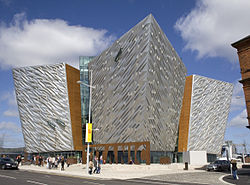
The Belfast Titanic is a Belfast Museum and Monument on the site of the former Harland and Wolf shipyard in the Titanic Quarter . Opened April 1, 2012
He tells stories about the ill-fated Titanic , who sank on his first voyage in 1912, and about his brothers, the ships Olympic and Britannic . The building contains more than 12 thousand square meters of area, most of which occupy a number of galleries, as well as private halls and utilities.
Content
History
The building is located on Queen's Island, a piece of land at the entrance to the Belfast Bay , which was freed from the water in the mid-19th century. It was used for many years by shipbuilders Harland and Wolf, who built huge stocks and dry docks to accommodate the simultaneous construction of the Olympic and the Titanic. The decline of shipbuilding in Belfast left much of the territory abandoned. Most of the abandoned structures on the island were destroyed. Some received the status of listed buildings , including slipways and dry docks of the Olympic and Titanic, as well as the iconic cranes Samson and Goliath [1] .
The abandoned lands were renamed the Titanic Quarter in 2001 and were intended for reconstruction by Harland and Wolf for a ten-year period [2] . An area of 100 hectares was subsequently purchased by Fred Olsen at a price of £ 46 million [3] , with another 23 hectares reserved for the science park. A further 78 hectares were sold to Harland and Wolf in 2002, for use in new development, including residential buildings, hotels and leisure facilities, as well as the Maritime Heritage Museum and Science Center [4] . In 2005, plans were announced to build a museum dedicated to the Titanic in order to attract tourists to the area, with plans for its completion by 2011 in honor of the centenary of the launch of the Titanic [5] .
A number of ideas have been put forward to attract visitors. Among the ideas considered were the reconstruction of massive steel portals in which the Olympic and the Titanic were built, [5] or the construction of the illuminated outline of the Titanic frame in the dock from which it was launched [6] . In June 2008, information was announced about the £ 64 million project - known at the time as the Titanic Dock [7] . Northern Ireland Tourism Secretary Arlene Foster announced that the Northern Ireland Cabinet will provide 50 percent of the funding through the Northern Ireland Tourism Board, and the remaining 50 percent will come from the private sector, represented by Titanic Quarter Limited and authorized by Belfast Harbor. Additional funding was pledged to Belfast . The task of attracting visitors was entrusted to the charity Titanic Foundation, which seeks to "educate people about the social, historical, industrial and marine heritage of Belfast through the history of the Titanic" [8] .
The building, now known as the Titanic Belfast, is expected to attract 400,000 visitors a year, of which 130,000–165,000 will come from outside Northern Ireland. It is assumed that it will serve a similar function as the Guggenheim Museum in Bilbao , designed by Frank Gehry , as a center for the revival of the city [8] . This is part of the Reconstruction of the Titanic’s relevance to the Titanic’s legacy in the Titanic Quarter, including the abandoned headquarters and drawing offices of Harland and Wolf, Nomadik - the last remaining White Star Line ship, as well as Hamilton dock, Titanic dock, pumping and slipway "Olympic" and "Titanic" [9] .
Design and Construction
Eric Kuhne and Associates has been tasked with working as lead concept architects. The construction of the building aims to reflect the history of Belfast in the shipbuilding and industrial heritage abandoned by Harland and Wolf. Its angular shape resembles the shape of the noses of ships, with its main “nose” between the Titanic and Olympic slipways on the Lagan River [8] (In addition, it was suggested that the building looks like an iceberg, and the locals nicknamed it Iceberg [10] . Most of the building’s façade is covered with 3000 single silver anodized aluminum tiles. With just one year to go until the Titanic disaster centenary, are Belfast's big projects on course ?, Belfast Telegraph (April 15, 2011). Building height 126 ft (38 m), ta the same height as the Titanic’s case [10] .
The interior of the five-story building has 12 thousand square meters of space [8] . Its center is a series of explanatory galleries to study aspects of the construction, design, flooding and heritage of the Titanic . On the top floor of the museum is the largest conference and reception hall in Belfast, Astor Suite, a banquet complex that can accommodate 750 people. The building also provides for educational, social activity, retail trade and restaurants, as well as a public resource center [11] .
The largest concrete plants in Ireland’s history, with 40,000 cubic meters of concrete delivered to 700 concrete mixers, participated in the construction of the £ 77 million building. Irish developer Harcourt Construction carried out the construction phase of the project [9] . It was managed by Harcourt Developments Ltd [11] .
In front of the building is a Rowan Gillespie Titanica sculpture depicting a sinking female figure. Made of bronze, it is mounted on a copper base, causing association with the design of figures on the bow of ships, designed to inspire hope. The figure was consecrated by representatives of the Anglican , Catholic , Methodist and Presbyterian churches on March 27, 2012, a few days before the opening of the Titanic Belfast [12] .
Exposition
The Belfast Titanic exhibition consists of nine explanatory and interactive galleries covering the following topics:
- The economic boom of Belfast is a city at the beginning of the 20th century.
The first gallery recreates scenes from Belfast during the construction of the Titanic in 1909-11. It shows the main industries of the city in front of the leading through the original gate from the Harland & Wolf shipyard, the interactive floor presents the construction plans of the Titanic, as well as original drawings and mock-ups of ships [13] .
- Shipyard - a trip on mini-cars around a copy of the Titanic steering wheel.
The second gallery is dominated by steel forests 20 meters high, which resemble the buildings of Arrol Gantry, intended for the construction of the Titanic and the Olympic. An elevator leads visitors to the top of the crane portal, where shipbuilding scenes are displayed using audio and images. The visit continues with a six-seater car that takes the visitor through the recreated shipyard, which is located around a copy of the huge Titanic steering wheel [13] .
- Descent - as the Titanic was launched May 31, 1911.
The Descent Gallery depicts scenes from the first day when the Titanic was launched in the Belfast Bay in the presence of 100,000 people. The windows overlook the slipways from which the Titanic was launched and the window allows visitors to see the slipways and docks as they appear to date [13] .
- Completion - completion of the Titanic from its descent to April 1912.
The fourth gallery is a huge model of the Titanic, designed to show how the ship was preparing to receive its passengers and crew and depicting all three classes of cabins. The central place in the gallery is a 360-degree computer tour of the Titanic through all levels of the ship, from the engine room to the dining room and the bridge [13] .
- The first flight is a journey from Belfast to Southampton, and from there to Cherbourg, Queenstown ( Cove ) and to the west.
The catastrophic first voyage of the ship is depicted in the fifth gallery, which shows the boat deck of the ship. Visitors can walk along the wooden deck, sit on benches or enjoy views of the docks and harbor. The gallery also features photographs of the ship of the Jesuit photographer, Father Francis Brown , who was aboard the Titanic on the section from Southampton to Queenstown (now Cove ) in southern Ireland [13] .
- Death is a disaster on April 14/15, 1912.
The sixth gallery depicts the death of the Titanic with the background sound of an SOS message being sent to other ships. Images of the death are combined with audio stories of the survivors and illustrations of press reports about the disaster. The walls of the iceberg are covered with 400 copies of life jackets, which depicts a sinking ship [13] .
- The consequences are the legacy of disaster.
Events after the death are described in the seventh gallery, in which a full-size copy of one of the lifeboats used to evacuate passengers from the ship prevails. American and British disaster investigations are depicted on both sides of the lifeboat in video and information panels. Visitors can use interactive screens to search for passengers and crew on lists to see if one of their relatives was on the ship. The gallery also provides information on the subsequent history of Harland and Wolf and the ships - the Titanic brothers [13] .
- Myths and legends are the facts behind some of the Titanic stories.
The catastrophe gave rise to many legends and myths immortalized through films, games, books and poems. With Celine Dion's My Heart Will Go On song playing in the background, visitors can explore aspects of pop culture inspired by the Titanic. An interactive screen will also allow visitors to explore ship myths [13] .
- Titanic at the bottom - about the place of flooding of the Titanic and its reopening.
The last gallery represents the Titanic, as it is now, 3,700 m below sea level in the North Atlantic. Presented in collaboration with the pioneer of the sunken Titanic, Dr. Robert Ballard , the gallery shows his expeditions to the ship through footage, audio, and images. The views of the flooded ship made by the Fisheye lens are set under a glass floor. Below the floor is the Ocean Research Center, the main scientific facility of the Titanic Belfast, which studies marine biology and conducts research in the coastal waters of Northern Ireland, as well as various Ballard expeditions around the world [13] .
Notes
- ↑ Case Study 3: Titanic Quarter (link not available) . Northern Ireland Environment Agency. Date of treatment March 19, 2012. Archived October 1, 2015.
- ↑ Macalister, Terry . Belfast yard on three-day week after £ 26m loss , The Guardian (February 6, 2001). Date of treatment March 19, 2012.
- ↑ Titanic relaunch , The Guardian (February 8, 2001). Date of treatment March 19, 2012.
- ↑ Titanic connection proves Belfast lifeline , The Guardian (13 April 2002). Date of treatment March 19, 2012.
- ↑ 1 2 Arendt, Paul . Titanic to come 'home' to Belfast , The Guardian (May 5, 2005). Date of treatment March 19, 2012.
- ↑ Peterkin, Tom . Relaunch for Titanic shipyard , The Daily Telegraph (October 19, 2005). Date of treatment March 19, 2012.
- ↑ McHugh, Michael . Titanic Quarter may get ship-shape £ 64m revamp (19 June 2008).
- ↑ 1 2 3 4 McConnell, Turlough . Architecture for a New Age, Irish America (October – November 2010).
- ↑ 1 2 With just one year to go until the Titanic disaster centenary, are Belfast's big projects on course ?, Belfast Telegraph (April 15, 2011).
- ↑ 1 2 Ediss, Tina . Belfast builds on the legacy of the Titanic, Sunday Express (April 15, 2012).
- ↑ 1 2 McGonagle, Suzanne . Structure aiming to capture spirit of Titanic under way - £ 97m venue will host 400,000 visitors a year, The Irish News (April 19, 2011).
- ↑ Richardson, David . Statue unveiled at Titanic Belfast , InsideIreland.ie (March 27, 2012). Archived on April 21, 2012. Date of appeal April 15, 2012.
- ↑ 1 2 3 4 5 6 7 8 9 Dougan, Patrice . Inside Titanic Belfast - a guided tour , Belfast Telegraph (April 2, 2012). Date of treatment April 2, 2012.