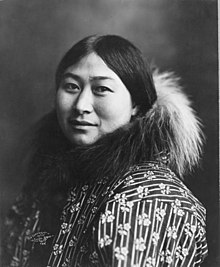


Mongoloid race [1] - one of the major races of mankind, common in North , East and South-East Asia (in South-East Asia there is an admixture of Australoids ), is also common in America among the Indian population ( American race ). The word "Mongoloid" is formed by the union of the word " Mongol " and the suffix "-oid", which means "similar." The term was introduced at the beginning of racial science to describe primarily the Asian populations of various countries in Central and East Asia . [2] [3] [4] [5] . It can be divided into Asian and American races.
Content
Characteristics
Black hard straight hair; dark eyes; small eyelashes; light or dark complexion; poor development of tertiary hair; strong cheekbone protrusion; flattened face; often low nose; spade teeth incisors; epicanthus and highly developed fold of the upper eyelid [6] .
Researchers
The term "Mongoloid" comes from the name of the Mongolian people, who in the XIII century captured most of Eurasia, creating the Mongolian empire . The term “Mongoloid race” by Christoph Miners was used for the first time in the “binary racial scheme”. His “two races,” called “Tatar-Caucasians,” included the Celtic and Slavic groups, as well as the “Mongols” [7] .
Johann Blumenbach borrowed the term "Mongols" from Christoph Miners, he called this race "second", [that] includes part of Asia beyond the Ganges and below the Amur River, along with the islands and most of those countries that are now called Australian " [ eight]
In 1861, Isidore Geoffroy Saint-Hilaire added the “Australian” as a “secondary race” (subrace) to the “Mongolian main race” [9] . In the XIX century, Georges Cuvier used the term "Mongols" again in the racial classification, but additionally included the concept of the American Indians [10] . Arthur de Gobino defined the "Mongolian race" as the "yellow", consisting of the Altai, Mongolian, Finnish and Tatar branches [11] [12] . Later, Thomas Huxley used the term "Mongoloid race", including the American Indians, as well as the Arctic Native Americans [13] . Other designations have been proposed, for example, “Mesochroi” (medium color) [14] , but “Mongoloid” has become widespread.
In 1882, Augustus Henry Keen declared that the "Mongolian type" includes the following "races": "Tibetans", "Burmese", "Thai", "Koreans", "Japanese", Ruks, and "Malays". Keen singled out the peoples of “ Caucasoid varieties,” that is, Uzbeks and Tajiks, considering them to be explicit representatives of the European race. He believed that the "Mongolian race" is best represented by the Buryats [15] .
In 1940, anthropologist Franz Boas included the “American races” in the framework of the “Mongoloid race”, among the aforementioned Aztecs in Mexico and Mayan Yucatan . He also noted that of the races of the Old World, East Asians are closest to Native Americans [16] .
In 1983, Douglas Futuyma , a professor of evolutionary processes at the University of Michigan, argued that the inclusion of Native Americans and Pacific Islanders in the Mongoloid race was not recognized by many anthropologists, who consider them to be representatives of different races [17] .
In 1984, Roger J. Lederer, professor of biological sciences at the University of California at Chico, listed Mongoloid races from Pacific islands and American Indians separately [18] .
In 1998, Jack D. Forbes, a professor of American Indian studies and anthropology at the University of California (Davis), stated that the racial type of indigenous peoples in North and South America "does not fall" in the Mongoloid racial categories. He noted that due to the different physical features of Native Americans, such as the shape of the head, which seems hardly distinguishable from many Europeans, Native Americans should either have been formed from a mixture of Mongoloids and Caucasians, or they originated from ancestors, whose type combined signs like Mongoloid , and the Caucasians [19] .
Markku Niskanen (Department of Anthropology at the University of Oulu , Finland ) disputes the former statement about the Mongoloid Finno-Ugric peoples. He argues that the reality is that “Balto-Finns,” Saami , “Volga Finns,” “Perm Finns,” and Hungarians are phenotypically and genetically typical Europeans [20] .
Unlike Niskanen, geneticist Luigi Luka Cavalli-Sforza of Stanford University (1994) stated that a genetic study of the Sami showed 47.5% of the "Mongoloid" and 52.5 "Caucasoid" genes with an error of ± 4.9%. Cavalli-Sforza considers the Caucasoid part of the Sami DNA, which "probably came" from Scandinavia, and their "Mongoloid" side - of Siberian origin [21] .
In 1995, Dr. Marta Mirazon Lar of the Department of Biological Anthropology at the University of Cambridge grouped all Asian populations under the name of “Mongoloid”, while the populations of northeastern Asia turned out to be typical Mongoloid and the other groups were atypical [22] .
History and signs
The most typical sign of the Mongoloid race - spatulate incisors - is already found in the synanthropists who lived 420 thousand years ago [23] .
In the Mesolithic, Mongoloid (or, more precisely, a complex of racial characteristics close to the Mongoloid) is noted in Europe (Bavaria) [24] . However, given the presence of “craniological polymorphism” up to the Holocene, that is, a wide variety of racial characteristics even within a small area, this cannot be unambiguously considered a manifestation of kinship - a similar complex of signs could have been formed within the parallel evolution of various groups.
The Mongoloid complex of characters was not pronounced and widespread until the advent of agriculture and the centralized states of China. Its distribution can be associated with a small population, the transition of which to agriculture has given significant advantages over carriers of other racial types [25] .
Notes
- ↑ Mongoloid race // BDT. T.20. M., 2012.
- ↑ Galileo Wept: Auspiciously (PDF). Emory University.
- ↑ Lieberman, Leonard Anthropology News. "Out of Our Skulls: Caucasoid, Mongoloid, Negroid? Volume 38, Issue 9, page 56, December 1997 . Onlinelibrary.wiley.com.
- ↑ Templeton, Alan R. Human Races: A Genetic and Evolutionary Perspective (PDF). Washington University . Realfuture.org.
- ↑ Keevak, Michael. "Becoming Yellow: A Short History of Racial Thinking." Princeton: Princeton University Press , 2011. ISBN 978-0-691-14031-5 .
- ↑ Mongoloid race // Great Soviet Encyclopedia : [in 30 tons.] / Ch. ed. A. M. Prokhorov . - 3rd ed. - M .: Soviet Encyclopedia, 1969-1978.
- ↑ Painter, Nell Irvin. Yale University. “Why White People are Called Caucasian?” 2003. (checked on September 27, 2007). ア ー カ イ ブ さ れ た コ ピ ー . The date of circulation is May 13, 2014. Archived October 20, 2013.
- ↑ Blumenbach, Johann. “The Anthropological Treatise of Johann Friedrich Blumenbach.” London: Longman Green, 1865.
- ↑ Deniker, Joseph. The Races of Man: An Outline of Anthropology and Ethnography C. Scribner's Sons: New York, 1900. ISBN 0-8369-5932-9
- ↑ [The End of Racism by Dinesh D'Souza, pg 124]
- ↑ Gobineau, Arthur. The Inequality of Human Races . - Putnam, 1915. - ISBN 0-86527-430-4 .
- ↑ DiPiero, Thomas. White Men Aren't gid / s work Duke University Press, 2002. ISBN 0-8223-2961-1
- Ux Huxley, Thomas, Mankind. 1870. August 14, 2006.
- ↑ James Dallas, “On the Primary Divisions and Geographical Distributions of Mankind”, 1886, United Kingdom and Ireland , p.304-30. James describes this as "equivalent to Professor Huxley's Mongoloid division" and as encompassing "Mongols and American Indians"
- ↑ Augustus Henry Keane. (1882). Asia. Stanford's Compendium for General Reading. London
- ↑ Boas, F. (1940). Race, language, and culture . New York: Macmillan.
- ↑ Futuyma, Douglas A. Evolutionary Biology. Massachusetts: Sinauer Associates, 1983. p. 520
- ↑ Lederer Roger J. Ecology and Field Biology. Cummings Publishing Company: California, 1984. ISBN 0-8053-5718-1 p.129
- ↑ Forbes, JD (1998). KENNEWICK MAN: A LEGAL HISTORICAL ANALYSIS. American Indian Review.
- ↑ Niskanen, M. (2002). The Baltic Finns from the Physical Anthropological Point of View. Mankind Quarterly Volume XLIII Number 2, Winter.
- ↑ Cavalli-Sforza, LL (2006). Presentation entitled “Genes and Languages.” (An excerpt from Genes, Peoples, and Languages. (2001). Penguin Press. Pp. 133-172.) Marges Linguistiques.
- Ah Lahr, MM (1995), Patterns of modern human diversification: Amerindian origins. American Journal of Physical Anthropology, 38: 163–198. doi: 10.1002 / ajpa.1330380609
- ↑ Anthropology. Theme 5. Race racial diversity
- ↑ Maloletko. Early migrations and racial evolution of Homo Sapiens (Inaccessible link) . The appeal date is December 23, 2006. Archived August 10, 2007.
- ↑ S. Drobyshevsky . Are the Indians protomorphic?
Links
- Mongoloid race // Great Soviet Encyclopedia : [in 30 t.] / Ch. ed. A. M. Prokhorov . - 3rd ed. - M .: Soviet Encyclopedia, 1969-1978.