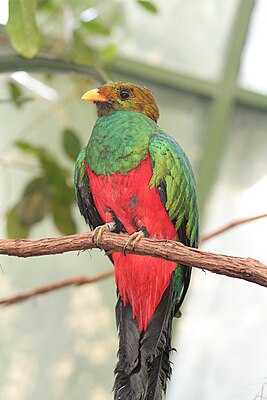
In appearance - typical tropical birds. They have a very bright coloring of plumage, in which green, red or blue tones predominate (usually with a metallic sheen); plumage is loose. They are characterized by medium and large sizes: the body length in most species ranges from 20 to 35 cm ( quesal is much larger: it has a body length with a tail of 120 cm [4] ). The wings are short and rounded, have 10 primary wing feathers . The tail of the trogons is long; there are 12 tail feathers. The beak is short and wide, the legs are weak, the foregrip is feathered. A distinctive feature of the trogon is the arrangement of the toes: the first and second toes are directed backward, the third and fourth to the front (while in other taxa of birds a different pattern is observed: if two fingers are directed backwards, then this is the first and fourth) [5] .
Tropical and subtropical forests live in three parts of the world: America (from the southern borders of Texas and Arizona to Argentina ), Asia (South and Southeast Asia), Africa (south of the Sahara , but without the southern tip of the mainland). They are found both in hot valleys and in cool zones of high mountains. Some species penetrate the cultural landscape: nest on coffee plantations [6] .
Trogon lead a sedentary and sedentary lifestyle; fly only short distances. They feed, taking off from a branch and grabbing insects on the fly or picking small fruits; also feed on mollusks. At the same time, insects predominate in African species in the diet (which they, like flycatchers , catch on the fly), and in Asian and American species, fruits and berries (a quesal, if necessary , can grab a frog, lizard or snake) [4] .
Trogons are usually found either alone or in pairs (much less often - in small groups). Monogamous . Nest in natural hollows; representatives of some species make nesting holes in nests of tree termites and paper wasps (before making a hole in an aspen nest, a bird eats wasps and their larvae). The female lays directly to the bottom of the hollow from 2 to 4 rounded eggs, which is whitish. Hatching (in which both the female and the male participate) lasts up to three weeks. The development of the chicks occurs according to the chick type; they are born without plumage and are in the nest from 15 to 25 days [4] .
The family of Trogonidae (Trogonidae) includes 8 genera, 40 species (living) :
- Genus Apaloderma - African trogons
- Apaloderma narina - African bridle trogon
- Apaloderma aequatoriale - Yellow - cheeked African trogon
- Apaloderma vittatum - African Mountain Trogon
- Genus Apalharpactes - Sonde trogons
- Apalharpactes reinwardtii - Asian blue - tailed trogon [2]
- Apalharpactes mackloti - Sumatran Trogon
- Genus Euptilotis - Eared trogons
- Euptilotis neoxenus - Eared Trogon
- Harpactes genus - Asiatic trogons
- Harpactes fasciatus - Malabari Asiatic Trogon
- Harpactes kasumba - Red Head Asian Trogon
- Harpactes diardii - Necklace Asian Trogon
- Harpactes ardens - philippine asian trogon
- Harpactes whiteheadi - Whitehead Asian Trogon
- Harpactes orrhophaeus - Brown-headed Asian trogon
- Harpactes duvaucelii - Red - faced Asian Trogon
- Harpactes erythrocephalus - Asian Red-headed Trogon
- Harpactes oreskios - Green-headed Asian trogon
- Harpactes wardi - Pink - tailed Asian trogon
- Genus Pharomachrus - Quezali
- Pharomachrus mocinno - Quesal
- Pharomachrus antisianus - Crested Quesal
- Pharomachrus fulgidus - Diamond Quesal
- Pharomachrus auriceps
- Pharomachrus pavoninus - Gold - headed quesal
- Genus Priotelus - Cuban trogons
- Priotelus temnurus - Cuban Trogon
- Genus Temnotrogon - Haitian trogons
- Temnotrogon roseigaster - Pink-bellied trogon
- Rod Trogon - Real Trogons
- Trogon melanocephalus
- Trogon citreolus - Gray-headed Trogon
- Trogon viridis - White-Tailed Trogon
- Trogon bairdii
- Trogon violaceus - Purple Trogon
- Trogon mexicanus - Mountain Trogon
- Trogon comptus - Blue Tailed Trogon
- Trogon collaris - Collared Trogon
- Trogon elegans - Copper Trogon
- Trogon aurantiiventris - Gold-bellied Trogon
- Trogon personatus - Masked Trogon
- Trogon rufus - Black - throated Trogon
- Trogon surrucura - Trogon-suruku
- Trogon curucui - Blue Crown Trogon
- Trogon melanurus - Black-Tailed Trogon
- Trogon massena - Shedtail Trogon
- Trogon clathratus - Hawk-Tailed Trogon
One of the most famous representatives of the family is the quesal ( Pharomachrus mocinno ), which in Guatemala is the national symbol of the country - the symbol of freedom (indeed, the quesal does not survive in captivity) [7] .
In addition to the existing genera, the trogon family includes three extinct genera: the paratrogon ( Paratrogon Lambrecht, 1933 ; lower — Middle Miocene of France) [8] , primotrogon ( Primotrogon Mayr, 1999 ; Middle Eocene of Germany and the Lower Oligocene of France) and Septentrogon ( Septentrogon Kristoffersen, 2002 ; Lower Eocene of Denmark) [3] .
Initially, the genus Archeotrogon was assigned to the family of trogons . ( Archaeotrogon Milne-Edward, 1891 ; Upper Eocene - Lower Oligocene of France); in 1980, it was isolated into a separate family Archaeotrogonidae [8] , which so far is not included in any orders, but is brought closer to goat-like and swift-like [9] .
The phylogenetic relationships between the genera of the carinaids are represented by the following cladogram, constructed in accordance with the results of a study by R. Moyle (2005) [10] .
| † Paratrogon |
|
| † Primotrogon |
|
| |
|