Oleg Olzhich (real name and surname is Oleg Aleksandrovich Kandyba , Ukrainian Oleg Oleksandrovich Kandiba ; 1907 - 1944 ) - Ukrainian archaeologist, poet and translator, activist of the Organization of Ukrainian Nationalists .
| Oleg Olzhich | |
|---|---|
| Ukrainian Oleg Olzhich | |
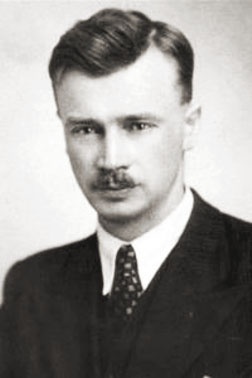 | |
| Birth name | Ukrainian Oleg Oleksandrovich Candiba |
| Date of Birth | July 8, 1907 |
| Place of Birth | Zhytomyr |
| Date of death | June 10, 1944 (36 years old) |
| Place of death | Sachsenhausen |
| Citizenship (citizenship) | |
| Occupation | archaeologist , poet , translator |
| Language of Works | Ukrainian |
Content
Biography
Born in Zhitomir on the corner of the current streets of Olzhich and Starovilskaya. The son of the famous Ukrainian writer and poet Alexander Ivanovich Kandyba, who wrote under the pseudonym Oleksandr Oles .
In the years 1912-1919. the family lived in Kiev in an apartment building on the New Building (64/16 Antonovich St .; the house is in disrepair). There Oleg began to attend school. In the years 1919-1922. He lived and studied at the Pushcha Voditsa secondary labor school near Kiev .
In 1918, Oleg’s father, having received a diplomatic passport from a cultural attaché in Hungary , went to Vienna . However, in 1922, in the year of Russia’s rapprochement with Germany, when the opportunity arose to create a “legal” intelligence residence in Europe with Russia's plenipotentiary in Berlin, the government of Ukraine in Kharkov, represented by the Minister of Education of the Ukrainian Soviet Republic V. Zatonsky and the chairman, became interested in the fate of the Kandyb family Council of People's Commissars of the USR H. Rakovsky . With their participation, the family quickly, in 1-2 months, received foreign passports, which was an unheard of rarity, and at the end of December 1922 left for Berlin .
In 1923, the family moved to Prague , in the summer rented a cottage in Rzhevnitsy. Disgraced in Berlin circles (after the publication of the satirical collection Perezva about the life of the Ukrainian emigration in Berlin), Oles suddenly found himself in demand in Ukraine, where this collection was published under the title Emigrazіna perezva. The poet received a good fee, which allowed the reunited family to begin a comfortable life. Until the early 1930s, Oles was regularly published in Ukraine, which gave him a steady income.
In the fall of 1923, Oleg and his mother returned to Prague and entered the paid full-year one-year gymnasium courses at the Ukrainian Public Committee in Prague. On December 11, 1924 he graduated with honors, which gave him the right to enroll as a volunteer in any higher educational institution in Czechoslovakia. Then he enrolled as a volunteer in the literary and historical department of the Ukrainian Higher Pedagogical Institute. Dragomanova in Prague, at the Ukrainian Free University , where he attended lectures on archeology prof. V. M. Scherbakovsky , and the Faculty of Philosophy of Charles University (winter semester 1925).
In the summer of 1926 he passed additional exams in Latin and became an ordinary student in the archaeological department of Charles University (paid course). In 1928, received a grant from the Scientific Partnership named after Shevchenko in Lviv on an expedition to Belche Gold.
While working in the archaeological department of the National Museum of Czechoslovakia, he also made scientific expeditions to Western Ukrainian lands, to Germany and the Balkan countries.
In the spring of 1932, the II Ukrainian Scientific Congress was held in Prague, at which the subsection of archeology and art history worked, where V. M. Shcherbakovsky chaired. Oleg Kandyba made two reports on Ukrainian hand-drawn ceramics. Perhaps, after serious theoretical disagreements arose at a conference with Shcherbakovsky and other followers of the Lyubor school, Niederle was dismissed from the Department of Archeology of the University of Ukraine and from the staff of the State Archaeological Institute in Prague.
Even in his youth, he began to take part in the Ukrainian nationalist movement. Since 1929 - Member of the Organization of Ukrainian Nationalists . Fulfilled a number of responsible tasks of the Board ("Leads") of the Ukrainian Nationalists, primarily Eugene Konovalets . At the same time, like everyone in Konovalets’s closest circle, he came to the attention of the German special services. In 1937 he headed the cultural and educational referential board. In the late 1930s. edited the magazine "Samostіyna Dumka", turned it into an organ of the Board of the OUN. In 1938–39 He took an active part in the activities of short-term state education - the Carpathian Ukraine - and in its armed struggle against the Hungarian invaders. He was arrested by soldiers of the Hungarian army and spent three days in prison, released at the request of Hungarian scientists. In 1939-1941 he headed the Revolutionary Tribunal of the OUN , was a member of the Board ("Provid") of Ukrainian Nationalists.
In 1938, on the instructions of the OUN Wire, the delegation ( Viktor Kurmanovich , Yaroslav Baranovsky , Roman Sushko ) was sent to the United States . The purpose of the visit was the organization of the Ukrainian Scientific Institute in America (UNIA), which was never created. As part of the preparation of a collection of scientific articles by Ukrainian emigrant scientists in Prague, under the auspices of a non-existent UNIA, he published an article on archeology, which became his last scientific work.
Since the early 1930s declared himself as a poet. He collaborated in the Lviv periodicals Literary and Scientific Noun, Vistnik, Obrіy, Frontier, Prague Student News, Probom.
At the beginning of World War II, he was one of the leaders of the “ OUN marching groups ” (supporters of Andriy Melnik ) who arrived in Ukraine to form the police and local administration. Together with the Olzhich Main Campaign Group, the militarized formation " Bukovinsky Kuren " arrived in Kiev. In 1941-1942 legally lived in occupied Kiev , with the knowledge of the German commandant's office, occupying apartments in the city center (Khreschatyk, 25, Passage; then the Golden Gate district), established a network of OUN (M) in Ukraine. In October 1941, he became one of the organizers of the Ukrainian National Council .
With the beginning of Hitler's repressions against Ukrainian nationalists, he moved to Lviv. In May 1942, the PUN Pochaev Conference elected him deputy chairman of the PUN and chairman of the Wire on Ukrainian lands.
On August 2, 1943, in the remote village of Yablunka-Vizhnia near Turki in the Boykov region, he married the daughter of the literary critic L. Beletsky, Yekaterin (Kalina).
In January 1944, after the arrest of Andriy Melnik, he took up the post of Chairman of the PUN OUN.
On May 25, 1944, the Gestapo was arrested. He was imprisoned in the Sachsenhausen concentration camp. He died during another interrogation on the night of June 9-10, 1944, tortured by the Gestapo troika (Wolf, Wiersing, Schulz).
Memory
In Lviv, a memorial plaque was installed on the house where Olzhich was arrested in 1944. The school in Pushcha-Voditsa, in which O. Olzhich studied, bears his name. It is planned to erect a monument to Olzhich in Kiev on Olena Teligi Street , opposite Olzhich Street. In Kiev, a memorial plaque was installed on the house where he lived in 1941-42 (Kiev, 15 Lev Tolstoy St.).
In Zhitomir, the street on which he was born was named after him (the house where he was born was demolished in the 1980s).
Literature
- O. Olzhich. The train. Prose. - Kyiv: Vidavnitstvo im. Oleni Teligi, 2007 .-- 544 p. - 1000 approx. ISBN 978-966-7601-97-3
- Translations into Russian: I. Kachurovsky; V. Yaskova
- M. Yu. Videiko, S. І. Kot., K., Our Hour, Naukova Spadshchina Oleg Olzhich, 2008 - ISBN 978-966-1530-13-2
- Vinar L., Atamanenko A. Oleg Kandiba і Ukrainian Science Institute of America: 1937-1939 // Olzhich O. In memoriam. - K., 2008. -
p. 344-345.
- Tragic optimist. “Day” is the daily socio-political newspaper of Ukraine No. 119, dated July 20, 2007.
- Tragic optimist. Afterword. "Newspaper 2000" - a weekly of public life, No. 6 (448) February 6 - 12, 2009