This is an article about the locomotive. On the cruise missile, see K-10C .
| K-10 (КН-10,10КА) | |
|---|---|
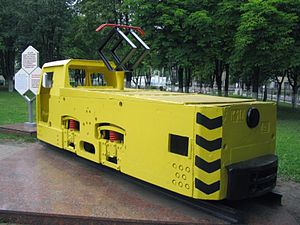 Electric locomotive K-10 | |
| Production | |
| Country of construction |  USSR , USSR ,  Russia , Russia ,  Kazakhstan Kazakhstan |
| Plants | Aleksandrovsky Machine-Building Plant [1] , Novocherkassk Electric Locomotive Building Plant (produces electric locomotives under the KN-10 series), PJSC PKF "Amplitude" (analogue of an electric locomotive under the brand name 10KA) [2] PC " Kazzincmash " Ridder (Kazakhstan) |
| Years built | 1971 - [to present] |
| Total built | K-10 - more than 5600, KN-10 - more than 900 |
| Technical details | |
| Type of service | mine, industrial |
| Type of current and voltage in the contact network | direct current, 250 V |
| Axial formula | 2 o |
| Full service weight | 10 t. |
| Load from driving axles on rails | 5 t. |
| Locomotive Length | 4520, 4920 or 5200 mm (depending on version) |
| Wheel diameter | 680 mm |
| Track width | 550, 575, 600, 750 and 900 mm |
| TED type | NB-33/20 (КН-10) |
| Hourly power TED | 2 × 33 kW |
| Hour force | 19 kN |
| Hour rate | 11.7 km / h |
| Continuous power TED | 2 × 20 kW |
| Durable traction | 9.5 kN |
| Structural speed | 25 km / h |
| Electric braking | Start-brake resistors PTR-27 |
| Exploitation | |
| Country | |
| Period | - |
The K-10 electric locomotive is a narrow-gauge coal mine electric locomotive designed for operation on the mine and industrial narrow-gauge railways electrified according to the 250 V DC system. dust, but also used in ground operation at various electrified railway railways of industrial enterprises.
The first electric locomotive of this series was produced in 1971 at the Aleksandrovsky Machine-Building Plant , from 1973 to the present it has been mass-produced. In 2011, the anniversary locomotive of this series with the number 5555 was released [3] . At the moment, electric locomotives of this series are the most common mine locomotives in Russia. Similar electric locomotives, having the designation of the KN-10 series and minor design differences, are produced at the Novocherkassk Electric Locomotive Building Plant . Also, the modified analogue is produced at the plant PJSC PKF "Amplitude" under the marking 10KA .
Construction
K-10 (KN-10) electric locomotives are locomotives with two leading wheel pairs located in one frame. The driver's cab is located in the end part of the locomotive. Electric locomotives have many modifications in the shape and height of the driver's cab, body length, type of current collector and gauge (the most common are modifications for 750 and 900 mm). As a rule, electric locomotives delivered to ground-based enterprises are equipped with more spacious driver's cabs and are designed for a greater height of the contact wire.
The main components of the body are the frame and control cabin. The frame body collapsible design, made of two sidewalls connected by cast buffer bars at the ends, two intermediate beams and a transverse wall. The frame suspension is balanced, consists of two external and two internal springs. To smooth the longitudinal vibrations of the sprung part, friction dampers are used. The upper part of the cab is welded to the driver’s structure, and its attachment to the frame is carried out using bolted joints. The cabin is glazed and equipped with wipers, inside there is a control equipment for electrical and pneumatic equipment of an electric locomotive, as well as a driver's seat.
The body length of the electric locomotive of the basic configuration on the frame is 4520 mm, the length of the pin hitch buffers is 4920 mm, the base length is 1200 mm, the body width is 1350 mm, the body height on the cab roof from the rail head is 1650 mm. The distance from the hitch axis to the rail head with new tires is 320 mm. The distance from the rail head to the working surface of the current collector in the working position is 1800–2300 mm. The minimum radius of curves passed by an electric locomotive is 12 meters.
The locomotive can be controlled from the driver’s cab or remotely. For remote control, a KM-7 driver controller is used, consisting of two control switches: main and reversible. The switching contacts of the main switch are assembled on the basis of cam elements and equipped with arc suppressors. Contact reversing switch finger.
The chassis consists of two consecutive wheel-motor units . Each unit includes a traction motor, a wheel set, a cylindrical-bevel gearbox and two axle boxes . On one wheel-motor unit mounted speed sensor. The traction motor NB-33/20 of direct current is located on the axial-type suspension and is a 4-pole electric machine with a series of excitation, protected mine normal performance, with self-ventilation.
The standard model of an electric locomotive is equipped with a pantograph-type TRN-H current collector with a safety device-synchronizer, a spring drive for lifting and a manual drive for lowering from the cab. The working height of the current collector is from 500 to 1100 mm, weight - 40 kg. Voltage stabilizer CH-7 is designed to convert and maintain the set voltage of the power supply of lighting circuits and auxiliary equipment.
The electric locomotive is equipped with a shoe brake with a manual and pneumatic drive and an electrodynamic resistance-controlled brake with a manual drive from the handle of the driver's controller. For resistive start-up and braking, the PTR-27 starting and braking resistor is used. The resistor is a unit consisting of three tape resistors of the framework type, and is installed in the body of an electric locomotive.
K-10 electric locomotives of the Zarai building materials plant
One of the first electric locomotives of the K-10 series arrived at the Zaraisk building materials plant in 1971 to transport sand from the quarry to the factory, where it was subjected to a serious modernization of the body. The traditional upper part of the electric locomotive and the driver's cab attached to it from the side was removed, and the entire length of the locomotive body was installed in its place. The entrance to the cockpit is from the end opposite to the control panel. Electrical equipment was moved under the floor, and searchlights and two types of current collectors were installed on the roof - standard and side. The side current collector is made in the form of a rod, pulled out manually by an assistant driver, and is used when the locomotive is moving at the loading point, where the contact wire can be suspended only on the side of the track. Later, 4 more electric locomotives (the last locomotive in 1991) arrived in Zaraysk , which were subjected to a similar modernization. [four]
As of the beginning of the 2000s, the very first electric locomotive was decommissioned and cut, the remaining 4 locomotives, which received inventory numbers from 1 to 4, were used for the transportation of trolleys (while 2 locomotives were in operation, and 2 were defended at dead ends). Locomotives were serviced by a brigade of 2 people. As of 2005, electric locomotive No. 1 was rejected from work, and in 2008 - No. 2. At the end of 2008, the narrow-gauge railway was closed, and electric locomotives were in an abandoned state until 2010. It was decided to save one of the electric locomotives as a monument, the rest were most likely cut into scrap metal.
Abandoned locomotive number 1
Electric locomotive number 3
Cabin locomotive number 3