GP1 ( P- type gas turbine locomotive, type 1 ) - a series of experimental Soviet gas-turbine diesel locomotives with electric transmission , produced in 1964 by the Kolomensky diesel locomotive plant in the amount of 2 units. The gas turbine locomotive was designed based on the TEP60 passenger locomotive.
| Gas turbine GP1 | |
|---|---|
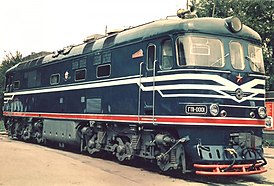 Gas turbine locomotive GP1-0001 on the territory of Kolomensky Zavod, 1964 | |
| Basic data | |
| Prime mover | Gas turbine |
| Year of construction | 1964 |
| Country of construction |  the USSR the USSR |
| Plant | Kolomna diesel locomotive |
| Total built | 2 [1] |
| Technical details | |
| Kind of service | passenger [1] |
| Axial formula | 3 0 -3 0 [1] |
| Locomotive length | 19 250 mm [1] |
| Diameter of driving wheels | 1050 mm [1] |
| Track width | 1520 mm [1] |
| Working weight | 129 t [1] |
| Rail axle load | 21.5 tf [1] |
| Turbine type | GP-3,5 [1] |
| Turbine power | 3,500 h.p. [one] |
| Gear type | Electric |
| Type TED | ED-105A [1] |
| TED output power | 6x305 kW [1] |
| Traction force | 12 500 kgf [1] |
| Construction speed | 160 km / h [1] |
| Exploitation | |
Content
- 1 History
- 1.1 Design
- 1.2 Operation
- 2 Design
- 3 notes
History
Design
In 1959, at the Kolomna diesel locomotive plant named. An experimental section of the G1 gas turbine locomotive was built by V.V. Kuybyshev , and soon at a meeting of the Committee of the Scientific and Technical Council of the Ministry of Railways it was decided to build two more passenger gas turbine locomotives to more quickly gain experience in operating such locomotives.
However, their design and manufacturing did not begin until 1963. There were several reasons for this pause: a different view of the economic efficiency of gas turbines compared to diesel locomotives by specialists, on whom the decision to begin work on new gas turbines depended to some degree; very limited experience in operating the G1-01 gas turbine locomotive; termination of gas train orders by US railways; reduction of sections of the USSR railway network serviced by steam locomotives and more suitable for introducing gas turbine locomotives than sections with diesel and especially electric traction.
When creating new locomotives, it was decided to use the body and electrical equipment of the TEP60 diesel locomotive as the basis, and instead of the diesel, install a gas turbine power plant similar to the G1 gas turbine locomotive. At the end of 1964, the plant completed the production of two passenger gas turbine locomotives, which received the designations GP1-0001 and GP1-0002.
Work on the creation of gas turbine locomotives began during the development of the production of diesel locomotives of the TEZ series, when there were no diesel locomotives with 3000 hp diesel engines yet. in one section. At that time, it was assumed that it would be possible to design and build gas turbine locomotives with technical characteristics that would allow them to operate with greater economic effect than diesel locomotives. However, gas turbine locomotives created by 1965 in this respect were inferior to existing diesel locomotives of the TE10 and TEP60 series with 3000 hp diesel engines.
Operation
At the beginning of 1965, the gas turbine locomotive GP1-0002 entered for testing on the experimental ring VNIIZhT . At the end of 1965, both locomotives were transferred for trial operation in the Lgov depot along with the G1-01 gas turbine locomotive. Also, to compare the performance of three experimental gas turbine locomotives with the performance of diesel locomotives when operating under the same conditions, the TEP60 series locomotives were sent to the Lgov depot.
Gas turbine locomotives GP1 initially drove passenger trains on the Lgov-Kiev section (395 km), but after the completion of the electrification in 1967 of the Kiev-Konotop-Khutor Mikhailovsky section, they started walking with trains only to Konotop (174 km). Also, passenger gas turbine carriers served sections of Lgov - Bryansk (208 km), Lgov - Gotnya (122 km), Lgov - Kursk (78 km), as well as suburban trains, in particular, on the section Lgov - Rylsk (64 km). At the same time, the G1-01 gas turbo locomotive operated with freight trains mainly on the Lgov - Bryansk section, as well as Lgov - Gotnya, Lgov - Kursk and Lgov - Vorozhba (99 km). However, while a cargo gas turbo locomotive drove trains quite rarely (3-4 trips per month), passenger trains were operated regularly, along with TEP60 series diesel locomotives assigned to the depot. As a result, the mileage of gas turbine locomotives GP1 turned out to be 3-4 times higher than that of G1-01.
The disadvantages of gas turbines compared with diesel locomotives were, first of all, greater fuel consumption and high level of external noise (in the driver’s cabs, the noise was within normal limits due to the presence of sound insulation). In addition, the capacity of gas turbine carriers during operation was not fully used, especially when working with commuter trains. These shortcomings, as well as the loss of interest in the gas turbine locomotive at the manufacturer and, as a result, the deterioration of the supply of spare parts for the depot, led to the fact that experimental locomotives were removed from train work in the early 70s, and were excluded from inventory after a few years.
Along with the cessation of operation of experimental gas turbine carriers assigned to the Lgov depot, the Ministry of Railways, fulfilling the order of the Council of Ministers, considered issues related to the use of gas turbine engines for train traction. In a report to the Council of Ministers dated April 22, 1971 signed by Minister of Railways B.P.Beshchev, it was said that the use of a gas turbine as a primary engine on an autonomous locomotive is advisable provided that the gas turbine installation has a coefficient of performance at a nominal rate of about 32% and acceptable fuel consumption at idle or partial loads. Gas turbine engines produced at that time did not meet these requirements, therefore, the solution to the problem depended on the creation of a transport gas turbine installation. Since the ways to create a gas turbine installation with the necessary parameters for gas turbine locomotives could not be found, further work on this type of locomotive was discontinued.
After the decommissioning, the gas turbines were dismantled and for a long time were in the depot of Lgov, and by the beginning of the 90s they were in rather poor condition. Soon they were cut into scrap metal and are currently not preserved.
Design
Gas turbine locomotives GP1 had bodies (with minor structural changes), bogies, electric traction motors ED-105A and gearboxes for passenger diesel locomotives of the TEP60 series. As a result, about 43% of the details of these locomotives turned out to be the same with the details of TEP60.
GP-3,5 single-cycle open-cycle gas turbine units without regeneration with a rated power of 3,500 hp were installed as the primary engine on the locomotives, the same as the last G1-01 gas turbine locomotive installations. The energy was transferred from the gas turbine engine to the wheelsets by electric, for which three MPT-74 / 23B traction DC generators with independent excitation and self-ventilation with a rated power of 667 kW were installed on each gas turbine locomotive (anchor speed 1800 rpm, voltage for long mode 470 V, maximum 700 V, current 1420 A). The generators were connected to the shaft of the gas turbine engine through gearboxes with a gear ratio of 185: 39 = 4.74. Two generators with a common shaft made up a two-machine unit, the third generator was a separate electric machine. The VT127 / 120A exciter was driven from its shaft, which differed in design from the VT275 / 120A exciter G1-01, but which had the same electrical parameters with it. Two traction motors connected in parallel were connected to each traction generator. In addition to complete excitement, it was possible to obtain two stages of the weakened one - 45–48% and 67–71%.
For maneuvers without starting a gas turbine installation on locomotives, there was a four-stroke V-shaped 12-cylinder diesel engine 1D12 of the Barnaul plant. The diameter of the diesel cylinders was 150 mm, the piston stroke was 180 and 186.7 mm. At a shaft speed of 1,500 rpm, the diesel developed a capacity of 300 liters. from. He put in rotation the anchor of the shunting generator MPT-49/25-ZK with a power of 195 kW (450 V, 434 A) and the auxiliary P-82 generator with a power of 24.5 kW (110 V, 222 A). All electric cars were manufactured by the Kharkov Electrotyazhmash plant.
ZST-135 acid battery with a capacity of 270 A.h and a voltage of 96 V, a refrigerator for cooling gas turbine engine oil, water and diesel oil, as well as auxiliary gear oil, were installed on gas turbines. The refrigerator was blown by air driven by two mechanically driven fans. Fans for cooling traction motors also had a mechanical drive. A compressor PK-35 of the Pervomaisk brake plant, driven by a diesel engine, was installed on gas turbines. During the operation of the gas turbine installation, the rotation frequency of the diesel and compressor shafts was 1100 rpm.
The locomotives were equipped with electro-pneumatic and pneumatic brakes with two-way brake pads.
During the long-term operation, gas turbines developed a thrust of 12,500 kgf and a speed of 50 km / h. The design speed of gas turbines was 160 km / h, the traction force at this speed was 4000 kgf. The stock of heavy fuel on locomotives was 8500 kg, diesel fuel - 850 kg, oil - 700 kg, water - 170 kg and sand - 600 kg. The working mass of gas turbines was 129 tons.
Notes
- ↑ 1 2 3 4 5 6 7 8 9 10 11 12 13 14 Rakov V. A. Passenger gas turbo locomotives GP1 // Locomotives of Russian Railways 1956 - 1975. - M .: Transport, 1999. - P. 201-203.