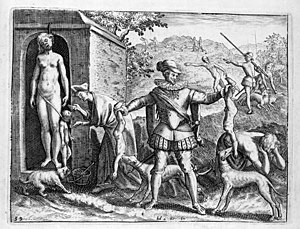
Black legend ( Spanish. La leyenda negra ) - Protestant propaganda from the time of the Counter-Reformation , which sought to put the Spanish Hapsburgs in the black light as the most powerful and decisive enemies of the Reformation . As a result, Catholic Spain of the 16th — 17th centuries was long accepted to be represented as the realm of effeminacy, inertia, and obscurantism.
The main breeding grounds for the "black legends" are the United Provinces , which for 80 years fought for independence from Spain, and Tudor England , which was under pressure from the Spanish fleet . It was here in the second half of the 16th century that the writings of Las Casas on how brutally the Spanish conquistadors treated defenseless Indians were especially in demand. The materials of Las Casas and the stories of the English navigators, collected in the book of Gakluyt , were used to illustrate the cruelty and fanaticism of the Spaniards [1] .
Another fertile material for denigrating Spanish society and mobilizing Protestants of all countries was the alleged atrocities of Spanish Inquisition against dissidents [2] . In the north of Italy, the “black legend” took the form of rumors about the ingenious “ intrigues of the Madrid court yard ” with the aim of subjugating the whole peninsula . Dutch authors painted in thick black all the activities of the Duke of Alba .
The term “black legend” was introduced into circulation in 1914 by the Spanish historian Julian Juderias . The Franco government set itself the task of not only opposing the “malicious distortion” of Spanish reality, but also of presenting Spanish history in a rosy light, thus falling into the opposite extreme (the so-called “white legend”) [3] .
Definition
The vocabulary of the Royal Spanish Academy defines the “black legend” as “a widespread opinion against all Spanish that began in the sixteenth century” and “a generally unfavorable opinion about someone or something, as a rule, unfounded.”
The origin of the term “black legend” is often associated with Julian Juderias, although its real origin is unknown. At the very least, Emilia Pardo Bazan and Vicente Blasco Ibáñez used this term earlier, [4] but the term became widely known precisely because of Juderes:
Julián Juderías, La Leyenda Negra (1914), p.24 :
[...] the atmosphere created by fantastic stories about our homeland that have appeared in all countries; grotesque descriptions of the Spanish character, both of the individual and society; by denying or at least systematically keeping silent about how beautiful and diverse are culture and art; the accusations to which Spain is constantly exposed based on exaggerated, misinterpreted or completely false facts; and, finally, the statement, many times reproduced in books that seemed to be respectable and true, discussed and strengthened by the foreign press, that our country is, from the point of view of tolerance, culture and political progress, a regrettable exception among European nations.
Original text (isp.)[...] el ambiente creado por los relatos fantásticos que acerca de nuestra patria han visto la luz pública en todos los países, las descripciones grotescas que se han he siémpre del carácter de los españoles como individuos y colectividad, a la êtes de los españoles heroso Ignorania sestemática de la Cuanto de loso de la Cultura de la Cultura de la Cultura a la firmación contenida en libros al parecer respetables y verídicos y muchas veces reproducida, comentada y ampliada en la Prensa extranjera, de que nuestra Patria constituente, desde el punto de vista de la tolerancia dentro del grupo de las naciones europeas.
The second classic on this theme is the “Hispanic-American History of the Black Legend” (Spanish: “Historia de la Leyenda Negra hispano-americana”) written by Romulo D. Karbia . If Houderias writes mainly about the European side of the legend, the Argentinian Carbia focuses on the American side. Thus, Carbia gives a broader definition of the concept:
Rómulo D. Carbia, Historia de la leyenda negra hispano-americana (1943) Carbia, p.34-35 :
the legend contains in its full scope, so to speak, in its typical forms, judgments about cruelty, obscurantism and political tyranny. About the cruelty she wanted to see in the process of spreading the Faith in America or defending it in Flanders, obscurantism, the alleged obstruction of all spiritual progress and any intellectual activity, and the tyranny that its bans choked the free life of Spaniards born in the New World, supposedly wanting to enslave them forever
Original text (isp.)[...] abarca la leyenda en su más cabal amplitud, es decir, en sus formas típicas de juicios sobre la crueldad, el obscurantismo y la tiranía política. A la crueldad se le ha querido ver los desimientos de que se echara mano para implantar la Fe en América o defenderla en Flandes; al obscurantismo, en la presunta obstrucción opuesta por aña año progreso espiritual ya cualquiera actividad de la inteligencia; ya la tiranía, en las restricciones con que se habría ahogado la vida libre de los españoles nacidos en el Nuevo Mundo ya quienes parecería se se hubiese querido esclavizar sine die
After Huderias and Karbia many other authors used this concept.
In 1944, the American Council on Education , concerned about the anti-Hispanic bias of educational materials in the United States , defined the concept in a long report as follows:
American Council on Education, Op. cit. Powell (1985), p.134; trad. García Carcel (1997), p.286 :
“Black legend” is a term used by Spanish writers to refer to ancient propaganda against the Iberian peoples, which began in the sixteenth century in England and has since been a weapon for opponents of Spain and Portugal in the religious, maritime and colonial wars of these four centuries.
Original Text (Eng.)It is a long time that it has been used in the sixteenth century. , maritime, and colonial wars of those four centuries.
Philip Wayne Powell in his book “Tree of Hate” (1971) defines “Black Legend” simply as a conviction:
Philip Wayne Powell, Tree of hate (1971), p.11 :
The main premise of the Black Legend is that the Spaniards have shown themselves historically to be extremely cruel, intolerant, tyrannical, obscurantist, lazy, fanatical, greedy and cunning, that is, they differ from other peoples so much that the Spaniards and the history of Spain should consider and understand in terms that are not commonly used to describe and interpret other nations.
Original Text (Eng.)It is the Spaniards have been shown, they are historically, cruel, bigoted, tyrannical, obscurantists, lazy, fanatical, greedy, and treacherous; This is what it means that it can be seen and understood in terms of what it means.
A more modern author, Manuel Fernandez Alvarez , defines the Black Legend as follows:
Manuel Fernández Álvarez, Op. cit. Alvar (1997), p.5 :
Careful distortion of the history of the people made by its enemies in order to better fight. And the most monstrous distortion in order to achieve the desired goal: the moral condemnation of this people, whose superiority had to be fought by all possible means.
Original text (isp.)Cuidadosa distorsión de la historia de un pueblo, realizada susjunos, para mejor combatirle. Y una distrosión lo más monstruosa posible, a financéra de los marrado obrativo marcado: la descalificación moral de ase pueblo, cuya supremacía hay que combatir por todos los medios.
For the philosopher Julian Marias , “The Black Legend” is an extremely unusual phenomenon in the whole world history. He describes it as follows.
Julián Marías, España, Responsible (1985), p.202; op.cit. Molina Martínez, p.25 :
The black legend is that, starting from a certain point, which we can consider true, expands to condemnation and disqualification of the whole country throughout its history, including the future . This is the original feature of the Black Legend. In the case of Spain, it begins at the beginning of the sixteenth century, becomes more dense in the seventeenth century, receives a new impetus in the eighteenth - will have to ask itself why - and swells, taking advantage of any occasion, never disappearing.
Original text (isp.)La Leyenda Negre consénte en que, partiendo de un punto concreto, que podemos suponer cierto, se é extiende la condenación des desalificación de todo el país alo largo de toda su historia, includia la futura . En eso consiste la peculiaridad de la Leyenda Negra. En el caso de España, se inicia a comienzos del siglo XVI, se hace más densa en el siglo XVII, rebrota con nuevo ímpetu en el XVIII-será menester preguntarse por qué- y reverdece con cualquier pretexto, sin prescribir jamás
The point of view that most historians agree on was expressed by William S. Maltby :
William S. Maltby, The Black Legend in England (1968), p.10-11 :
The black legend can not be the basis for a legal or fair point of view, but we must remember that this is a legend, not a myth. It originated, as legends do, from real events, and this cannot be ignored in the interests of political sympathies. The Spaniards have done a lot of evil, but the people of other nations, too.
Original Text (Eng.)It is necessary to recall the legend. It can not be ignored. Other nations [...]
Criticism
In recent years, a group of historians has been formed, including Alfredo Alvar , Ricardo Garcia Carsel , Lourdes Mateo Breton and Carmen Iglesias , who do not believe in the objective existence of a legend and believe that the “black legend” is nothing more than Spanish ideas about their image abroad. Carmen Iglesias spoke as follows:
Carmen Iglesias, Vaca de Osma, p.208 :
“Black legend” is, so to speak, the appearance of Spain, as Spain itself imagines [...]. “Black legend” consists, therefore, of negative features — objectively repeating, which the Spanish consciousness reveals in its image.
Original text (isp.)La le leyenda negra es es por así decir, la imagen exterior de [es] and los rasgos negativos — que son obetivamente los més repetidos— que la conciencia española descubre en la imagen de ella misma
Garcia Carsel directly denies the existence of the black legend in his book The Black Legend:
García Cárcel y Mateo Bretos, La leyenda negra (1991), p.84 :
This is not a legend, because so far a lot of negative opinions about Spain have not the slightest historical background, and not black, because the coloring has never been either permanent or continuous. A lot of gray, but the color of these opinions is always determined by the contrasting colors to them, which we called here the pink legend.
Original text (isp.)Ni leyenda Abundan los grises, pero la coloración de estas opinionas estuvo siempre determinada de los colores contrapues de lo que aquí hemos llamado leyenda rosa
According to the Hispanic historian Henry Kamen , the concept of “black legend” ceased to exist in the English language many years ago, although it is still used in the description of Spanish domestic politics [5] .
The position of Kamen and his book “The Empire” was strongly criticized by the writer Arturo Perez-Reverte and the historian and diplomat Jose Antonio Vaca de Osma [6] [7] . According to Waki de Osma, Kamen distorts arguments, repeating anti-Spanish themes and contradicts himself, transferring his claims from truth to lies [8] . The historian Joseph Pérez also believes that the “black legend” no longer exists, but its traces can still be found, and that the prejudices about Spain are indistinguishable from the prejudices about other countries [9] .
Argentine writer Ernesto Sabato in his article “Neither the Black Legend nor the White Legend” (“Ni leyenda negra ni leyenda blanca”), published in the newspaper El Pais in 1991, on the eve of the 500th anniversary of the discovery of America, proposed to overcome the “false dilemma "between two legends, such an interpretation that" not denying and not regretting the "atrocities committed by the torturers", at the same time being able to recognize the culture, language and racial mix that the Spaniards brought to America [10]
In fiction
The “black legend” was most consistently reflected in the work of the famous British writer-writer, the recognized master of adventure literature, G. R. Haggard . His historical novels “ The Daughter of Montezuma ” (1893), “ Leiden Beauty ” (1901), “ Beautiful Margaret ” (1907), “Mistress of Blossholma” (1909) - contain a negative image of Spain and the Spaniards of the Conquest era, against the background of the apparent exaltation of the Protestant religion and ethics to the detriment of Catholicism .
The Spanish colonial policy and the Catholic Church's activities in Europe and Latin America in historical essays and adventure novels by another British writer Raphael Sabatini - The Nights of History (1917), Odyssey of Captain Blood (1922), Dogs The Lord ” (1928),“ The Black Swan ”(1932),“ Columbus ”(1941), and others.
Notes
- ↑ Keen, Benjamin. 1969. The Black Legend Revisited: Assumptions and realities. The Hispanic American Historical Review. volume 49. no. 4. pp. 703-719.
- ↑ Kamen, Henry (23 November 2000). The Spanish Inquisition: An Historical Revision. Orion Publishing Group. p. 49. ISBN 1-84212-205-3
- ↑ Walsh, Anne L. (2007). Arturo Pérez-Reverte: narrative tricks and narrative strategies. London: Tamesis Books. p. 117. ISBN 1-85566-150-0 .
- ↑ Luis Español Bouché. La Leyenda Negra: una denuncia de Julián Juderías (español) // es: La Aventura de la Historia . - enero 2008. - Vol. 111 . - pp . 56-61 . ; Español Bouché, p. 112
- ↑ Henry Kamen. Henry Kamen // El Mundo. - 21 de agosto de 2001.
- ↑ Vaca de Osma (2004)
- ↑ Arturo Pérez-Reverte. La Historia, la sangría y el jabugo // XLSemanal. - 4 de septiembre de 2005. Archived February 7, 2009.
- Ver La verdad del Imperio Español // Alfa y Omega.
- ↑ Pérez, p.197-199; Agencia EFE. El hispanista Joseph Pérez da por superada la "leyenda negra" de España (Unreferenced) (not available link) . Google News (20 de noviembre de 2009). The date of circulation is 1 de mayo de 2010. Archived January 29, 2014.
- ↑ Ernesto Sabato. Ni leyenda negra ni leyenda blanca // El País. - Vol. 304 .