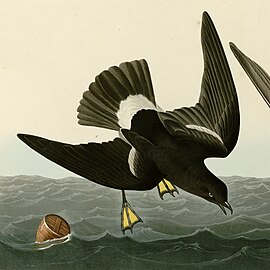
"Song of the Petrel" - a poem in prose , a literary work by Maxim Gorky , written in March 1901.
Content
- 1 Writing History
- 2 Value
- 3 Criticism
- 4 In culture
- 5 See also
- 6 References
Writing History
"Song of the Petrel" was written in response to the bloody crackdown of a student demonstration at the Kazan Cathedral in St. Petersburg on March 4, 1901. The writer at that time was associated with the Moscow organization Iskra , conducted revolutionary propaganda among students and workers, and initiated widespread public protests against the persecution of students. “... Spring dawns burn in my heart and I breathe deeply,” he wrote to L.N. Andreev in the spring of 1901.
Initially, the poem was part of the satirical short story “Spring Melodies”, where different sections of society were depicted as birds. The song "About the Petrel" here belongs to Chizhu , representing the younger generation. Censorship forbade the whole story to be published (the entire Spring Melodies were illegally printed on the hectograph by the Nizhny Novgorod radicals), but did not extend the ban on the song of the Chizhik. As a result, the poems were published in the journal Life as an independent work. Before being sent to print, Gorky changed the final phrase: instead of “Wait! Soon the storm will strike! ”Set“ Let the storm strike more strongly! ”.
On April 17, Gorky and his close friend, the poet S. G. Skitalets, were arrested and then deported from Nizhny Novgorod. Seeing the writer resulted in a mass demonstration. In May, Life magazine was closed.
Value
The release of the magazine with "Song of the Petrel" caused a stir among the gendarmes . After the release of "Songs of the Petrel", the author himself became known as the "petrel" and the "herald". "Song" was one of the reasons for the prohibition of the magazine - the number in which it was printed was the last. However, the distribution of the work did not end there. The Song of the Petrel was included in collections of revolutionary poems and songs that went abroad. Having become a combat password during the years of the first Russian revolution, the Song of the Petrel caused hatred in the reaction camp. In the advanced circles of Russian society, "The Song of the Petrel" was adopted as a fiery revolutionary proclamation; the work was widely distributed through illegal publications.
Bolshevik propaganda repeatedly used the images of "Songs of the Petrel", which is why, often, the work is perceived only in a political and temporary context . However, in the poem, in addition to invoking the "storm", the eternal theme of the loneliness of a brave hero, whose fearlessness is contrasted with cowardice, narrow-mindedness, the gray life of many ordinary people, is mentioned.
The Song of the Petrel was one of the most effective means of revolutionary propaganda, calling for the struggle against the autocracy.
Criticism
Anton Chekhov criticized Gorky for “The Song of the Petrel”. Stalinist repressions also affected ordinary citizens who doubted the literary significance of this work. So, according to the memoirs of Oleg Volkov :
I sat down for the great proletarian writer, ”said Ivan Sergeevich. - Rather, as formulated in the prosecution, for discrediting him. I celebrated my name day so badly. There were guests, all of them, by the way: work friends, old friends. A conspiracy about Gorky came ... Unclean and yanked me to say - I do not like his language, they say: artsy, a lot of foreign words ... Yes, he also drew Chekhov, who called “Song of the Petrel” with a set of crackling phrases.
- "Immersion in the darkness"
In Culture
- “Song” was put to music by P. N. Renchitsky (melodeclamation).
- According to the plot of the cartoon "Petrel", the student reads Gorky's poem, the words of which become reality.
- With the work of Gorky, the song from the cartoon “ In the Blue Sea, in White Foam ... ” literally and visually echoes.
- In the feature film Criminal Talent , the main character, Alexander Rukoyatkin, begins to read Maxim Gorky’s poem, Song of the Petrel, to the question of the investigator of the prosecutor’s office.
See also
- Imaginary prose
Links
- Sat “The revolutionary way of Gorky”, Center Archive. M. - L., 1933, pp. 50-51.
- E. Yaroslavsky. See: “The Gorky Revolutionary Way”, M. — L., 1933, p. 8 - 9
- http://www.a4format.ru/pdf_files_bio2/475a9f17.pdf