Fox cousin [1] [2] , or brushtail [2] , or fox-shaped pussum [2] , or common cousinous fox [2] ( Trichosurus vulpecula ) is a couscous mammal.
| Fox kuzu |
|---|
 |
|
| No rank : | Bilateral symmetrical |
| Squad: | Two-tailed marsupials |
| Suborder : | Phalangeriformes |
| Superfamily : | Phalangeroidea |
|
|
Trichosurus vulpecula ( Kerr , 1792) |
|
- T. v. vulpecula
- T. v. arnhemensis
- T. v. eburacensis
- T. v. johnsoni
- T. v. fuliginosus
|
|
|
|
Least ConcernedIUCN 3.1 Least Concern : 40585 |
|
Body length is from 32 to 58 cm, tail length is from 24 to 40 cm, weight is from 1.2 to 4.5 kg. Sexual dimorphism is expressed , males are much larger than females. The kuzu has a sharp muzzle, long ears, fur of gray color, sometimes brown, there are albinos. The tail is long and fluffy. The diploid number of chromosomes is 2n = 20.
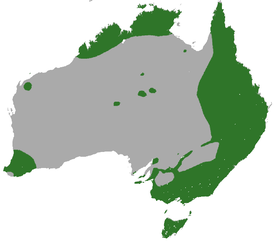
Lives in a large territory of eastern Australia, in some areas of western Australia, in particular near Perth , in the north of the mainland and on the island of Tasmania . In the 19th century, the fox kuzu was acclimatized, and then introduced to New Zealand .
Fox kuzu lives on trees, active at night. During the day, he rests in hollows or in peculiar nests. Also satisfied with the den. It feeds on leaves, berries, fruits.
The mating season has no clear boundaries; it lasts all year round. In New Zealand, however, according to Crowley (1973), a distinct breeding season is from April to July. Childbirth occurs in September – November and in March – May. Pregnancy lasts 16-18 days. 1 baby is born who lives with his mother for up to 9 months. In general, life expectancy is up to 13 years.
The main predators that prey on the fox body are birds of prey and monitor lizards. Previously, people in significant quantities destroyed these animals because of their valuable fur. It was exported from Australia under the name Australian Possum or Adelaide Chinchilla. In 1906 alone, 4 million fox skins were sold in the fur markets of New York and London. Today this species is under protection.