
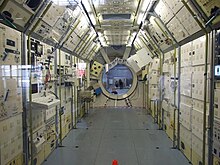
SpaceLab is an American reusable space laboratory , which the Space Shuttle could take on as a payload, designed to conduct experiments in Earth's orbit, under microgravity conditions. It is an analogue of a manned orbital station , performing only joint flight with a spacecraft . SpaceSlab consists of several components: a pressurized compartment, an unpressurized open platform, and other equipment placed in the cargo compartment of the shuttle, whose wings, as a rule, were opened during the flight. Each launch used its own set of components in accordance with the needs of the mission [1] [2] .


Content
Background
After the completion of the short-term project of the Skylab orbital station, the program for the development and creation of the SpaceSlab laboratory complex was carried out at the international level as a general Western project. This decision in many respects had a political basis, since it was associated with the change of the US Presidential Administration after the departure of Richard Nixon and the assumption of the presidency of Gerald Ford . SpaceSab was the most expensive aerospace project of the decade worth about $ 5.3 billion. Despite the fact that the program pursued peaceful goals, international technical cooperation was mainly carried out by NATO , with a few exceptions in satellite countries that were not formally members of the bloc ( Spain and Switzerland ), which implies the dual purpose of the ongoing program. Two German consortiums with foreign investments fought for the general contract for the creation of SpaceSab: Messerschmitt-Bölkow-Blom (MBB) and Entwicklungsring Nord (ERNO). The victory was ultimately won by the latter, which was a subsidiary of the association of the German concerns (VFW) and Fokker . Entwicklungsring Nord had not only foreign investments, but also foreign founders. Subsequently, Messerschmitt was invited to participate in the development of a spacecraft automatic orientation system for instruments and sent technical specialists to help the involved subcontractors. The station’s operation program was planned for the next five years after putting into orbit, or for fifty separate missions (spacecraft flights connecting to the station). In 1973, a memorandum of understanding was signed between the parties in the USA and Western Europe, in 1974 ERNO began the development of laboratory components. The development was carried out by American and Western European engineers in equal volume, from the American side the bulk of the work was carried out by the Marshall Space Center in Huntsville , Alabama , from the European side the European Center for Space Research and Technology (ESTEC) in Noordwijk , South Holland . The program was characterized by a high level of interaction: a significant number of European specialists worked in Huntsville, while there was a significant American presence in Noordwijk [3] .
The first manufactured components, including the LM1 laboratory, were donated by NASA for free in exchange for the possibility of flying European astronauts. NASA purchased the second laboratory module LM2 from ERNO for flights according to its own programs [4] [2] .
Sealed modules for SpaceSlab within the framework of ESA were built by Italy ( Italian Space Agency ); subsequently, this experience allowed ESA and Italy to create Columbus , Harmony , Calm , Dome, and Sealed Multipurpose Supply Modules (MPLM) Leonardo, Rafael, and the International Space Station (ISS). Donatello.
The smaller, but largely similar SpaceHub shuttle laboratory was set up by US private businesses.
Involved Structures
The following commercial structures took part in the creation of the SpaceLab:
- General contractor
- The spacecraft as a whole - , Bremen ;
- Founders: , Bremen ; Krupp GmbH , Essen , North Rhine-Westphalia ; Heinkel AG , Stuttgart , Baden-Wurttemberg ; Northrop corp. Hawthorne , California ; United Aircraft Corp. , Hartford , Connecticut ; Algemene Bank , Amsterdam .
- Associate Contractors
- Technical Consulting - McDonnell Douglas Aerospace Corp. , Huntsville , Alabama ; TRW, Inc. , Redondo Beach , California .
- Subcontractors
- Electricity network / Electrical equipment - AEG Telefunken
- Spacecraft Orientation System / Life Support System / Air Conditioning - Dornier
- Laboratory module - Aeritalia ;
- Information Management System / Hardware-software complex - Engins Matra , SEL ;
- Software - ;
- Cargo Compartment - Hawker-Siddeley ;
- Gateway / Portholes - Fokker ;
- Docking Module / Storage - ;
- Ground equipment - INTA , , BTM CIR , Hawker-Siddeley .
Missions with SpaceSalb
The open leaky platform consisted of separate sections; up to five such sections could go into flight. There were two airtight compartments: LM1 and LM2. For those flights, when only sections were sent into space, without airtight compartments, Igloo ( Igloo ), a small airtight module where instruments not working in vacuum were placed, was sometimes used [5] [6] .
The table below provides a list of flights in which from November 1981 to February 2000 the various components of SpaceSab participated [7] [8] .
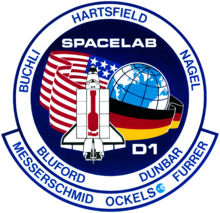
In addition to flights for ESA and NASA, a number of Spacebus missions on shuttles were carried out entirely in the interests and funds of other countries: two - Germany (D1 and D2), one - Japan (J).
| Flight | Shuttle | Launch date | Mission Space slab | Sealed compartment | Leaky platform |
|---|---|---|---|---|---|
| STS-2 | Colombia | November 12, 1981 | OSTA-1 | 1 section [9] | |
| STS-3 | Colombia | March 22, 1982 | OSS-1 | 1 section [10] | |
| STS-9 | Colombia | November 28, 1983 | Spacelab 1 | LM1 module | 1 section |
| STS-41-G | Challenger | October 5, 1984 | OSTA-3 | 1 section [11] | |
| STS-51-B | Challenger | April 29, 1985 | Spacelab 3 | LM1 module | MPESS |
| STS-51-F | Challenger | July 29, 1985 | Spacelab 2 | Igloo | 3 sections + IPS |
| STS-61-A | Challenger | October 30, 1985 | Spacelab D1 | LM2 module | MPESS |
| STS-35 | Colombia | December 2, 1990 | ASTRO-1 | Igloo | 2 sections + IPS |
| STS-40 | Colombia | June 5, 1991 | SLS-1 | LM1 module | |
| STS-42 | Discovery | January 22, 1992 | IML-1 | LM2 module | |
| STS-45 | Atlantis | March 24, 1992 | ATLAS-1 | Igloo | 2 sections |
| STS-50 | Colombia | June 25, 1992 | USML-1 | LM1 module | Edo |
| STS-46 | Atlantis | July 31, 1992 | 1 section [12] | ||
| STS-47 | Endeavor | September 12, 1992 | Spacelab-j | LM2 module | |
| STS-56 | Discovery | April 8, 1993 | ATLAS-2 | Igloo | 1 section |
| STS-55 | Colombia | April 26, 1993 | Spacelab d2 | LM1 module | Unique Support Structure (USS) |
| STS-58 | Colombia | October 18, 1993 | SLS-2 | LM2 module | Edo |
| STS-59 | Endeavor | April 9, 1994 | SRL-1 | 1 section | |
| STS-65 | Colombia | July 8, 1994 | IML-2 | LM1 module | Edo |
| STS-64 | Discovery | September 9, 1994 | LITE | 1 section [13] | |
| STS-68 | Endeavor | September 30, 1994 | SRL-2 | 1 section | |
| STS-66 | Atlantis | November 3, 1994 | ATLAS-3 | Igloo | 1 section |
| STS-67 | Endeavor | March 2, 1995 | ASTRO-2 | Igloo | 2 sections + EDO |
| STS-71 | Atlantis | June 27, 1995 | Spacelab-mir | LM2 module | |
| STS-73 | Colombia | October 20, 1995 | USML-2 | LM1 module | Edo |
| STS-75 | Colombia | February 22, 1996 | 1 section [11] | ||
| STS-78 | Colombia | June 20, 1996 | Lms | LM2 module | Edo |
| STS-82 | Discovery | February 21, 1997 | 1 section [11] | ||
| STS-83 | Colombia | April 4, 1997 | MSL-1 | LM1 module | Edo |
| STS-94 | Colombia | July 1, 1997 | MSL-1R | LM1 module | Edo |
| STS-90 | Colombia | April 17, 1998 | Neurolab | LM2 module | Edo |
| STS-99 | Endeavor | February 11, 2000 | SRTM | 1 section |
See also
- Spacehab
Notes
- ↑ Walter Froehlich. What is Spacelab? // Spacelab. An International Short-Stay Orbiting Laboratory .
- ↑ 1 2 C. Gatland. SpaceSlab // Space technology .
- ↑ Lewis, Richard . Spacelab and the Shuttle: NATO in orbit? // New Scientist . - London: New Science Publications, September 12, 1974. - Vol. 63 - No. 914 - P. 665-667.
- ↑ Lord, Douglas R. Spacelab: An international success story .
- ↑ Spacelab, Subsystems Igloo . Smithsonian National Air and Space Museum. Date of treatment April 13, 2012. Archived September 17, 2012.
- ↑ SPACELAB (English) . NASA Date of treatment April 13, 2012. Archived September 17, 2012.
- ↑ Most of the flights are listed on the NASA website , for flights not on this list, a separate link is provided.
- ↑ David Michael Harland. The Story of the space shuttle. - Springer Praxis, 2004 .-- P. 444. - ISBN 978-1-85233-793-3 .
- ↑ STS-2 . NASA Date of treatment April 12, 2012. Archived September 17, 2012.
- ↑ STS-3 . NASA Date of treatment April 12, 2012. Archived September 17, 2012.
- ↑ 1 2 3 Spacelab joined diverse scientists and disciplines on 28 Shuttle missions . NASA (March 15, 1999). Date of treatment April 12, 2012. Archived September 17, 2012.
- ↑ ESA hands over a piece of space history . Date of treatment April 12, 2012. Archived September 17, 2012.
- ↑ Tim Furniss, David Shayler, Michael Derek Shayler. Manned Spaceflight Log 1961-2006. - Springer Praxis, 2007 .-- P. 829.
Links
- NP-119 Science in Orbit: The Shuttle & Spacelab Experience, 1981-1986 . NASA Date of treatment April 13, 2012. Archived May 16, 2012.