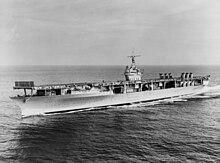

Storm nose ( English hurricane bow ) - a closed nose of an aircraft carrier , reaching in height to the level of the flight deck. The first aircraft carrier of this design was the English aircraft carrier Hermes , which went into operation in 1924. Lexington-type American aircraft carriers also had a similar design feature, the first of which became part of the US Navy in 1927. Prior to this (and on most aircraft carriers until the early 1950s), the flight deck was a deck raised above the hangar deck, and the hangar itself remained open from all sides.
The open hangar was convenient for deploying anti-aircraft artillery and an additional take-off strip, but it was extremely difficult to maintain aircraft in stormy conditions.
Most American aircraft carriers received a closed hangar as a result of modernization under the SCB-27 , SCB-110 programs.
The first closed-nose Japanese aircraft carrier was the Taihō.
Storm nose is also called a bulwark in the bow of the ship, used to improve seaworthiness. This design element is characteristic, for example, missile cruisers of the type "Ticonderoga" .
Photo
Bulwark of the cruiser CG-54 "Antietam"
Cruiser CG-57 “Lake Champlein” with a partially lost storm nose