STS-56 - 54th flight of the Space Shuttle spacecraft, sixteenth flight of the Discovery shuttle . The launch took place on April 8, and this is the eighth night launch of the shuttle, landing was April 17, 1993 . During the mission, the crew conducted a series of atmospheric studies and observations of the Sun [1] [2] .
| STS-56 | |
|---|---|
 | |
| General information | |
| Organization | |
| Ship flight data | |
| Ship name | Discovery |
| Shuttle Flight No. | 54 |
| Discovery Flight No. | 16 |
| Launch pad | KC Kennedy Launch Pad 39-B |
| Launch | April 8, 1993 5:29:00 UTC |
| Ship landing | April 17, 1993 11:37:19 UTC |
| Flight duration | 9 days 6 hours 8 minutes 19 seconds |
| Number of turns | 148 |
| Distance traveled | 6 202 407 km |
| Mood | 57.0 ° |
| NSSDC ID | 1993-023A |
| SCN | 22621 |
| Crew flight data | |
| Crew members | 5 |
| Crew photo | |
 | |
| Associated Expeditions | |
Content
- 1 crew
- 2 Flight Description
- 3 emblem
- 4 Gallery
- 5 notes
- 6 References
Crew
- ( NASA ): Kenneth D. Cameron (2) [3] - commander;
- (NASA): Stephen S. Oswald (2) - pilot;
- (NASA): C. Michael Foale (2) - Flight Specialist 1;
- (NASA): Kenneth D. Cockrell (1) - Flight Specialist 2;
- (NASA): Ellen Ochoa (1) - Flight Specialist 3.
Ellen Ochoa became the first Hispanic American in space [2] .
Flight Description
The flight was devoted to the study of the ozone layer of the atmosphere over the northern hemisphere using the ATLAS-2 laboratory. Its name is an acronym for Atmospheric Laboratory for Applications and Science (Laboratory for fundamental and applied research of the atmosphere) [2] .
ATLAS-2 is designed to collect data on the relationship between solar energy output and the middle layers of the Earth’s atmosphere. It included six devices installed on the “ Spacelab ” section in the cargo compartment and the seventh on the compartment wall [1] :
- ATMOS - spectroscopy of traces of atmospheric molecules;
- MAS - millimeter atmospheric probe;
- SSBUV / A - ultraviolet spectrometer (on the wall of the cargo compartment);
- SOLSPEC - measurement of the solar spectrum ;
- SUSIM - monitoring of the ultraviolet radiation of the Sun;
- ACR - active resonant radiometer ;
- SOLCON - measurement of the solar constant ;
The shuttle crew also put into orbit the SPARTAN research satellite Shuttle Pointed Autonomous Research Tool for Astronomy to observe the solar corona . After two days of automatic operation of the device, it was captured by the shuttle manipulator and returned to the Discovery cargo hold [4] .
During the flight STS-56 astronauts "Discovery" for the first time managed to communicate with the orbital station "Mir" using amateur radio communications [4] .
Emblem
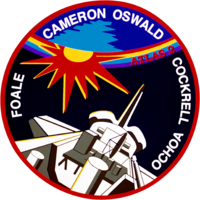
Designed by crew members, an image of the mission from the shuttle cockpit. ATLAS-2, SSBUV and SPARTAN equipment are visible in the payload bay. Since scientific research at the ATLAS-2 laboratory is carried out under the Mission to Planet Earth program, the emblem has an image of planet Earth. At the top there is a stylized image of the atmosphere in the form of a color spectrum and the Sun in the form of a two-color corona. The names of the commander and pilot are placed on the background of the Earth, the other astronauts on the background of space.
Gallery
View of the cargo compartment of the shuttle with ATLAS-2 laboratory instruments
SPARTAN satellite launch
End of STS-56 mission: shuttle landing at KF Kennedy
Notes
- ↑ 1 2 STS-56 (English) . - A description of the flight on the NASA website. Archived on September 17, 2012.
- ↑ 1 2 3 Launch of the Discovery spacecraft under the STS-56 program // Cosmonautics News . - 1993. - No. 7 .
- ↑ (3) - the number in brackets shows the number of flights performed by a crew member, including this
- ↑ 1 2 USA. Flight of the Discovery spacecraft under the STS-56 program // Cosmonautics News. - 1993. - No. 8 .
Links
- The film is about the flight of STS-56 . Archived on May 16, 2012.
- STS-56 (English) . Encyclopedia Astronautica. Archived on May 16, 2012.