The destroyers of the Kamikaze type ( Japanese 神 風 型 駆 逐 艦 Kamikazegata kutikukan ) are a type of Japanese destroyers . The most massive series of destroyers of Japanese construction.
| Destroyers of the Kamikaze type | |
|---|---|
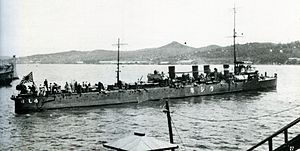 The destroyer "Usio" in Vladivostok, 1920 | |
| Project | |
| A country |
|
| Operators |
|
| Prior type | Harusame |
| Subsequent type | Umikaze |
| Built | 32 |
| In the ranks | Discontinued |
| Scrapped | thirty |
| Losses | 2 |
| Main characteristics | |
| Displacement | 387-460 tons |
| Length | 72 m |
| Width | 6.57 m |
| Draft | 1.8 m |
| Engines | 2 triple vertical steam engines , 4 boilers |
| Power | 6000 l with. |
| Mover | 2 propellers |
| Speed | 29 knots |
| Sailing range | 850 nautical miles at 11 knots |
| Crew | 70 people |
| Armament | |
| Artillery | 2 × 76 mm / 40 Type 41 , 4 × 76 mm / 28 |
| Mine torpedo armament | 2 × 457 mm TA , 2 torpedoes Type 38 |

Content
Construction
Ordered under the 1904 shipbuilding program, adopted after the outbreak of war with Russia . Structurally repeated the type of "Harusame" , distinguished by the use of steam boilers with mixed heating (which increased the range) and installed weapons. Instead of four 57-mm guns of Hotchkiss with a barrel length of 40 calibres, four lightweight 76-mm guns with a barrel length of 28 calibers were used. It was believed that despite the low aiming range, their more powerful shells would give an advantage in short-range combat.
Due to their more numerous calculation of guns, the crew increased to 70 people. This seriously worsened the already difficult living conditions on ships.
In total, in 1904-1909, 32 units of this type were built, the last of which are morally obsolete even on the slipways.
The next type of "Umikaze" already belonged to the destroyers of the next generation, and had little in common with ships of the "Kamikaze" type.
Service History
The first two representatives of the series (Kamikaze and Hatsushimo) joined the fleet a few days before the signing of the peace treaty in Portsmouth, but they no longer had time to take part in the Russo-Japanese war.
For a rather long time, ships of this type formed the basis of the destroyers of the United Fleet .
On November 9, 1913, Asatsuyu was lost, crashed on the rocks in Noto Bay on Honshu Island.
After Japan entered World War I, the 2nd Squadron of the United Fleet under the command of Vice Admiral S. Kato was assigned to act against the German base in China Qingdao . In addition to 5 armadillos, 6 cruisers and several auxiliary ships, it included the 2nd squadron of destroyers. The bulk of its 20 units were representatives of this type, distributed as follows: 9th division: “Shirayuki”, “Novake”, “Sirotae”, “Matsukadze”; 12th division: “Ayanami”, “Ison”, “Uranium”; 5th division: "Usio", "Nenokhi", "Wakaba", "Asakaze"; 8th Division: Yugure, Yudati, Shiratsuyu, Mikazuki.
The blockade of Qingdao Bay was established on August 27, 1914, and the destroyers were used to keep watch in two shifts, 8 ships each, having 4 ships in reserve, entering the reach zone of coastal batteries. On the night of September 3, 1914, the Sirotae maneuvering in foggy conditions flew to the rocks near Lientao Island, receiving damage that made it impossible to remove it. The command was evacuated by another destroyer, and the hull of the ship was shot in the morning by the German gunboat Jaguar, which went to sea under the cover of coastal batteries. On the night of October 17, Japanese patrols could not find the German destroyer S-90 , which went to sea and sank the old cruiser Takatiho , used as the destroyer base.
After the war ended and Japan signed the Washington Treaty, obsolete destroyers began to be withdrawn from the fleet, despite their relatively small age. In 1923, Asakazze, Wakaba, Wuxio, Nenokhi, Kisaragi, Kamikaze, Hatsushimo, Yugure, Harukadze, Hibiki, Hatsuyuki and Judati were reclassified as minesweepers, retaining their former names. As such, they turned out to be ineffective, and already in 1928 they were withdrawn from the fleet and scrapped.
In the years 1925-1926, 12 units were excluded: “Yayoi”, “Oite”, “Matsukazze”, “Novaki”, “Mikazuki”, “Sigure”, “Hatsuharu”, “Shiratsu”, “Shirajuki”, “Yunagi”, "Uzuki", "Hayate." The first three were used for some time as target ships, and the rest were scrapped.
Six destroyers were converted into minesweepers in 1926. They removed torpedo tubes and installed trawling equipment. The artillery weapons were replaced by two 120-mm Type 3 guns with a barrel length of 45 calibers (in place of torpedo tubes) and two previously standing 76-mm guns with a barrel length of 40 calibers (in the same places). Instead of the names, the ships received numbers: "Isonami" - No. 7, "Urani" - No. 8, "Ayanami" - No. 9, "Minazuki" - No. 10, "Nagatsuki" - No. 11, "Kikuzuki" - No. 12. They were Deleted from the lists only in 1930.
Series Representatives
Representatives of the series [1] .
| Title | Place of construction | Pledged | Launched | Went into operation | Fate |
|---|---|---|---|---|---|
| Kamikaze ( Japanese 神 風 divine wind ) | Yokosuka , Japan | August 20 1904 | July 15 1905 | August 16 1905 | Since December 1924, a minesweeper, in April 1928 scrapped |
| Hatsushimo ( 初 霜 first frost ) | Yokosuka , Japan | August 20 1904 | may 13 1905 | August 18 1905 | Since December 1924, a minesweeper, in April 1928 scrapped |
| Yayoi ( Japanese 弥 生 month of growth (March) ) | Yokosuka , Japan | August 20 1904 | August 7 1905 | 23 September 1905 | Flooded August 10, 1926 |
| Kisaragi ( 如月 如月 month of clothing (February) ) | Yokosuka , Japan | 10 September 1904 | 6 September 1905 | October 19th 1905 | Since December 1924, a minesweeper, in April 1928 scrapped |
| Asakaze ( Japanese 朝 風 morning wind ) | Mitsubishi Shipyard , Nagasaki , Japan | December 30th 1904 | 28 of October 1905 | April 1st 1906 | Since December 1924, a minesweeper flooded on August 1, 1929 |
| Shiratsu ( Japanese 白露 white dew ) | Mitsubishi Shipyard , Nagasaki , Japan | 25 February 1905 | 12th of February 1906 | August 23 1906 | Since December 1924 in reserve, in April 1928 scrapped |
| Shirajuki ( 白雪 pure snow ) | Mitsubishi Shipyard , Nagasaki , Japan | March 24 1905 | May 19 1906 | October 12th 1906 | Since December 1924 in reserve, in April 1928 scrapped |
| Matsukadze ( Japanese. Wind on a pine shore ) | Mitsubishi Shipyard , Nagasaki , Japan | September 25th 1905 | December 23 1906 | March 15th 1907 | Since December 1924 in reserve, in April 1928 scrapped |
| Harukadze ( 春風 spring breeze ) | Kawasaki Shipyard , Kobe , Japan | February 16th 1905 | December 25th 1905 | May 14 1905 | Since December 1924 in reserve, in April 1928 scrapped |
| Sigure ( 時 雨 autumn drizzling rain ) | Kawasaki Shipyard , Kobe , Japan | June 3rd 1905 | March 12th 1906 | July 11th 1906 | In December 1924 scrapped |
| Asatsuyu ( Japanese. Morning dew ) | Osaka , Japan | April 28th 1905 | April 2 1906 | November 16th 1906 | November 9, 1913 he sat on the stones, and later dismantled |
| Hayate ( 疾風 storm ) | Osaka , Japan | September 25th 1905 | 22nd of May 1906 | June 13th 1907 | In December 1924 scrapped |
| Oite ( Japanese 追 手 auspicious wind ) | Maizuru , Japan | August 1 1905 | January 10th 1906 | August 21 1906 | In December 1924 scrapped |
| Yunagi ( Japanese 夕 凪 evening lull ) | Maizuru , Japan | January 20th 1906 | August 22 1906 | December 25th 1906 | Scrapped in December 1924 |
| Yugure ( 夕 暮 evening twilight ) | Sasebo , Japan | March 1 1905 | November 17th 1905 | 26 of May 1906 | Since December 1924, a minesweeper flooded January 23, 1931 |
| Judati ( Japanese 夕 立 sudden summer rain ) | Sasebo , Japan | 20th of March 1905 | 26 March 1906 | July 16 1906 | Since December 1924, a minesweeper, in April 1928 scrapped |
| Mikazuki ( Jap. 三 日月 young month ) | Sasebo , Japan | June 1st 1905 | 26 of May 1906 | 12-th of September 1906 | Since December 1924, a minesweeper, flooded July 21, 1930 |
| Novaki ( Japanese 野 分 Autumn Typhoon ) | Sasebo , Japan | August 1 1905 | July 25th 1906 | Nov. 1 1906 | Scrapped in December 1924 |
| Usio ( Japanese. Tide ) | Kure , Japan | 12th of April 1905 | August 30th 1905 | October 1st 1905 | Since December 1924, a minesweeper, in April 1928 scrapped |
| Nanohi ( jap. 子 日 Christmas tree ) | Kure , Japan | June 25 1905 | August 30th 1905 | October 1st 1905 | Since December 1924, a minesweeper, in April 1928 scrapped |
| Hibiki ( Japanese 響 echo ) | Yokosuka , Japan | September 28th 1905 | March 31 1906 | 6 September 1906 | Since December 1924, a minesweeper, in April 1928 scrapped |
| Sirotae ( Japanese 白 妙 white cloth ) | Yokosuka , Japan | March 24 1905 | July 30th 1906 | January 21 1907 | Sunk during the siege of Qingdao September 4, 1914 |
| Hatsuharu ( Jap. 初春 beginning of spring ) | Kawasaki Shipyard , Kobe , Japan | 11th of November 1905 | May 21st 1906 | March 1 1907 | Scrapped in April 1928 |
| Wakaba ( jap. 葉 葉 young foliage ) | Yokosuka , Japan | May 20 1905 | November 25 1905 | 28th of February 1906 | Since December 1924, a minesweeper, in April 1928 scrapped |
| Hatsuyuki ( 初雪 first snow ) | Yokosuka , Japan | 11 September 1905 | March 8 1906 | May 17 1906 | Since December 1924, a minesweeper, in April 1928 scrapped |
| Uzuki ( Jap. 卯 月 month of Unhousing (April) ) | Kawasaki Shipyard , Kobe , Japan | March 22 1906 | September 20 1906 | March, 6 1907 | Scrapped in December 1924 |
| Minazuki ( Japanese 水 無 月 anhydrous month (June) ) | Mitsubishi Shipyard , Nagasaki , Japan | 25 February 1906 | November 5 1906 | The 14th of February 1907 | Since December 1924, a minesweeper, renamed No. 10 in August 1928, flooded May 28, 1931 |
| Nagatsuki ( Jap. 月 月 month of long nights (September) ) | shipyard Uragi, Japan | 28 of October 1905 | December 15th 1906 | July 31 1907 | Since December 1924, a minesweeper, renamed No. 11 in August 1928, was removed from the lists in June 1930 |
| Kikuzuki ( jap. 月 月 month of chrysanthemums (September) ) | shipyard Uragi, Japan | 2nd of March 1906 | April 10th 1907 | September 20 1907 | Since December 1924, a minesweeper, renamed No. 12 in August 1928, was removed from the lists in June 1930 |
| Uranium ( Jap. 浦 波 wave in the bay ) | Maizuru , Japan | 1st of May 1907 | December 8th 1907 | 2 October 1908 | Since December 1924, a minesweeper, renamed No. 8 in August 1928, a port ship since June 1930 |
| Isonami ( Japanese 磯 磯 wave in the sea bay ) | Maizuru , Japan | January 15 1908 | November 21 1908 | April 2 1909 | Since December 1924, a minesweeper, renamed No. 7 in August 1928, a port ship since June 1930 |
| Ayanami ( Japanese 綾 波 waves running one after another ) | Maizuru , Japan | May 15 1908 | 20th of March 1909 | June 26th 1909 | Since December 1924, a minesweeper, renamed No. 9 in August 1928, a port ship since June 1930 |
Notes
- ↑ Conway's All the World's Fighting Ships, 1906-1921 London Conway Maritime Press 1986 0-85177-245-5 p.241
Literature
- Patyanin S.V. Squadron destroyers and destroyers of Japan 1879-1945.
- Conway's All the World's Fighting Ships, 1906-1921. - London: Conway Maritime Press, 1986. - ISBN 0-85177-245-5 .